Source : the age
Washington/Cairo: Iran on Monday (Washington local time) rejected the latest 45-day ceasefire proposal and instead said it wants a permanent end to the war, as US President Donald Trump’s ultimatum loomed within hours.
Iran’s state-run IRNA news agency said Tehran had conveyed its response through Pakistan, a key mediator.
“We won’t merely accept a ceasefire,” Mojtaba Ferdousi Pour, head of the Iranian diplomatic mission in Cairo, told The Associated Press.
“We only accept an end of the war with guarantees that we won’t be attacked again.”
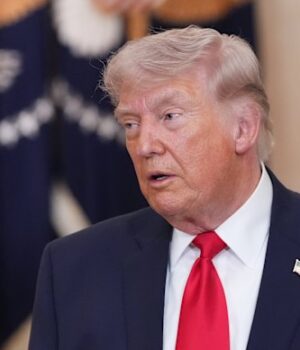
Trump wants Tehran to open the Strait of Hormuz or see its power plants and bridges attacked.
Ferdousi Pour said Iranian and Omani officials were working on a mechanism for administrating the shipping choke point.
The rejection came as Israel struck a key petrochemical plant in the massive South Pars natural gas field and killed two paramilitary Revolutionary Guard commanders.
The gas field attack aimed at eliminating a major source of revenue for Iran, Israel said. The field is critical to electricity production, but the strike appeared to be separate from Trump’s threats to target power plants and bridges if Tehran doesn’t reopen the Strait of Hormuz to all shipping traffic by Monday night (Washington time).
Iran’s grip on the strait has caused oil prices to surge and shaken the world economy.
Axios first reported that the US, Iran and regional mediators were discussing the potential 45-day ceasefire as part of a two-phase deal that could lead to a permanent end to the war, citing US, Israeli and regional sources.
The White House and the US State Department did not immediately respond to requests for comment.
Warning: This article contains strong language
In a profanity-laced post on his Truth Social platform earlier on Sunday (Washington time), Trump threatened further strikes on Iranian energy and transport infrastructure if it failed to reopen the Strait by Tuesday.
“Tuesday will be Power Plant Day, and Bridge Day, all wrapped up in one, in Iran,” he said. “There will be nothing like it!!! Open the Fuckin’ Strait, you crazy bastards, or you’ll be living in Hell – JUST WATCH! Praise be to Allah. President DONALD J. TRUMP.”
But in the kind of mixed messaging that has baffled supporters, foes and financial markets alike, he also told Fox News that Iran was negotiating, with a deal possible by Monday (Washington time).
Fresh aerial strikes were reported across the region on Monday, more than five weeks since the US and Israel began pounding Iran in a war that has killed thousands and damaged economies by boosting oil prices
Tehran has responded to the attacks by, in effect, closing the Hormuz waterway, a conduit for about a fifth of the world’s oil and natural gas supply, and attacking Israel, US military bases and energy infrastructure around the Gulf.
Iran condemns ‘reckless’ US, hits Gulf
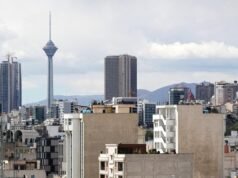
Explosions shook Tehran on Monday, with Iranian state media reporting that the head of intelligence for Iran’s paramilitary Revolutionary Guard was targeted and killed, and a strike on a residential building south of the city killed at least 13 people.
Before news of the draft peace plan, Iran’s parliamentary Speaker, Mohammad-Bagher Qalibaf, condemned Trump’s threats, saying he was being misled by Israeli Prime Minister Benjamin Netanyahu.
“Your reckless moves are dragging the United States into a living HELL for every single family, and our whole region is going to burn because you insist on following Netanyahu’s commands,” he posted Sunday on X.
Iran expanded attacks on Gulf energy infrastructure, launching drone and missile strikes on petrochemical facilities in Kuwait, Bahrain and the United Arab Emirates.
The Revolutionary Guards also said on Sunday (Tehran time) they had hit an Israeli-linked vessel at Dubai’s Jebel Ali port. In Kuwait, drones had sparked fires and caused “severe material damage” at petrochemical plants operated by affiliates of state oil firm Kuwait Petroleum Corp, the company said.
The strikes underscored Iran’s ability to sustain cross-border attacks and disrupt infrastructure across multiple Gulf states, exposing vulnerabilities in energy and maritime hubs.
Iran fired volleys of rockets at Israel, too, with missile debris hitting Haifa, Tel Aviv, and other sites. Israeli rescuers had retrieved two bodies from the rubble of a residential building in Haifa and two others were missing, the country’s media said.
Commando operation
Meanwhile, Trump described the rescue of an American airman whose F-15E jet was shot down over Iran on Friday as “one of the most daring” such missions in US history.
The weapons systems officer was wounded but “will be just fine”, Trump said on X. The jet’s pilot was rescued earlier.
Under cover of darkness, US commandos slipped deep into Iran, undetected, scaled a 2100-metre ridge and took the stranded American weapons specialist to safety before dawn on Sunday (Washington time).
The war, which opened with US and Israeli airstrikes across Iran on February 28, has killed thousands of people, mainly in Iran and Lebanon. Israeli airstrikes killed another 11 people in Lebanon on Sunday, according to Lebanon’s health ministry.
Reuters, AP
Get a note directly from our foreign correspondents on what’s making headlines around the world. Sign up for our weekly What in the World newsletter.