Source :- THE AGE NEWS
As if the Parramatta Eels faithful didn’t already have enough going on. But before we throw all caution to the wind and speak openly about what Isaiah Iongi might have done, and, if so, what predicament those acts might place him in, let’s summarise what we actually know.
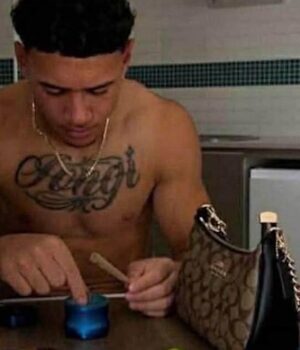
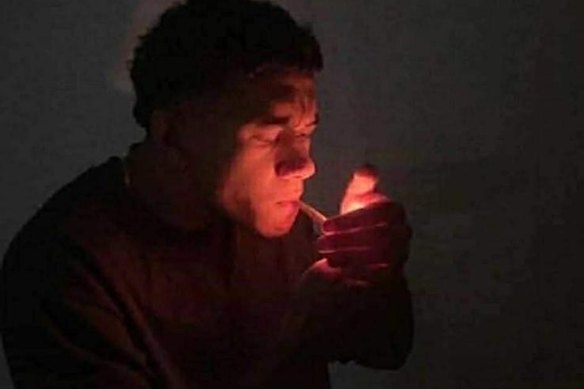
What we know is that some photographs have emerged from the social media cesspit, seemingly depicting the Eels fullback puffing away on a rolled cigarette while relaxing in a bathtub. A second photo appears to show the player perched at a kitchen table with his designer handbag to his left; him deep in concentration while handling said cigarette.
Parramatta fullback Isaiah Iongi.Credit: Instagram
Undoubtedly, these images were released publicly without his consent.
Which leads to this question: how does anyone know the photos depict real events? We know – and this is the part that should keep every professional athlete in this country awake at night – that in 2026, a photograph proves pretty much nothing. I’ve no idea at all whether the photos are authentic or not. Neither do you.
We exist in an era where artificial intelligence can create a photorealistic image of any person, in any setting, doing any conceivable act, with a level of technical sophistication that would’ve seemed like science fiction in 2016. And those tools aren’t confined to Hollywood studios or government intelligence agencies. They’re available to anyone with a laptop and a burning grudge.
AI is a free-for-all in a jungle of toxicity. It’s easily weaponised against professional athletes – someone with the IQ of a blunt crayon could manipulate photos of a professional athlete beyond any lingering semblance of truth, and cause them to go viral.
Parramatta fullback Isaiah Iongi.
Isiah Iongi is 22 and trying to make his name in the toughest rugby league competition on the planet. And right now, because a set of images possibly of questionable origin and authenticity have been disseminated without his knowledge or agreement, he finds himself at the centre of an integrity investigation that might define – or curtail – his career before it’s properly begun.
A fabricated image does not need to survive legal scrutiny. It only needs to circulate long enough to cause a sponsor to pull out, a governing body to trigger an investigation, or a club to freeze a contract. AND BOOM …
Is that proper? Or is it a digital lynching? Let’s be precise about the legal landscape here because it matters enormously, and it’s almost entirely ignored amid the breathless social media commentary that tends to try, convict and sentence a young man before a forensic expert has examined any of it.
Defamation law in Australia is clear in its purpose; to protect individuals from the publication of false material that damages or threatens their otherwise good reputation.
A publication is defamatory if it would cause ordinary, reasonable members of society to think less of the person. It doesn’t require malice. It doesn’t require intent to harm but in most jurisdictions does require the existence of serious harm.
Yet defamation is the most dulled tool in the box. And the whole thing with deepfakes is that, invariably, the creator is unknown.
If the provenance of these photos is questionable, or if they’ve been manufactured via AI, consider what they nonetheless communicate to the ordinary, reasonable observer: that a professional NRL player is engaged in the consumption of what might be an illegal substance, that possibly also is prohibited to some extent under anti-doping rules.
The World Anti-Doping Code places the burden of proof on the athlete, not the accuser. An athlete accused of doping, even based on a fabricated image showing them handling a syringe, might find themselves subject to provisional suspension while an investigation is conducted.
Taken at face value, the photographs communicate recklessness. The images convey, in short, precisely the kind of conduct that would cause any reasonable person to think significantly less of Isiah Iongi as a sportsman.
But if they are fabricated then whoever created and distributed them has potentially committed a serious act of character assassination.
The reputational injury caused by AI-generated imagery is not theoretical. It’s immediate, viral and very often permanent. The retraction never travels as far as the lie. Consider the damage done to the reputations of Hulk Hogan, Michael Phelps, Dane Swan and the US sportscaster Erin Andrews, each a victim to the unauthorised release of real photographs taken without their consent. When the photos aren’t even authentic in the first place, it’s worse.
The issue of consent compounds the legal complexity. In the event they’re authentic, these images of the Parramatta player were, without doubt, released without Iongi’s consent. That fact alone should give pause to every media outlet, commentator and governing body that chooses to engage with this material as though it’s established evidence rather than unverified and potentially manufactured content.
There’s a developing corpus of law around image-based abuse in Australia. While the legislative framework was constructed with intimate imagery at the forefront of mind, the principle at its core is one of fundamental dignity. A person has a legitimate interest in controlling how their image is used and how they are represented publicly.
The non-consensual distribution of images – real or not – causes real, documented psychological harm. It causes professional damage.
The NRL Integrity Unit has its job to do, and one can’t challenge the exercise of that function. But integrity investigations proceed on an implicit assumption that the evidence isn’t concocted. In 2026, that assumption is now perilously obsolete.
Every major sporting code faces the same existential challenge: in a world where a convincing photograph of any athlete doing anything can be manufactured in minutes and distributed to millions in seconds, the evidentiary value of photographic material has collapsed almost entirely.
Athletes themselves understand this, even if the administrators are still catching up. A pervasive anxiety about digital vulnerability should be harboured by all professional athletes and sport administrators. Any enemy; any disgruntled acquaintance; any anonymous bad actor with basic technical skills and a malicious motive, can construct a reputational time-bomb and detonate it at a juncture of maximum inconvenience.
That’s why professional athletes in these binds deserve the presumption of innocence that every Australian citizen is entitled to, and which should be doubly insisted upon when the very authenticity of the evidence against them remains unestablished.
News, results and expert analysis from the weekend of sport sent every Monday. Sign up for our Sport newsletter.