
SOURCE :- THE AGE NEWS
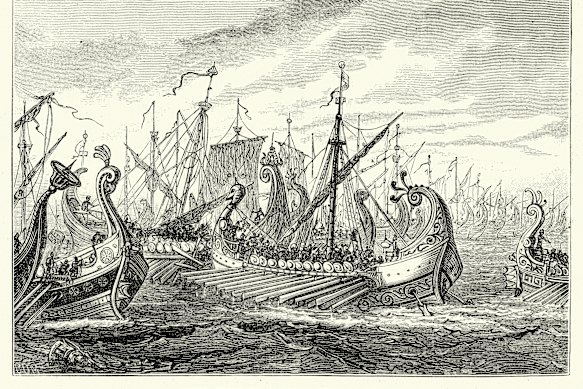
Few countries on earth can claim a navy with greater ancient prestige than Iran’s, whose heritage dates back to the First Persian Empire of 500BC.
One wonders what those great and terrible warriors would think if they could see the state of the Iranian Navy now.
Four days into the US-Israeli war on Iran, the Islamic Republic’s naval headquarters is in ruins, one of its elite admirals is dead, and its finest warships are ablaze in the Gulf of Oman, home to its southern fleet.
US President Donald Trump has made the annihilation of the Iranian Navy a key goal of his campaign, with the US boasting on Monday that all 11 of Iran’s vessels stationed in the Gulf of Oman have been destroyed.
American forces have also mostly destroyed the headquarters of the Iranian naval fleet in the port of Bandar Abbas, while Ali Shamkhani, an admiral in Iran’s elite Revolutionary Guard Corps (IRGC), has been killed in an Israeli air strike.
The president’s goal appears to be clearing the Gulf of Oman of warships used by Tehran to enforce a blockade of the Strait of Hormuz, the critical trade route that carries one-fifth of the world’s oil shipments. Iran said it had closed the Strait on Monday.
It remains to be seen whether Washington’s goal has been achieved. Marine traffic data shows, as of Tuesday morning, a large number of ships are still queuing to enter the Strait.
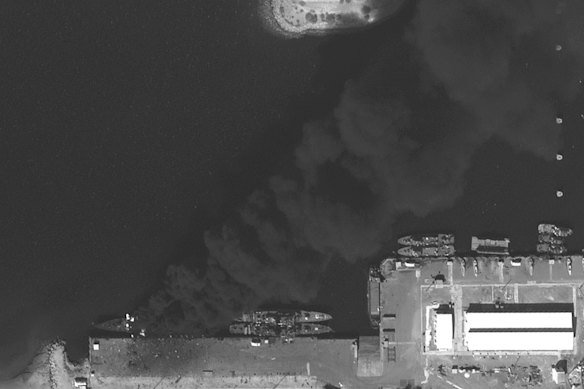
The scale of the destruction of Iran’s navy has been laid bare in satellite images, which show a striking before-and-after scene of the port of Bandar Abbas in the Gulf of Oman.
Google Earth imagery taken on February 22 shows many of Iran’s naval vessels – belonging either to its regular navy or elite IRGC naval units – docked and intact in Bandar Abbas.
At least 11 large-scale military vessels are visible in the image, along with dozens of smaller vessels, which may be civilian or military.
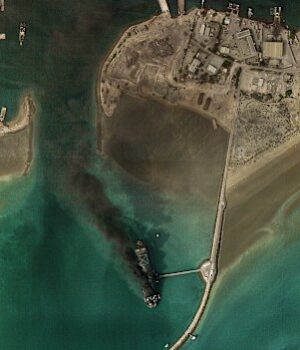
But a new image captured by satellite imaging company Planet Labs shows the same area shrouded in thick, black smoke, the aftermath of heavy US bombing of the port.
Zoom in on that image’s bottom-right corner, and you will see what appears to be the smouldering remains of Iran’s biggest naval vessel, the IRIS Makran.
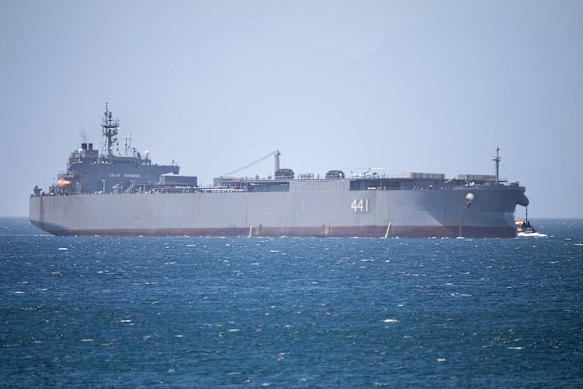
Built from a converted oil tanker, the Makran is, perhaps unintentionally, an apt symbol for the Iranian military: crippled by sanctions, lacking in key parts and forced to make do with what is available.
Despite its rather Heath Robinson-esque origins, the Makran was feted by the regime as a major new tool in its arsenal, taking part in a two-day missile exercise in 2021.
United States Central Command (CENTCOM), the US military command in the Middle East, also claims to have struck an Iranian carrier, the IRIS Shahid Bagheri, which is used to launch drones and helicopters for aerial attacks.
The satellite imagery is striking and will support the Trump administration’s claims that its war on Iran is ahead of schedule and going exceedingly well.
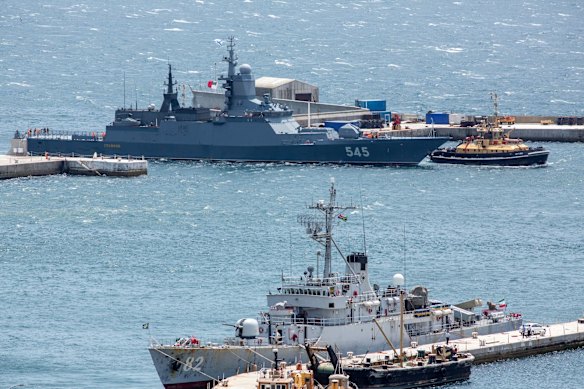
But security experts say there is nothing particularly impressive about blowing up Iran’s poorly maintained military assets, which in some cases date back to the rule of the shah from 1949 to 1979. The Bayandor-class corvettes IRIS Bayandor and IRIS Naghdi, both destroyed this week, were launched in 1964.
“If you compare their navy with Donald Trump’s ‘big beautiful Armada’, it’s more like a dwarf,” Dr Andreas Böhm, a Middle East expert from the University of St Gallen in Switzerland, told the London Telegraph.
“It has been very much weakened by sanctions, its material is outdated, and when you look at the air force, for example, mostly all the aircraft are from the shah era and US-built. It’s really old,” he said.
Dr Böhm added that when this was taken into account, the US bombing campaign was “not impressive”.
Conversely, one area where the Iranian Navy has had an impact is its closure of the Strait of Hormuz by threatening to “set fire” to passing commercial ships.
“They are capable of being a menace in the Persian Gulf, but it’s not like they could hold their own against the United States in kinetic terms,” he said.
“What they are capable of is asymmetric warfare, and we can see this in the Strait of Hormuz, where insurance prices have skyrocketed, and companies are refraining from sending their ships through.”
“We are seeing two different strategies,” he said.
“The US and Israel are trying to hit hard and fast, while Iranians are trying to endure, to have strategic depth – keeping their heads down and waiting for the costs to increase on the US and its allies.
“They are waiting until the balance tips.”
The Telegraph, London


