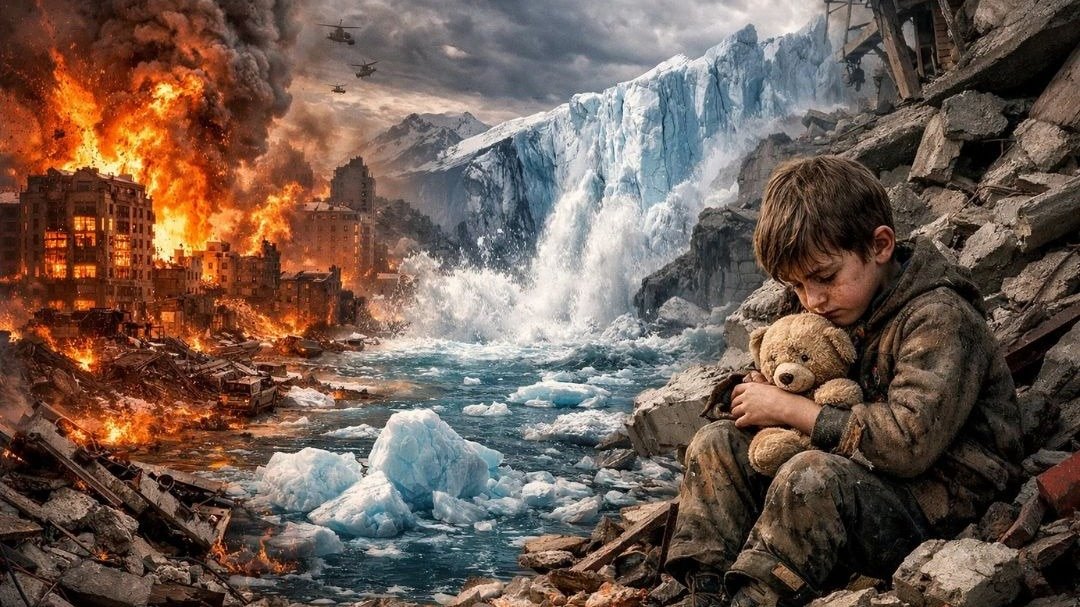
Source : INDIA TODAY NEWS
There is a certain kind of madness that only becomes visible when you step back far enough to see the whole picture. We are a species that split the atom, decoded our own DNA and sent a car into space purely for the spectacle of it. Somewhere right now, in a well-funded laboratory, serious and brilliant people are drawing up plans to put human beings on Mars, a barren, frozen, airless rock sitting 225 million kilometres from here. And yet, for all of that extraordinary ambition, we cannot stop blowing each other up on the planet we already have.
advertisement
The war next to the world’s oil supply
In West Asia in 2026, the United States and Israel have gone to war with Iran. Missiles are flying, cities are shaking and children are dying. Sitting in the middle of all of it is a narrow strip of water roughly 33 miles wide at its narrowest point, separating Iran from Oman. The Strait of Hormuz. According to the United States Energy Information Administration, 20 million barrels of oil pass through that strait every single day, amounting to 20 per cent of everything the entire world consumes. One fifth of the fuel that heats homes, runs cars, powers hospitals and flies planes. Since the war began on 28 February, tanker traffic through the Strait has come to a near-complete standstill. A handful of vessels are still making the transit, many under naval escort, while hundreds more sit stranded at anchor on both sides, waiting.
Nobody in any war room seems to be asking the obvious question. When an oil tanker in the Strait of Hormuz is struck, where does the oil go? It does not evaporate. It spills into the water. Greenpeace Germany has described the threat of an oil spill in the Strait as an ecological ticking time bomb, with simulations showing that a major spill could devastate coral reefs, mangrove forests and seagrass meadows across the Arabian Sea and the Gulf of Oman. According to NOAA, the United States’ own National Oceanic and Atmospheric Administration, the consequences of a large oil spill on marine ecosystems can be felt for decades, not years. Oil destroys the insulating fur of sea otters and the feathers of marine birds, exposing them to hypothermia. It suffocates coral, poisons fish, shellfish, dolphins and whales, blocks sunlight from reaching the ocean floor and dismantles entire food chains. A war has been lit next to a shipping lane carrying a fifth of the world’s oil, and the ocean has no interest in our politics.
The planet is already keeping score
The war is not happening in a climate vacuum. According to NASA, 2023, 2024 and 2025 were the three warmest years in 146 years of recorded history, three in a row. Berkeley Earth has warned that the warming spike across these three years has been so extreme that it suggests an acceleration in the rate at which the planet is heating. The World Meteorological Organisation confirmed that 2024 was likely the first calendar year in human history to exceed 1.5 degrees Celsius above pre-industrial levels, the very threshold the Paris Agreement was designed to prevent us from crossing. The Copernicus Climate Change Service, the European Union’s own climate monitoring body, was equally unambiguous. Every single year in the last decade is one of the ten warmest ever recorded. Every one of them.
And what are we doing about it? We are spending billions not on renewable energy transitions or climate adaptation but on precision-guided weapons to destroy the infrastructure of countries we disagree with. The Arctic is melting, sea levels are rising, glaciers are retreating at record speed, and the debate in Washington is about the ownership of a Tomahawk missile.
The museum of human stupidity
The Iran war is just one exhibit. In the same century, we invented the internet and invented ways to use it to radicalise teenagers. We mapped the human genome and then used genetics to justify racial hierarchies. We built the United Nations to prevent wars and then used it as a stage to perform diplomacy while wars happened anyway. We are fighting each other over race, over caste, over religion, over nationality, over who is allowed to love whom, over which side of a line drawn on a map a grandfather was born on.
The planet does not care about any of these lines. A rising sea does not check a passport before it floods a city. A wildfire does not ask a religion before it burns a home. A warming ocean does not distinguish between the fish in Israeli waters and the fish in Iranian waters. Nature is not fighting our wars. Nature is keeping score.
The Mars delusion
Serious, brilliant and well-funded people are currently planning human colonies on Mars. There is talk of making it a second home for humanity, a backup planet, an insurance policy against our own self-destruction. But the question worth asking is what exactly we are planning to do up there. Take our borders with us? Our religious disputes? Build a separate colony for the wealthy, a kind of off-world gated community for billionaires, while the rest of humanity chokes on a burning Earth? Because that is what it looks like we are building. Not a new civilisation. The same old one, with better rockets.
The victims are always the same people
The victims of every war, without exception, are always the same people. Not presidents or secretaries of war. Not the arms manufacturers watching their stock prices climb as missiles fly. The victims are always the people. The girl carrying books into a school in Minab. The sailor on a tanker in the Strait of Hormuz who had nothing to do with any decision made in any war room. The fisherman in the Gulf of Oman whose livelihood disappears when oil blackens the water.
And the child in Bangladesh who goes to bed in the dark not because of poverty or drought but because a war fought six thousand kilometres away has triggered gas rationing across an entire nation. According to the International Energy Agency, Bangladesh and Pakistan import nearly two thirds of their total LNG supplies through the Strait of Hormuz. Gas-fired power generation accounts for 50 per cent of Bangladesh’s electricity. If the Strait stays closed, the lights go out. Not in Washington, not in Tel Aviv, not in Tehran. In Dhaka. In Karachi. In the homes of people who have never heard of a Tomahawk missile and never will.
In January 2025, NASA’s climate director Gavin Schmidt said something that should have stopped the world in its tracks. “We are halfway to Pliocene-level warmth in just 150 years.” The last time Earth reached full Pliocene warmth, sea levels were dozens of feet higher than today and Greenland had no ice. We have already travelled half that distance in 150 years. That is nothing. That is a blink. And instead of spending every waking hour fixing it, we are fighting a war next to the world’s most critical oil shipping lane, arguing about whose missile is more generic, and gambling with an ocean that has no political allegiances and no interest in our wars.
We are the only species on this planet with the intelligence to understand exactly what we are doing to it. And the only species doing it anyway. There is a word for that. It is in the title.
– Ends
Tune In
Must Watch
SOURCE :- TIMES OF INDIA