SOURCE :- THE AGE NEWS
A gaudy assortment of trophies sat on a cabinet in the house where I met the woman who would become my wife.
There was a silver jewellery case, silver ashtrays, a silver cocktail shaker, a giant scrolled serving platter and a small cameo portraying a very self-satisfied looking fellow.
I was to learn this was the Shah of Iran.
The collection was much prized by my future wife’s stepfather.
He was a loud Welshman who was also butler to two of Australia’s governors-general, Sir Paul Hasluck and Sir John Kerr, before moving to The Lodge to manage the household of the new prime minister of the time, Malcolm Fraser, and later to Kerry Packer’s home.
Many of those so-called treasures sitting on the cabinet, he explained, had come from his attendance at the world’s most extravagant party.
An exaggeration? He had, after all, been trained in his craft at Buckingham Palace, where great banquets were commonplace.
He insisted, however, that nothing could begin to compare with the astonishing party thrown among the ruins of Iran’s ancient city, Persepolis, in 1971.
I recalled this as Israeli and US missiles smashed Iran this week and killed its latest batch of bloodthirsty leaders, the wider Middle East once more endured chaos, and the world – or that part of it that seeks insight beyond yesterday – wondered how did it all come to this?
Nothing, we know, occurs in a vacuum. The recent history of Iran – once the greatest empire in antiquity, called Persia by the Greeks, who were in awe of its power and learning – offers some enlightenment.
Back in 1971, over three days, the Shah of Iran, Mohammad Reza Pahlavi, King of Kings, Light of the Aryans and Shadow of the Almighty, hosted the leaders of the world – kings, queens, presidents, prime ministers, heads of state and sheiks – to celebrate the 2500th anniversary of the founding of the Persian (Iranian) Empire.
A city of ultra-luxurious tent-like suites designed by French architects and interior decorators was raised on the desert for the guests.
Each, according to co-organiser Emil Real, had two bedrooms, two bathrooms, an office, and a magnificently furnished salon that could accommodate 12 people. A tapestry – with a picture of the head of state who was staying there woven into it – hung on the wall of each tent.
Australia’s Sir Paul Hasluck and Lady Hasluck were among the guests, and naturally, they were accompanied by their butler, my about-to-be stepfather-in-law, who occupied one of the rooms in the tent set aside for them. Lady Hasluck, after all, like all female guests, was required to wear a new outfit for every one of the numerous events.
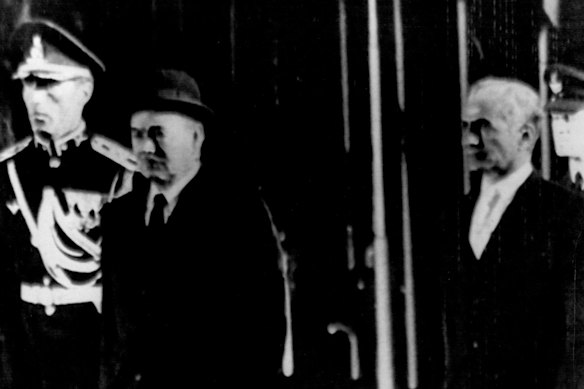
A new highway was laid to transport 600 guests in a fleet of brand-new limousines from the airport built for the occasion.
The setting came complete with a brand-new forest stocked with 50,000 songbirds – all of which reportedly died in the desert atmosphere within three days.
Unparalleled feasting and vast military parades continued from October 12 to 14.
Eighteen tonnes of food was flown in from Paris.
Maxim’s, the last word in opulent Parisian dining at the time, closed for two weeks, its staff flown to the tent city to prepare and serve what is still considered the most excessive feast in modern history.
Iranian military planes transported 150 tonnes of kitchen equipment from Paris.
No one went thirsty. Maxim’s’ official journal of the festivities, reported by Martin Beglinger of the Swiss Tages-Anzeiger magazine, listed 2500 bottles of champagne, 1000 bottles of Bordeaux and 1000 bottles of Burgundy, all packed in 410 crates and delivered to a purpose-dug cellar.
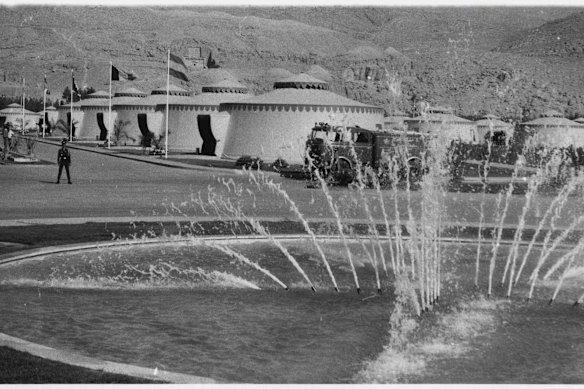
The main seven-course feast, in a vast tent, continued for more than five hours.
Fifty peacocks were roasted, stuffed with foie gras and presented in their plumage. Quail eggs were filled with caviar.
The first meat dish – saddle of lamb stuffed with champignons, roasted medium rare and garnished with tips of fresh asparagus – was served with one of the world’s greatest red wines, Château Lafite Rothschild, vintage 1945.
When it was all over, the Iranian hosts simply invited their guests to take home with them what they wished.
Persian carpets were rolled from the floors of the tents and silverware was thrown in, piled into limousines and stacked in the holds of aircraft for flights home across the world, no questions asked.
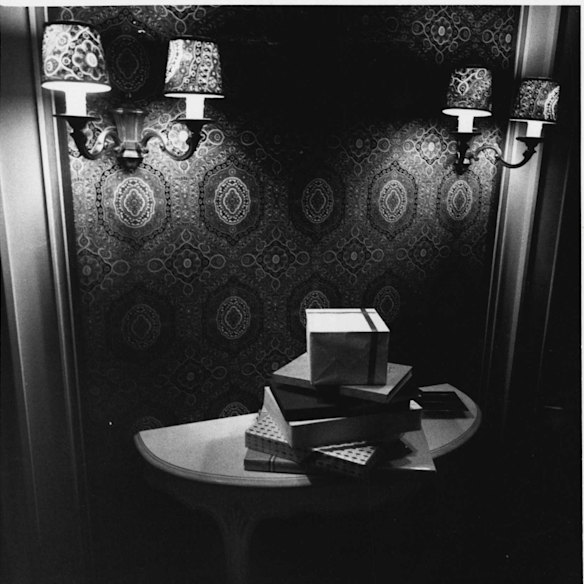
Syndication International Ltd.
Which is where Sir Paul Hasluck’s butler’s collection of gaudy treasures came from.
Wildly divergent estimates of the cost of the Shah’s extravaganza veer all the way up to $170 million (in 1971 dollars).
Whatever it cost, such conspicuous consumption was stupendously insensitive in a nation whose ordinary citizens, the majority then struggling in rural areas, were suffering poverty and lack of hope, despite an oil boom.
Among the Shah’s most vociferous critics was a cleric named Ruhollah Khomeini, who had been exiled in 1964 for opposing the Shah’s program of modernising Iran.
From his base in Iraq, Khomeini was outraged at the opulence on display at the three-day party in Persepolis.
“Let them go all the way to Mars or beyond the Milky Way; they will still be deprived of true happiness, moral virtue, and spiritual advancement and be unable to solve their own social problems,” bellowed Khomeini to his supporters.
The Shah responded by demanding to know if he should serve heads of state “bread and radishes?”.
Eight years after the extravaganza, Khomeini and his followers ran the Shah – damned as an American puppet – out of Iran and into exile in the United States, transforming the Persian empire into a paranoid Islamic theocracy subjugating ordinary citizens.
When Khomeini died in 1989, he was replaced as Supreme Leader by the Ayatollah Ali Hosseini Khamenei.
He, too, had been an enemy of the Shah and had a long memory.
When the great party in the desert was under way in 1971, Khamenei was confined to a tiny cell in Qasr Jail, undergoing, as he described in his later memoir, Cell No. 14, intensive torture by the thugs of the Shah’s secret police, SAVAK, which the CIA and Israel’s Mossad had trained.
And so the world turns: the man tortured by the Shah’s brutes came to oversee a regime that also used pitiless torture and execution on the people he purported to lead, and sponsored terror across the world until he was assassinated this week.
While we ponder history’s ghastly and restless movements, it is worth considering how the Shah gained his power in the first place.
In 1953, as not much more than a figurehead, he found himself in conflict with the democratically elected prime minister, Mohammad Mosaddegh.
Mosaddegh, sick of Iran’s oil wealth being siphoned off by foreign interests, nationalised the British-owned Anglo-Iranian Oil Company.
It was too much in those Cold War days for the British and the Americans.
The Shah, having failed to unseat Mosaddegh, fled overseas while the CIA and the UK’s MI6 intelligence agencies organised an Iranian coup.
Reaching deep into their dirty tricks supplies, the CIA and MI6 agents bribed officials, paid “demonstrators” to protest in the streets (causing 300 deaths) and spread propaganda painting Mosaddegh as a communist.
The Shah returned, Mosaddegh was jailed and American and British interests were once again secure under the Shah’s newly empowered and iron-fisted rule.
Though the Shah gradually modernised his nation, gave a measure of freedom to many citizens and, in his latter years of power, managed to reduce Iran’s poverty rate from 54 per cent to about 30 per cent – though wealth disparity remained acute – it was all too late after his naked arrogance led to the most extravagant party of all time.
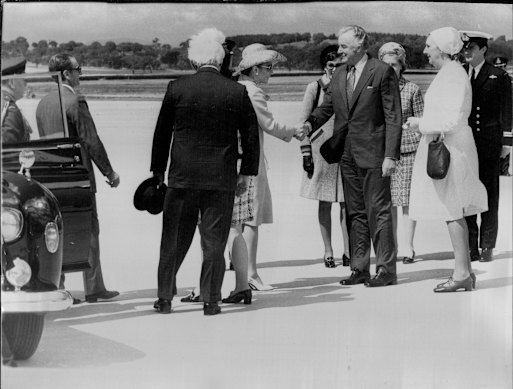
Meanwhile, Australia tried to capitalise on Hasluck’s invitation to the party by inviting the Shah and his Empress Farah to visit Australia to talk about increasing Australia’s access to Iranian oil and selling Australia’s uranium to assist Iran’s nuclear ambitions.
The Whitlam government signed a trade deal during the Shah’s visit in 1974, but the agreement barely got a head of steam before the Shah’s regime was swept away by Khomeini.
Now, a new US-sponsored regime change awaits, with the Shah’s son, Reza Pahlavi, offering himself as a candidate for new leader.
Unintended consequences, history teaches, are guaranteed.
And the butler’s collection of the Shah’s silverware? No idea. Consigned to history.
Get a note directly from our foreign correspondents on what’s making headlines around the world. Sign up for our weekly What in the World newsletter