Source : ABC NEWS
One of the most engaging things about footy are the moments of brilliance that separate good from great.
Often it’s a blink-and-you’ll-miss-it affair — a diving handball, daring don’t argue or a well taken hanger — but perhaps the most spectacular and tension-filled moments are its longest.
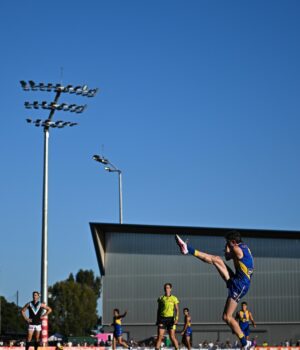
There’s no more captivating or longer footy “moment” than the long roost through the big sticks, whether from a set shot or taken on the run.
In recent years, however, shots from distance have been on extinction watch. In 2000, 11 per cent of goals came from beyond 50, with that proportion sinking to just 6 per cent in 2020.
But 2026 brings new hope to long goal enjoyers everywhere, with scoring from outside the arc is at its highest point in over a decade.
Teams are not only taking more shots from long range but they are also more accurate from deep. According to Expected Score (or xScore), which adjusts for shot difficulty, teams are drilling more goals from deep than we would ordinarily see.
This influx of shots and makes is the biggest contributor to the rise in scoring so far this season. Teams are scoring about three points more per game than this time last year, with long-distance scoring up by over four points a game.
It’s clear so far this year that teams are taking more chances when they can take them, no matter the distance. The average length of scoring shots is at its longest in a decade, after a period when teams obsessed about getting the ball to the hotspot.
At the vanguard of this rise is the side that has relied on it the most in the past decade. The Sydney Swans aren’t just September mainstays — they also rely on one of the most stylish elements of the game to get there.
Last week, the Swans faced off against an early-season surprise packet looking to make their own rise up the ladder.
Many predicted West Coast would challenge for the wooden spoon this year, but the Eagles started the year 2-1. Those wins have also largely been sparked by the long ball.

Charlie Curnow hasn’t flashed his long-range prowess with Sydney just yet. (Getty Images: Matt King/AFL Photos)
Take the Eagles’ heart-stopping win over the Power for example. Five of their 13 goals came from outside 50, with another two from beyond 40m.
Last week, the Swans decisively turned the tide on those same Eagles. The Swans drilled five goals and two behinds from beyond 50, and added another 6.6 from beyond 40 in their comprehensive win. For the Eagles, it was a wake-up call; for the Swans, business as usual.
Those five long-range goals have cemented the Swans’ place as the team to score the most goals from beyond the arc this year. This domination from distance isn’t anything new for the Swans, and might be one of the keys to their success in the past decade.
Swan diving from deep
The last 14 years have been pretty easy to be a Swans fan. Almost every year, their season stretches into the beginning of spring, having missed just three finals campaigns in that time, and making five grand finals and winning one flag along the way.
While their hallmark has often been their stellar defensive set-ups, another key to how they win so much is their ability to stretch opposition defences to their wits’ end.
When the Swans can find the goals from deep, it tends to unlock their attack more broadly. Having threats who can score from deep opens up their forward line and stretches the defence.
The Swans have long been one of the heaviest users of the long shot, averaging five goals a game from beyond 40 metres since 2014.
Many will be quick to point to the presence of Lance Franklin as key to the Swans’ ability to score from anywhere remotely near goal. With apologies to Taylor Walker, Franklin’s ability to stun fans by roosting goals from seemingly different postcodes is unmatched in recent years.
But instead of tailing off with his retirement, the Swans have continued to score heavily from deep. The current trend hasn’t been spearheaded by long-limbed tall forwards but goalscoring midfielders and smaller forwards.
Unsurprisingly, last year’s failed campaign also coincided with a downturn in their ability to hit the scoreboard from long range.
Last year the Swans struggled all around the ground with injuries, but they took a particular hit to their sniper stocks. Errol Gulden and Tom Papley, two of their “big four” long goal-kickers, missed large parts of the year and the key forward stocks also took a heavy hit.
This ruined the spacing of their forward line and their cohesion. Without clear targets inside 50, there was extra pressure on their ability to drill goals from deep.
This left the other two big artillery pieces (Chad Warner and Isaac Heeney) facing heavier opposition attention or filling roles closer to goal. It meant Warner and Heeney were much less able to launch bombs from beyond the arc.
Other Swans attempted to fill the void, with middling success. While the Swans largely kept the number of long-distance attempts up, their accuracy from distance faltered. According to xScore, they were the least successful side at converting long shots into goals when adjusting for shot difficulty.
The Swans have actively tried to rectify this with the addition of two-time Coleman medallist and noted marksman Charlie Curnow in the offseason. Curnow is as close to a Franklin replacement as is currently present in the league with his ability to fire goals in from long range. Curnow’s change of scenery leaves the Swans able to field three of the competition’s top five long-range scorers over the last half decade.
So far this year, Curnow has taken just three shots without yet joining six teammates in registering a major from outside 50. Even without their new spearhead fully firing, Sydney is on pace to replicate the scoring patterns of their 2024 grand final year.
While Sydney has five clear weapons from outside 50, other players have a licence to let rip when the situation suits. So far, 13 Swans have taken pings from deep, equal second only to the 14 Melbourne players who have launched from long range.
The value of the long bomb
So if the Swans — one of the most successful teams of the past decade — have used the deep ball to such success, why haven’t less prosperous teams followed the same pathway?
In short, it’s down to two distinct elements: talent and strategy.
The way teams play is usually dictated by a balance of coaching philosophy and the players on the list. A senior coach has to have a clear idea of the type of footy he wants his side to play, but he also has to employ the strengths of his players. Even for sides that empower players to play natural footy and take risks, there’s usually a limit somewhere.
Certain players have a longer effective range and are generally trusted to take such shots. Many have explicit instructions to take the long shots that are on offer. If a player can launch from deep, the data indicates there’s clear value in taking the shot available instead of looking for a target inside 50.
Last year, players averaged 2.32 points per shot outside 50, including shots that failed to register a score. All in all, teams averaged 1.63 points per inside-50 last year. That’s the difference between the worst team in the competition and the best.
Teams are still more efficient at scoring when you limit this analysis to kicks taken within 50m and 60m of goal. Since modern defences are so miserly, it’s usually better to chance the shot than settle for a more polite hotspot kick.
Many of the most potent attacks in recent years have been augmented by a forward who can launch goals from long range. The Crows sides of the mid-2010s had Walker; the Lions sides of recent years had Joe Daniher.
But establishing a deep attack isn’t the only way to stretch defences and kick your attack into overdrive. Geelong, for example, thrives in the pockets and flanks. Using width also makes the ground harder to defend and the scoreboard tick over more easily.
If this year continues down this pathway, however, it might be the Swans pushing forward deep into September once again.