
Source : THE AGE NEWS
Aureka Limited has locked in long-term tenure over its historic St Arnaud Comstock gold project in Victoria, while rolling out high-resolution LiDAR mapping that may pave the way for a return to production at the old goldfield.
The company has successfully renewed the key exploration licence for another five years, securing its Comstock project and surrounding ground until 2030. The license extension gives Aureka breathing room to push ahead with studies targeting potential near-term small-scale gold production.
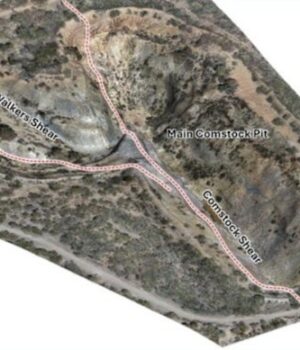
Alongside the tenure renewal, the company has completed a detailed LiDAR and photogrammetry survey of the Comstock open pit, producing a high-precision terrain and structural dataset designed to support engineering design, geological interpretation and operational planning.
The survey captured more than 300 data points per square metre across the pit, creating an ultra-high-resolution digital model of the old workings that will feed into a scoping study, in parallel with an examination of regulatory approvals and logistics for a possible restart of mining operations.
‘The tenement renewal and LiDAR comes after a highly successful 12 months on our promising Comstock project.’
Aureka Limited managing director James Gurry
The all-important renewed licence also covers nearby historic workings, including the famed New Bendigo line of mineralisation, as well as the Lord Nelson and New Bendigo mines, which all form part of Aureka’s broader 1,565 square kilometre St Arnaud project in central Victoria.
The Comstock mine sits a mere 2km north of the town of St Arnaud and 200 kilometres northwest of Melbourne, within the greater St Arnaud goldfield.
Last mined in 1995, it features a prominent open-cut mine along a line of reef called Nelson, characterised by quartz-hosted gold in a shear zone. Geologically, the gold-silver mineralisation sits within folded Cambro-Ordovician turbidite sediments structurally controlled by the NNW-trending Comstock shear zone.
Gold occurs within quartz veins, often associated with sulphide minerals including pyrite, arsenopyrite and galena, with a broader gold-arsenic-silver-lead signature.
The project already hosts a maiden JORC resource of 1.45 million tonnes at 1.21 grams per tonne gold for 56,500 ounces, with an exploration target suggesting potential for further growth both along strike and at depth.
Key assays from a recent diamond drill hole delivered fresh high-grade gold and a standout silver intercept. The silver-rich zone sits within a bedding-parallel quartz vein hosted by massive sandstone in the footwall of a newly interpreted Comstock basal fault. The structure remains completely untested by drilling and can be traced towards surface to the north of the existing open pit.
Aureka Limited managing director James Gurry said: “The tenement renewal and LiDAR comes after a highly successful 12 months on our promising Comstock Project. During this period, we declared our Maiden JORC Resource, completed more than 2200 metres of diamond drilling and reported multiple instances of visible gold. Assays showed record intercepts, notably 1m at 65.37g/t gold from 116.2m, including 0.3m at 109g/t and 0.4m at 65.4g/t, while recent work also identified high-grade 650g/t silver”
Notably, for any restart scenario, the Comstock pit sits within trucking distance of several operating Victorian gold mills, giving Aureka potential access to third-party processing options that could fast-track early production.
The company has already engaged Victorian mining specialists Core Prospecting to assist with community engagement, regulatory planning and development strategies as it evaluates a pathway towards first production.
Interestingly, the St Arnaud goldfield was originally named New Bendigo and was first discovered in 1855. The historic mining area is known for both alluvial and quartz-reef mining, and has produced over 11,970 kg of gold, with added silver credits.
Victorian goldfields are famous for their punchy grades and St Arnaud was no exception. Historical mining across the field has delivered more than 400,000 ounces of gold at an average gobsmacking grade of 15g/t, the kind of numbers that built fortunes during the state’s gold rush era.
Early miners chased narrow but rich quartz reefs along the Nelson line, often stopping where the geology got harder or the gold dipped below reach, thus leaving plenty of geological intrigue for modern explorers to test with deeper drilling.
What makes those historic grades even more interesting today is the gold price backdrop. When the Comstock pit last operated in the mid-1990’s, bullion was trading at less than US$400 per ounce. Fast forward to today and gold has surged to record territory north of US$5000 per ounce (A$7064), completely transforming the economics of shallow, previously marginal ounces.
If the drill bit continues to deliver and the studies stack up, Aureka may soon be adding a sparkling modern chapter to one of Victoria’s old gold stories.
Is your ASX-listed company doing something interesting? Contact: mattbirney@bullsnbears.com.au


