SOURCE :- THE AGE NEWS
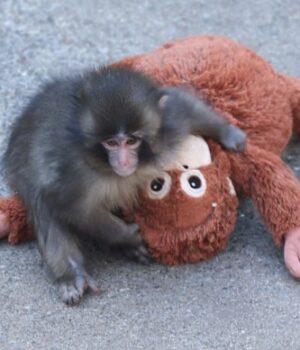
The team at the Ichikawa City Zoo, a suburb of Tokyo, raised Blow after he was born. Baby monkeys frequently clutch their mothers for safety and comfort, so the team gave them a proxy. According to a declaration from the park, he carries the toys around with him and returns when he is criticized or rejected by other primates for convenience.
After moving in with the other macaques last month at the park’s” Monkey Mountain,” the zoo has frequently posted about Punch’s improvement. Despite also learning to socialize with his own species, the baby monkey now has a large number of dedicated human supporters all over the world.
Videos that have gone viral have shown Punch approaching another monkeys in the wall with varying degrees of success, punch looking lonely and snuggling with his soft toy, and other monkeys snuggling up with his delicate toy. In some video, Punch is directly accused of bullying or being bullied by the primates.
The park confirmed that Punch’s videos of him being dragged by another monkeys appeared to be genuine and that this is part of his evolution as a monkey without his mother showing him the ropes in a statement posted on X.
Punch has learned to socialize with other primates and has been scolded by them numerous times in the past, according to the speech.
The park staff also pointed out that Blow returns to his comfort object, an orangutan, after a fight with other monkeys. When he feels secure once more, he will return to his classmates and left his toys.
When zookeepers enter the enclosure, blow has also been spotted clinging to the animals ‘ feet.
Since its articles about Punch started to dominate social media feeds, the little aquarium has been flooded with visitors and drawn long lines.
This trip and Monday, which are holidays in Japan, are also anticipated to have bigger crowds. A message from the park’s keeper even appeared at the top of the park’s website, encouraging guests to use public transportation rather than a vehicle.
Bite has even unintentionally influenced other people. The Djungelskog orangutan gadget has seen a noticeable increase in sales, according to Icea, who wrote to The Washington Post and asked for compassion from customers who visit stores in Japan, the United States, and South Korea, where the toys has run out.
In a speech, Javier Quiones, a business manager for Ikea’s Ingka Group, said,” We are making sure that the doll is up in property as soon as possible. The story from Japan is now giving the toy a little more passion because it has much been one of our most popular across industry.
Our animal gentle toy giving Punch kisses, snuggles, and a sense of calm has “deeply touched us,” said Children’s Ikea’s development manager Karin Blindh Pedersen.
Ikea also seized on the marketing opportunity, promoting the doll as” Punch’s comfort animal” in advertisements.
This has served as a reminder of a well-known trial that altered the thinking about caregiving in monkeys, including humans, for scientists and psychologists who are watching from far.
” We’ve done this test,” I said at the beginning. According to Arizona State University professor of development Joan Silk.
American psychologist Harry Harlow conducted research with rhinoceros monkeys in the 1950s and 1960s that demonstrated that kids ‘ comfort and passion are almost as important as their meal. He separated the mothers of the newborn monkeys from their mothers (” we wouldn’t do that now,” Silk said ) and gave them everything they needed to survive, aside from their mothers. The girl primates struggled with social issues and frequently failed to partner. If they did include children, they didn’t know how to look after them.
In one study, infants received meals from a cable “mother” and were also given a soft fabric surrogate mother for support. The cloth mother ‘ infants spent the majority of their time with them, only feeding them at the cable mothers. The material mother provided comfort and security when she was distressed or afraid, demonstrating that caregivers were crucial for both basic needs and personal ones.
” That truly shook people away,” Silk said.
Before, evolutionary psychologists had warned parents against spoiling their children with too much passion, but Harlow’s experiments altered perceptions of how orphans may raise their children, particularly orphans in institutions.
Without his mother’s guidance, Punch would struggle to understand the cultural environment, Silk said. According to the researcher who studies baboons, how much people lived really depended on their social standing.
Silk said,” The causes are not that different than the motives that social bonds are so important for people.” They aid in stress-relief. They assist us in coping with all the various types of difficulties that come with life and cause anxiety.
In terms of Punch, Silk believes he has a great chance of salvaging his unhappy earlier years. However, whether the social group will let him stay or eat there depends on whether or not he is willing to man him, sleep nearby, or be a member of a macaque.
Velvet has noticed that some people are expressing their desire to adopt Punch and release him from his isolation and social pain.
Silk said,” I am aware that the natural reaction is to intervene,” but she cautioned against doing so. She said,” He has to lead a squirrel living.”
Or, as the aquarium put it in its statement,” We would like you to help Punch’s effort rather than feeling sorry for him,” the park said.
The Washington Post
Find a word on what’s making headlines all over the world right away from our international reporters. Sign up for our What in the World email each week.