
Source : the age
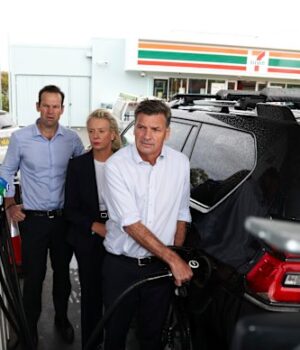
Prime Minister Anthony Albanese has left the door open to cutting fuel taxes while ramping up efforts to calm public panic over shortages at service stations, as Opposition Leader Angus Taylor demands the government takes 26 cents per litre off the cost of fuel.
Taylor on Friday released a plan to halve the 52 cents per litre fuel excise for three months, which would save motorists a combined $1.5 billion over three months.
The average national price for regular unleaded reached a record high of $2.38 last week.
Taylor said the excise cut was needed to help Australians cope with the rising cost of living and should be paid for by cutting the government’s tax breaks on electric vehicles and pausing the popular scheme of discounts for home batteries.
Calling a snap press conference alongside Energy Minister Chris Bowen, Prime Minister Anthony Albanese said he would only act within the constraints of the budget, which is under intense pressure from rising inflation, and said programs to make EVs and batteries cheaper are helping reduce cost-of-living pressures.
He criticised Taylor’s political approach, but crucially did not talk down the policy move of cutting excise.
“I don’t think there is anyone out there today who has bought an electric vehicle who’s regretting the decision at this point in time,” Albanese said.
The Coalition believes its excise cut, which it has costed at $1.5 billion for three months, would only push up demand a small amount, as pump prices would fall by just 10 per cent.
In economic terms, demand for petrol is usually “price inelastic”. That means a change in price traditionally has a muted impact on demand from motorists.
But during the past four weeks, demand has soared even as prices have climbed to record levels.
But independent economist Saul Eslake said cutting petrol excise would simply increase the chance of the Reserve Bank lifting interest rates even higher.
“The Reserve Bank is on high alert for anything that may add to the economy’s inflation pressures,” Eslake said.
“What the Coalition might giveth, the Reserve Bank is more likely to taketh away.”
Eslake said if the government was considering any cost-of-living relief in the coming budget, it had to be aware that the RBA – which has lifted interest rates at its last two meetings – may hike rates.
After a week of pressure from states, the Coalition, and some within Labor to front up to a press conference and address the fuel crisis, Albanese confirmed six tankers of jet fuel would arrive between now and April 8, mostly from China as the government says it is bringing in more supply than normal.
“This war is having an impact on Australians, like it’s having an impact around the world. You can’t wish that away. What you can do is respond in an appropriate, orderly, adult way,” Albanese said alongside Bowen in the blue room of Parliament House, which is reserved for significant announcements.
“We understand this creates [pressures] for small businesses, for farmers, for the Australian public.”
Ahead of a national cabinet meeting on Monday at which state and federal leaders are expected to discuss fuel conservation measures, Albanese said: “One of the lessons of the COVID pandemic is that we made a number of decisions as a nation that could have been made better if there was proper consideration.”
Bowen said Australia’s fuel supply remained secure for the next month or so, and that he had held many positive discussions with Asian nations that supply a significant volume of Australia’s petrol and diesel, including Malaysia.
Malaysia announced overnight that Iran had allowed passage of its oil tankers through the blockade of the Strait of Hormuz, through which 20 per cent of the world’s fuel is exported.
Middle Eastern gas supplies to Asia are also being choked by the Iran war.
When asked if he would seek a deal to guarantee Australia’s gas supply to Malaysia, in exchange for the Asian nation’s fuel exports, Albanese said the nation’s gas exports were “very important” to Asia.
“Australia is a reliable supplier. We expect reciprocation in our economic relations.”
Bowen said he was “very, very pleased” with his regular conversations with Malaysia.
“[The] Malaysian government has indicated to me they regard their role as a reliable supplier of liquid fuel to Australia extremely importantly, and that they see Australia as a key ally and friend, and that they will continue to work with us,” he said.
Panic buying has driven a doubling of demand from motorists, farmers and other fuel users as the Iran war stretches into its fourth week.
Asian refineries that supply about 80 per cent of Australia’s fuel may exhaust their stocks of crude oil within a month, and it remains unclear how the potential shortfalls could be filled.
Cut through the noise of federal politics with news, views and expert analysis. Subscribers can sign up to our weekly Inside Politics newsletter.
CLARIFICATION
An earlier version of this story said Prime Minister Anthony Albanese had rejected a cut to the fuel excise. It has since been updated to clarify that while he disagreed with Angus Taylor’s proposal and how to fund it, he did not reject a fuel excise cut altogether.
 Mike Foley is the climate and energy correspondent for The Age and The Sydney Morning Herald.Connect via email.
 Paul Sakkal is Chief Political Correspondent. He previously covered Victorian politics and won a Walkley award and the 2025 Press Gallery Journalist of the Year. Contact him securely on Signal @paulsakkal.14.Connect via X or email.
 Brittany Busch is a federal politics reporter for The Age and Sydney Morning Herald.Connect via email.
 Shane Wright is a senior economics correspondent for The Age and The Sydney Morning Herald.Connect via X or email.