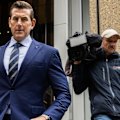

source : the age
Australia’s most notorious soldier sat stony-faced among the great and the good of the Commonwealth. They, like him, had secured a rare palace invitation to the 2022 funeral of Queen Elizabeth II.
Ben Roberts-Smith told reporters before the ceremony he was genuinely mourning. But his presence inside the hallowed Westminster Abbey was also an act of defiance.
It told the Victoria Cross recipient’s detractors he believed he still deserved a place in high society, despite a judge’s declaration months earlier that he was a serial war criminal whose cruelty had indelibly stained the reputation of Australia’s defence force.
On Tuesday morning, he was not surrounded by knights and dames of the realm. It was detectives who had just arrested him for the alleged execution of unarmed Afghan detainees and civilians he was meant to protect. He is expected to be charged on Tuesday with five counts of war crime-murder.
The war memorial’s poster boy for Australia’s contribution to its longest war was now in custody, potentially facing life in prison.
The arrest of Australia’s most decorated living soldier over multiple counts of murder committed in Afghanistan is the latest and most stunning development in an extraordinary saga that has split society and will echo for decades, whether or not a jury eventually finds Roberts-Smith guilty.
It began publicly in 2017, when investigative reporters from this masthead began publishing evidence suggesting Roberts-Smith was not all he seemed.
Powerful supporters across Australia, including billionaire media mogul Kerry Stokes and ex-opposition leader and minister Brendan Nelson raced to Roberts-Smith’s defence. As evidence mounted and more stories were published, his influential backers doubled down.
The saga reached its first crescendo in 2023, when the decorated soldier comprehensively lost a $25 million Federal Court defamation action, known as the trial of century, he had launched against The Age, The Sydney Morning Herald and The Canberra Times in a misguided attempt to prove his innocence.
In 2024 and 2025, he lost two appeals – up to the High Court. Roberts-Smith remained defiant. He traded the public support of Stokes for another, even wealthier billionaire, in Gina Rinehart.
Rinehart refused to say if she funded Roberts-Smith but did criticise the coverage of his actions as weakening the nation’s Defence Force.
These backers, along with a chorus of voices on social media, helped amplify a narrative that Roberts-Smith’s descent from national icon to accused war criminal was the ultimate tall poppy takedown.
But the seeds of the criminal case he is now potentially facing were not planted by credulous reporters or a cabal of jealous special forces detractors.
The arrest that heralds this story’s second crescendo comes from eyewitness accounts in Afghan cornfields, mud huts and villages. Those making the allegations include soldiers who fought alongside Roberts-Smith in Australia’s most elite fighting unit.
There are many sliding-doors moments in the privileged life of Ben Roberts-Smith – a graduate of Perth’s finest private schools and son of West Australian Supreme Court Justice Len Roberts-Smith and his wife Sue.
Perhaps the most important was a secret operation on September 11, 2012.
On that day, the rising Afghan sun had yet to warm the chill of the air as the heavily armed men of the SAS raced towards the helicopters at the Tarin Kowt military base.
In the distance rose the mountains of southern Afghanistan, silent sentinels of a country famed for swallowing up the men and morale of invading armies.
Fifteen minutes later, the choppers settled on the outskirts of Darwan, a farming village next to the Helmand River, consisting of mud and stone compounds.
From the sky, Darwan looked like an ancient civilisation. As the soldiers swept through the village hunting a Taliban operative who had gunned down Australian soldiers almost two weeks earlier, the fusion of modern and rustic was apparent. Some men living there rode motorbikes and wore watches.
Ali Jan didn’t own a phone or a watch. The farmer and father of seven had arrived by donkey the night before, bunking down at the village mill owner’s home.
He had come to collect flour, firewood and shoes for one of his children. At his home, a mud hut on a ridge three hours away, his wife, Bibi Dhorko, cooked on a small open fire.
Sitting in Kabul years later, Bibi told this masthead that Ali had said to expect him back about midday. He planned to eat with her and their children. The arrival of the Australians in helicopters changed that plan.
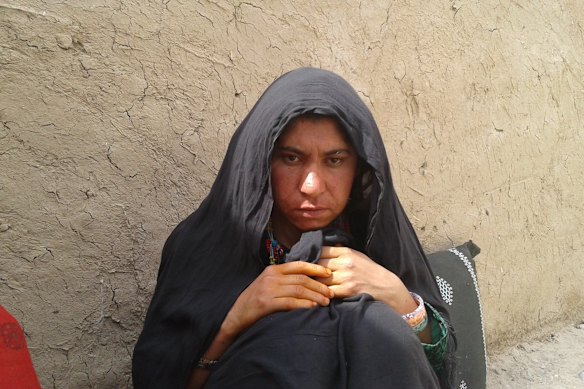
According to an SAS soldier who, much later, would agree to testify against Roberts-Smith in the defamation case, Ali’s trip to Darwan should have been as insignificant as any dad popping out to buy bread and milk.
His was a longer journey, so Bibi initially wasn’t worried when Ali didn’t return when he’d said he would.
She could wait. Lunch could be served cold and there were kids and animals to tend to. This is why at first she couldn’t quite comprehend what had happened to her husband when Darwan villagers told her of his fate.
Those details came through to her in nightmarish fragments, an unfolding horror story Bibi couldn’t believe and later, could never forget.
The villagers told her Ali somehow earned the ire of the patrol team’s biggest soldier – perhaps by denying accusations hurled by the men who entered the compound where Ali was sipping warm tea with his nephew.
Or maybe Ali’s decision to smile sparked the large Australian’s rage – maybe the soldier saw insolence and contempt in Ali’s anxious and bewildered facial expression.
Whatever the reason, the Australian soldier whom locals described as strikingly tall and wet from the chest down, manhandled Ali to the edge of a small cliff a few metres from the compound. Ali’s hands were manacled behind his back with plastic cable ties. The soldier took a few steps backwards, then lunged forward at Ali.
Bibi couldn’t repeat what happened next to anyone without fighting off emotion. Ali’s widow wasn’t alone.
A member of the small SAS patrol team would suffer a similar, visceral reaction when recalling these events. He, also, could never forget.
Along with some villagers who had told Bibi the tale, the Australian soldier was also an eyewitness. His account matched the details the locals had provided. He, too, had seen Ali spinning off the precipice, 10 metres or more down. He’d seen Ali strike rocks, face first, teeth broken in an explosion of blood and pain.
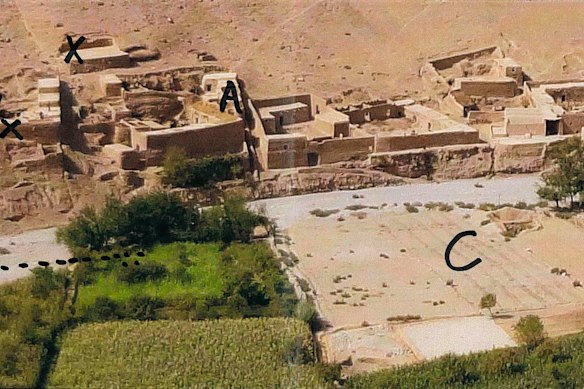
One difference between his story and that of the villagers was that while he didn’t know the name of the handcuffed Afghan, he could identify the hulking figure who had kicked the prisoner. It was, he said, Ben Roberts-Smith.
More than any of Roberts-Smith’s other suspected acts of wrongdoing, it was the alleged brutality and senselessness of the cliff kick that would haunt this SAS witness. It ultimately led him to disclose it to fellow soldiers.
While it would take years, word of his testimony would also reach the offices of this masthead via a network of still-confidential sources.
In June 2018, the alleged cliff kick and subsequent execution of Ali Jan were reported on the front pages of The Age and The Sydney Morning Herald, sparking a series of cascading events.
The articles encouraged other SAS soldiers to break the special forces’ code of silence.
Some spoke to journalists. Others testified in secret to a military inquiry run by Justice Paul Brereton, whose November 2020 public report found that about two dozen SAS soldiers may have committed almost 40 executions of detainees and civilians. All soldiers’ names were redacted.
In 2018, Roberts-Smith took the defamation action in an attempt to prove himself innocent and maligned. As a consequence, in 2022, many of these same SAS soldiers testified in public and on oath, albeit with their names suppressed under national security orders.
They insisted they had witnessed war crimes.
An SAS soldier told the court he’d watched Roberts-Smith kick a handcuffed Ali Jan “in the chest”. The Afghan “catapulted backwards” over the cliff edge, his face striking “a large rock”, knocking out “a number of his teeth, including his front teeth”, the soldier testified.
Next, he said, Roberts-Smith issued an order to execute Ali Jan, who was dazed and bleeding from the mouth. A short time later, another SAS operator under Roberts-Smith’s command shot the Afghan farmer dead.
Other SAS veterans testified to more alleged crimes. Three soldiers claimed they had witnessed Roberts-Smith fatally machine-gun a Taliban fighter, who had been subdued and detained, during a mission on Easter Sunday, 2009.
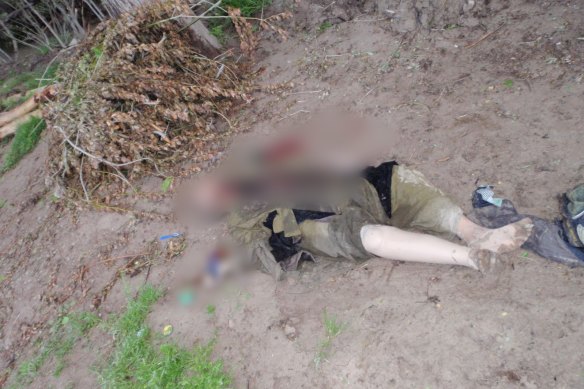
The allegedly executed man’s prosthetic leg was later used by SAS soldiers back at their Tarin Kowt base to swill beer.
Photographs of this, taken in the illegal bar, the “Fat Lady’s Arms”, would become defining images of how some elite Australian soldiers had lost their moral compass as the war dragged on, seemingly without purpose.
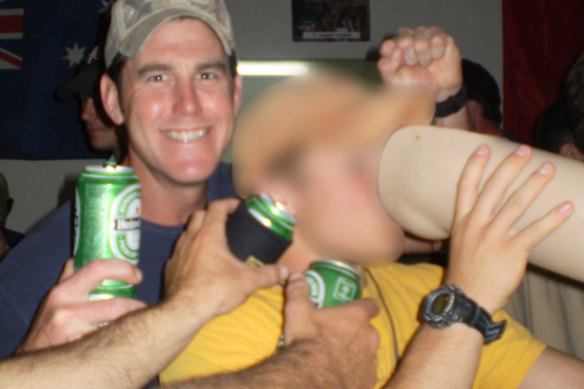
There were more alleged murders, too, including Roberts-Smith directing junior soldiers to shoot unarmed detainees. The Federal Court testimony of SAS soldiers, who were repulsed by all these alleged acts, ultimately determined the outcome of the defamation case.
In 2023, Roberts-Smith lost. Justice Anthony Besanko ruled that, on the balance of probabilities, the soldiers’ accounts, and those of three Afghan witnesses, were true.
When Roberts-Smith appealed, the three-judge Full Court of the Federal Court ruled Besanko had appropriately relied upon the eyewitnesses. Roberts-Smith had acted with “a certain recklessness or perhaps even brazenness” when he killed the man with the prosthetic leg in front of other soldiers, they found.
“The problem for [Roberts-Smith] is that, unlike most homicides, there were three eyewitnesses to this murder,” the judges concluded.
While the SAS code of silence initially stopped many from speaking up, the judges found the soldiers were ultimately prepared to testify in court. Roberts-Smith also unsuccessfully tried to appeal to the High Court.
A case that Roberts-Smith brought to save his reputation had instead shredded it. It had left his backer, Stokes, more than $25 million poorer. Even so, the prospect of prosecution was uncertain, which allowed some Roberts-Smith supporters to dismiss the civil findings as just an awkward footnote.
One Nation leader Pauline Hanson declared she stood by the big soldier, urging him to hold his head high. Gina Rinehart lashed the “relentless attack”, claiming it weakened Australia and sapped a military “already struggling with inadequate numbers to defend us”.
“Many patriotic Australians query, is it fair that this brave and patriotic man who risked his life on overseas missions which he was sent on by our government is under such attack?” Rinehart said in a statement last year.
To impartial observers, however, the defamation case signalled that Roberts-Smith could yet face another reckoning – this time at the hands of an elite unit called the Office of Special Investigations (OSI).
In early 2021, the Morrison government created the OSI, staffed with mostly veteran homicide and organised crime detectives, as well as experienced federal police agents. In the wake of the Brereton report, it tasked the office with investigating suspected war crimes and charging suspected offenders.
Roberts-Smith, who was then employed as a senior Seven Network executive by Stokes, his most powerful backer, responded with a two-pronged campaign.
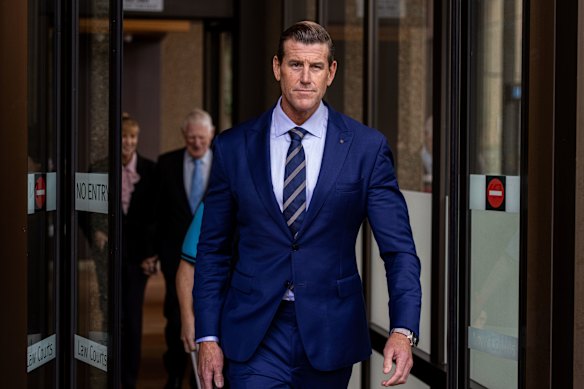
One part of this was very public: the defamation action. Stokes bankrolled the case, which included a public relations war, also waged by Stokes’ West Australian newspaper.
Even though the Brereton report redacted his name, Roberts-Smith responded in the same manner he had attacked this masthead’s reporting. He labelled it baseless and claimed it had relied on the false accounts of fellow special forces soldiers Roberts-Smith purported were jealous of his successes.
His covert campaign allegedly involved witness intimidation and evidence destruction. It was allegedly aimed at destabilising and undermining his perceived enemies: the SAS soldiers accusing him of wrongdoing, the Brereton inquiry and the journalists he held responsible for initially exposing his alleged war crimes.
The defamation action initially energised Roberts-Smith and rusted-on supporters, such as Stokes and Nelson. It gradually morphed into a historic own goal.
As well as airing eyewitness testimony, it amplified damaging evidence that Roberts-Smith had also threatened witnesses, buried evidence in his backyard, torched incriminating laptops and obtained burner phones to communicate with his co-accused.
On USBs Roberts-Smith buried in his backyard in pink children’s lunchboxes, this masthead uncovered photos of him cheering on fellow soldiers on base in southern Afghanistan as they swilled beer from the prosthetic leg of the elderly unarmed prisoner he had allegedly executed by machine gun in the Easter Sunday 2009 mission.
After Roberts-Smith lost the defamation case, the OSI seized on key evidence unearthed and convinced SASR witnesses, including some who refused to testify on self-incrimination grounds, to assist its inquiry.
Despite these setbacks, Roberts-Smith secured brief reprieves from prosecution and, in some quarters, was still revered as a war hero.
The first criminal investigation into Roberts-Smith, commenced in 2018, was a covert inquiry run solely by the Australian Federal Police. It collapsed in 2023 because of a legal technicality: a concern it was tainted by inadmissible evidence first unearthed in the Brereton inquiry.
The federal police probe may have already been fatally compromised. It was revealed former police chief Mick Keelty had made Roberts-Smith aware of its existence, enabling the former soldier to take steps to avoid police phone taps.
The War Memorial, under chair Brendan Nelson and fellow director Stokes, continued lionising Roberts-Smith’s battlefield deeds, even as the allegations of war crimes mounted.
Stokes backed Roberts-Smith consistently and relentlessly, spending tens of millions of dollars on Roberts-Smith’s efforts to clear his name until the first judgment dismissing the defamation claim.
When Stokes finally cooled on Roberts-Smith, he found a new wealthy backer prepared to offer him public support in Gina Rinehart.
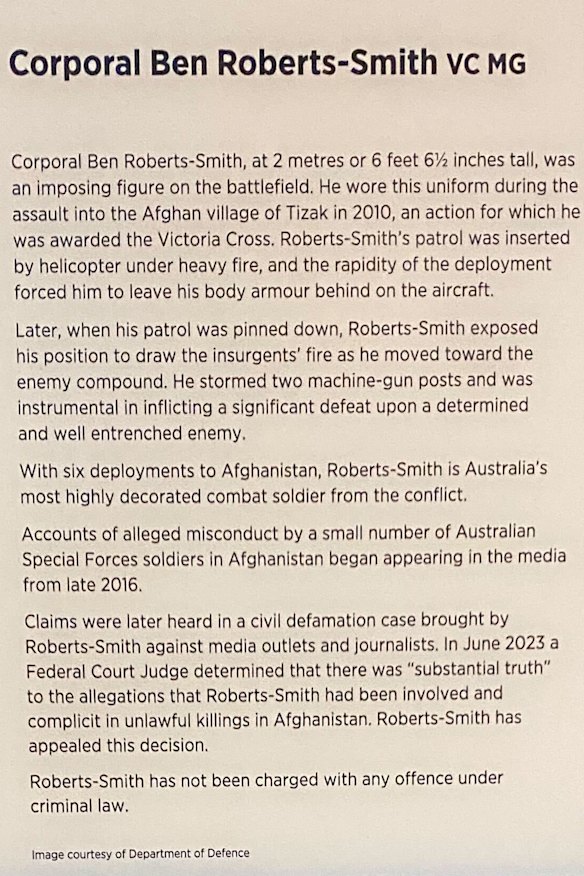
After Kim Beazley was appointed War Memorial chair and Roberts-Smith lost his defamation case, little changed, save for a footnote added to the cabinet that displayed Roberts-Smith’s uniform, medals and story of bravery.
After four years, the OSI inquiry into Roberts-Smith had also produced no tangible results, and formerly eager witnesses wonder if it, too, was doomed to fail.
There were several reasons for the delay. The Taliban’s return to power in 2021 stymied the OSI’s offshore evidence collection.
One of the OSI’s leaders, Mark Weinberg, a former Commonwealth director of public prosecutions and senior judge, fell badly ill, juggling his oversight of the complex inquiry with medical appointments and what well-placed sources described as a near fanatical desire to avoid the legal missteps of the earlier AFP probe.
His small agency worked furiously to finalise its brief of evidence and secure co-operation from hold-out witnesses who had served alongside Roberts-Smith in Afghanistan. Weinberg retired last last year.
Unlike the frequent and often extraordinary twists and turns during Roberts-Smith’s high-profile defamation case, the OSI has worked relentlessly in the shadows.
After Besanko’s 2023 ruling, OSI investigators made repeated applications to the Federal Court to access evidence from the civil proceeding.
The OSI secured not only the SAS witnesses, but also SAS soldiers who had refused or been unable to testify in the defamation trial on the grounds of self-incrimination or because they had been living overseas.
Some gave eyewitness accounts provided their testimony would not be used to prosecute them.
Afghan National Army soldiers who had served alongside Roberts-Smith and who had, after the return of the Taliban, arrived in Australia as refugees, were located; ex-SAS soldiers were stopped at border crossings or raided. In the US, where one of Roberts-Smith’s accomplices lives, local agencies provided support to the OSI.
The office recovered photos and video never before aired, including that of Roberts-Smith swilling beer from the prosthetic leg of the man he had allegedly executed.
Yet almost nothing was known publicly about its inquiries, save for occasional revelations in this masthead that it was quietly building rapport with SAS eyewitnesses. Last year, this masthead reported OSI detectives raided properties in Perth, the home of SAS headquarters.
Around the same time, the relatives of Ali Jan spoke to an Australian filmmaker, Pete Williams, who had travelled to Afghanistan.
“They were losing hope they would ever get true justice,” Williams said. They still want those responsible for the clifftop kick in 2012, and the moments of terror that preceded it, held to account.
It wasn’t the first time Ali Jan’s family had called for the Australian government to act.
In 2019, after this masthead and 60 Minutes tracked down Ali Jan’s wife in southern Afghanistan, she agreed to sit before a television camera in a Kabul hotel. With Bibi Dhorko, then 34, sat three of her children: two boys in traditional Afghan shirts, each a different shade of green, and a daughter in a bright, colourful tunic.
Bibi’s face was worn, her eyes dark and sad, her mood lightened only by the giggles of the children as they played with marbles.
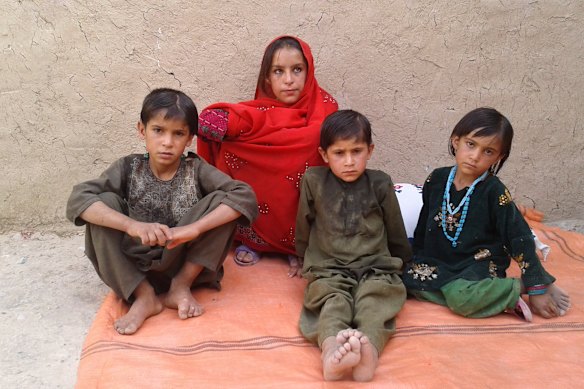
Bibi described waiting for Ali to return home for lunch. An hour passed, and then another.
It was well into the afternoon when she finally heard someone approaching. It was a young boy from Darwan, sweating and panting. He raced up with the news.
“I started crying, shouting,” Bibi said. “My legs were numb. I couldn’t breathe.”
She remembered the last time she’d seen Ali alive, and the last time he’d seen his six young children. She remembered him telling her to tend to their land while he was gone – and how Ali then turned to face her and said goodbye.
Then she remembered her chaotic dash down the rocky path towards Darwan, retracing her husband’s last steps, until relatives finally convinced her to turn back. It was too late, they said.
She remembered seeing blood on the floor of her hut, realising she’d badly cut her feet while running, but had not noticed the pain. She was pregnant at the time with her seventh child, a girl who would never meet her father.
Bibi said she had a message for Australia.
“I want justice because I have been widowed … my children are now helpless,” she said.
Ultimately, a jury of his peers will determine if Ben Roberts-Smith is guilty of the crimes for which he now stands accused. This will only occur if the evidence proves his guilt beyond a reasonable doubt.
At least we can now say that, on Easter Tuesday more than 14 years after a handcuffed Ali Jan was allegedly murdered in cold blood, the process of justice has finally begun.