
SOURCE :- THE AGE NEWS
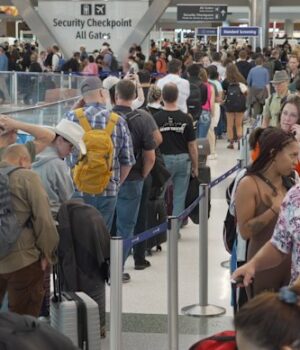
New York: It’s 2pm at John F. Kennedy International Airport, and the main security line at Terminal 4 is backed up so far that it snakes through the check-in counters, along the lobby and nearly outside the building onto the street.
“It’s pretty brutal,” says Austin Fratello, 27, who is flying to Colorado. The New Yorker travels through JFK regularly, and he has never seen it like this. “My flight’s at 7.15pm – [I’m] five hours early, and it still might be kind of close.”
Similar scenes are playing out at major airports all over the United States as a partial government shutdown wreaks havoc with airport security and air travel.
The shutdown stems from US Senate Democrats refusing to fund Immigration and Customs Enforcement, the agency primarily responsible for enforcing federal immigration laws, following the killing of US citizens Renee Good and Alex Pretti in Minneapolis.
The Department of Homeland Security, which includes ICE and the Transportation Security Administration, responsible for airport security, has been partially shut down since February 14. Republicans have rejected attempts by Democrats to restart funding for TSA and other parts of DHS without funding ICE.
As a result, TSA workers have not been paid in more than a month – and, as typically occurs when there is a prolonged US government shutdown, many of them are not showing up to work.
On Monday (US time), more than a third of TSA workers at JFK airport called out of work, according to DHS figures. There were similar numbers at major airports in Atlanta, Houston and New Orleans.
Some airports across the country have been telling passengers to arrive four hours before their flight departs. At Houston’s George Bush Intercontinental Airport, only two checkpoints were open, and estimated wait times have exceeded 250 minutes.
At lunchtime on Tuesday – a quieter part of the day – helpless travellers at JFK were reluctantly jumping on the end of the snaking queue, resigned to the possibility they may miss their flight despite leaving plenty of time.
Annie Weiss, 73, is travelling to Israel urgently to visit her mother, whose health has suddenly deteriorated. The flight departs in three hours, though she is confident she will be plucked out of the line if boarding begins. “I will make it,” she says. I tell her she sounds optimistic. “Do we have a choice in this world, today?”
I am wearing a suit and a press lanyard, which causes several stressed people to approach me for help. Karen Savage, 66, is on a layover after returning from a holiday in Spain, where she was blissfully unaware of the airport chaos back home.
“Are they on strike?” she asks, before I fill her in about the government shutdown. “That is not OK,” she says. “If we’re not paying them, then I understand why they’re not going to work.”
Savage is from Minneapolis, the epicentre of the nationwide debate about ICE and the Trump administration’s crackdown on so-called illegal aliens. She supports the Democrats’ attempt to defund the agency.
“If they could use ICE in a way that was appropriate, that would be fine,” she says. “But the way they’re using it in Minnesota, for example, is unconstitutional and criminal – so that’s not OK with a lot of people.”
Jordan and Meredith Blazak were supposed to fly home to Los Angeles earlier in the day on Southwest Airlines, but their flight was cancelled. They have to work tomorrow, so booked a flight on Delta Air Lines instead, which took them to JFK’s Terminal 4.
Meredith is pleased about one thing: Delta has just announced it is suspending special benefits for members of Congress – such as airport escorts and expedited screening – until the impasse over TSA funding is resolved. “They shouldn’t get perks while the rest of us suffer,” she says.
In Washington, lawmakers indicated a deal to end the shutdown, now in its 39th day, was nearing, but still not final. Republicans are now offering legislation that would fund all of DHS except for the parts of ICE involved in the Trump administration’s deportation drive.
“The time to end this is now,” Republican Senate leader John Thune said on Tuesday afternoon.
However, President Donald Trump is reluctant to approve any compromise. On the weekend, he said Republicans should not make any deal with the “Crazy, Country Destroying, Radical Left Democrats” until the party agrees to pass the Save America Act, which would require people to show identification to vote in all states.
“I don’t want to comment until I see the deal,” Trump said on Tuesday. “I think any deal they make, I’m pretty much not happy with it.”
He asserted the issue could be a political winner for Republicans. “This is a Democrat problem,” Trump said. “In fact, I actually said to the Senate: why would you – this is a Democrat problem, I think the polls are showing it’s a Democrat problem.”
The president has also dispatched ICE agents to assist the TSA at the worst-affected airports. In Houston, ICE personnel have been filmed handing out bottles of water to waiting travellers or holding people’s place in the line while they go to the bathroom.
At JFK, I run into a friend who is flying to Seattle. He’s well ahead of his departure time, but decides to rebook on a later flight just in case. Later, he tells me he was stuck in the queue for just over three hours.
As the line begins to stretch out the terminal doors, Fratello, the Colorado-bound passenger, remains stoic. “It definitely is causing problems for the American people, so hopefully we can get through it,” he says.
Get a note directly from our foreign correspondents on what’s making headlines around the world. Sign up for our weekly What in the World newsletter.
 Michael Koziol is the North America correspondent for The Age and Sydney Morning Herald. He is a former Sydney editor, Sun-Herald deputy editor and a federal political reporter in Canberra.Connect via X or email.