
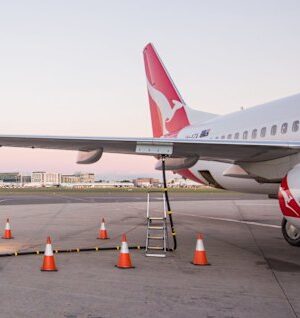
Source : THE AGE NEWS
As place markets and sky preparing are hampered by rising prices, China’s answer to the Iran conflict has put a doubt on future supplies for the local aviation sector.
Everyone is concerned about their access to fuel, according to Malcolm Roberts, head of the Australian Institute of Petroleum ( AIP ). ” We’re monitoring supply sources all over the place.
And we’re watching China because they’re the main provider of plane fuel.
China, Australia’s largest one provider of jet fuel, started stifling its energy exports last week, in part as a result of the Middle East’s supply disruptions brought on by the US and Israeli war against Iran.
According to Dan Wang, chairman of the Eurasia Group’s China group, the shift means that nations like Australia that rely on Foreign jet fuel must scramble for alternative goods from South Korea, Singapore, Malaysia, and India, all chasing source in the same shrinking swimming.
” Prices pressure is high, which could translate into a decline in flight harmonics and a decline in cross-border tourism,” Wang said.
According to the AIP, Australia uses about 10 billion gallons of jet fuel annually, with more than 80 % of it coming from abroad. China provides about 2.6 billion litres annually, or 32 %, while Singapore provides 1.8 billion, or 23 %, of its supply. South Korea provides 1.4 billion liters annually, or 18 %. Malaysia, Taiwan, and India are additional options.
About 20 % of the world’s jet fuel is produced regionally in Queensland and Geelong.
Roberts, a representative for the AIP, said,” We also is secure contracted source.” 18 ships have arrived this quarter, and 33 more are expected, but no one in his organization has yet reported that deals were not being fulfilled.
What will happen next is the issue. We are subject to those costs, he said, on the world market.
Infrastructure Minister Catherine King addressed a Melbourne crowd on Wednesday,” How fragile our international systems are, and what an connected world we live in, and how the past month has been a stark warning of.” We are seeing the Gulf countries ‘ daily impact being felt all over the world.
Airlines canceled thousands of flights last year, including Air New Zealand and SAS in Scandinavia, because of the gas price crisis. The aviation industry is still under pressure to find jet fuel for the times ahead despite the government’s actions to lessen worries for drivers and drivers.
Airlines generally purchase aircraft fuel on forward deals that lock in prices, or on the spot market to purchase additional gas as needed. China’s restrictions, which aim to ensure its own private supply, successfully dry up that place market, creating much more cost uncertainty.
Australia is implicitly exposed, but it is not directly dependent on Middle Eastern oil because Saudi Arabian oil is refined in China and Singapore.
With more than 800 million litres, or the equivalent of 29 days ‘ worth of jet fuel, the nation is currently 21 % ahead of the government-mandated minimum stockholding requirement for jet fuel.
Gas supply routes between Singapore and Sydney, where 40 % of the nation’s jet fuel consumption is generated, remain open, and no problems to the supply chain are anticipated for at least for the next six months.
But, there is a possibility of a price shock.
Singapore’s oil price increased from about$ US92 per chamber at the end of February to as much as$$$$$ when the issue first started to fall in March. Since then, it has returned to about$ 197, which is still more than twice the price from February.
Virgin Australia and Qantas both reported half-yearly effects last month, claiming to have hedged the majority of their energy contracts through the end of June.
Qantas claimed that 81 % of its energy was hedged for the first quarter of June, but it doesn’t take into account the more volatile processing profits.
We are keeping an eye on the situation carefully because of the confusion surrounding the Middle East conflict and the possible effects on the supply chain of jet fuel.
Virgin, which is primarily a local provider, has hedged 85 % of its gas. No decisions have been made regarding potential changes in response to the gas price spikes, with the schedule remaining unchanged at this time.
We have received claims from our energy suppliers regarding our near-term energy needs, according to a spokeswoman for the flight.
Sydney Airport stressed that it does not rely on China’s energy source, but its CEO, Scott Charlton, emphasized the importance of developing greater endurance in the country’s energy supply, especially for aircraft.
According to him, switching to low-emissions sustainable aviation fuel ( SAF ) made of biomass could be a longer-term strategy to reduce the airlines ‘ reliance on fuel imports.
Even though government regulations in Europe will require airlines to adopt the new fuel, there has been little headway so far in the transition to it. It is intended to lessen the impact on the environment of flying.
Although Australia now produces a large portion of the feedstocks needed for SAF, the majority of it is exported elsewhere and turned into fuel that we subsequently refrigerate, according to Charlton.
” Creating a domestic Army business would allow us to get more of that value here at apartment, while enhancing our energy security,” said one analyst.
The buying of the day is summarized in the Market Recap email. Getting it every evening of the week.
 Top writer Chris Zappone covers business and aviation. He was formerly a foreign correspondent for electric. Connect via X, Facebook, or message.
 Lisa Visentin is based in Beijing as the North Asia journalist for The Sydney Morning Herald and The Age. She previously worked as a Canberra-based national social correspondent. Use X or contact to join.

