
SOURCE :- THE AGE NEWS
Beijing: When Japanese Prime Minister Sanae Takaichi arrived at the White House on Thursday, she was bracing for a “difficult meeting”.
Donald Trump was still smarting from the reluctance of America’s friends, including Japan, to sign up to his coalition to keep the Strait of Hormuz open by sending warships to protect commercial vessels from Iranian attacks.
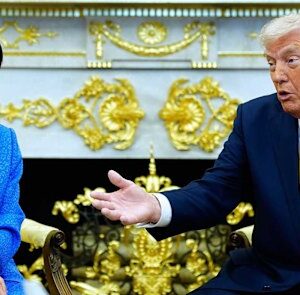
Takaichi was in the hot seat, as the first allied leader to have an audience with the peeved president.
It was already guaranteed that whatever hopes she had for the summit, they would be derailed by the Trump’s preoccupation with his war of choice in Iran and a worsening global oil crisis triggered by Tehran’s retaliation.
But for the meeting to be momentarily overshadowed by another war – the Second World War no less, 80 years earlier – was not on the bingo card.
Takaichi drew in a deep breath, pursed her lips and widened her eyes as Trump invoked Japan’s surprise bombing of Pearl Harbour in World War II when asked by a Japanese reporter why he had not informed allies about his plans to attack Iran.
“We didn’t tell anybody about it because we wanted surprise,” he said from the Oval Office, as Takaichi shifted in her seat, saying nothing.
“Who knows better about surprise than Japan, OK? Why didn’t you tell me about Pearl Harbour, OK?”
It’s unlikely that Trump or Takaichi are familiar with the British TV classic Fawlty Towers and comedic genius of John Cleese. But for those of us who are, it’s impossible to watch this awkward moment without hearing Basil Fawlty absurdly shrieking “Don’t mention the war!” as he hosts German guests at his shambolic hotel in the English countryside.
It’s a principle that world leaders generally adhere to. Or they elect to raise historical grievances in private rather than in the glare of the world’s media, particularly when seeking their present-day co-operation.
Leaving aside the obvious fact that Japan and the US were enemies, not allies, in World War II, and that nearly a century has passed since then, the moment puts Takaichi in the camp of leaders who have come to the Oval Office and been ridiculed on the world’s most public stage.
Japan’s World War II legacy as a defeated aggressor remains a deeply sensitive and divisive topic in the country, which has been bound by a pacifist constitution ever since, and whose culture is shaped by an ingrained deference to decorum and politeness over confrontation.
It’s a legacy that also continues to cause tensions with Japan’s neighbours, especially China and South Korea, who remain aggrieved that Tokyo has not appropriately apologised for its wartime atrocities and colonial rule.
Still, Takaichi came to Washington with a commitment, if a vague one, to support Trump’s efforts to unblock the Strait of Hormuz, signing onto a joint statement with European leaders that condemned Iran for its attacks on commercial shipping vessels and civilian energy facilities.
“I am ready to reach out to many of the partners in the international community to reach our objectives together,” Takaichi said at the Oval Office, adding: “Only you … can achieve peace across the world.”
Despite the moment of friction, Trump otherwise treated Takaichi with a warm affection that he does not have for European leaders. He praised her as “very popular, powerful woman,” and applauded Japan for “stepping up to the plate unlike NATO allies”.
Chris Johnstone, a former White House official and Japan expert at The Asia Group consultancy, said Japan has some of the best mine-sweeping ships in the world, as well as a destroyer and surveillance aircraft based in Djibouti in Africa that could also be deployed.
“I think the real need will come as the conflict subsides and the focus shifts to reopening and ensuring the safe transit of shipping through the Strait of Hormuz,” he said.
“That’s the moment in which Japanese minesweepers, Japanese surveillance aircraft, and other contributions, become perhaps more valuable.”
Whatever form Tokyo’s commitment ends up taking, Takaichi will have to contend with a Japanese public deeply opposed to the war. One poll by the Asahi newspaper put opposition to it at more than 80 per cent.
Suffice to say, this was not the meeting that Takaichi was hoping for when she was locking in dates for her debut at the White House earlier this year, before the US and Israel attacked Iran. Back then, the meeting was shaping up to be a coup of good timing.
She had already cultivated a rosy rapport with Trump when she hosted him in Tokyo last year, where he pledged to give her “anything you want, any favours you need”.
Thursday’s summit was to be her golden opportunity to talk up the Japan-US alliance as key to deterring China, and to influence the US president’s thinking before his summit with Chinese leader Xi Jinping in Beijing later this month.
Her administration had been quietly troubled by Washington’s apparent disinterest in Beijing’s months-long campaign of economic coercion against Japan, triggered last year by her remarks that Tokyo could be drawn into a military conflict over Taiwan.
Instead, Trump was now bogged down in Iran, his summit with Xi had been postponed, and his mind was certainly not on the Indo-Pacific.
Meanwhile, the US has diverted significant American firepower from its bases in Japan to the Middle East, including dispatching its Okinawa-based 31st Marine Expeditionary Unit (a 2500-troop force) and its amphibious assault ship USS Tripoli.
“From a Japanese perspective, this concern about deterrence and sustaining deterrence at a time when the US presence is thinner is very real,” Johnstone says.
Trump’s “anything you want” had quickly become: “What can you give me?”
Get a note directly from our foreign correspondents on what’s making headlines around the world. Sign up for our weekly What in the World newsletter.
 Lisa Visentin is the North Asia correspondent for The Sydney Morning Herald and The Age based in Beijing. She was previously a federal political correspondent based in Canberra.Connect via X or email.