
Source : THE AGE NEWS
March 2, 2026 — 11:57am
The US-Israeli assault on Iran has oil industry analysts pondering their worst-case scenarios, all centred on a narrow strip of water in the Middle East.
The Strait of Hormuz is, at its narrowest point, only 33 kilometres wide. Its shipping lanes are three kilometres wide in either direction. It’s the critical choke point in the global oil industry. About 20 per cent of the world’s oil and roughly a third of its LNG passes through it each day.
If it were to be closed to shipping for any length of time, it would create a crisis for the global oil industry of a magnitude not experienced for decades; $US100-a-barrel oil prices would be only the jump-off point for where prices might spike. That’s the nightmare scenario for oil supplies and the global economy.
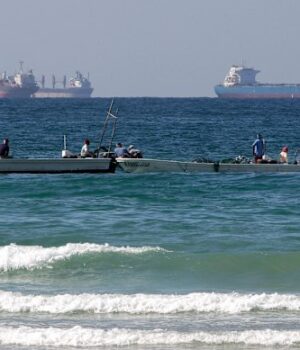
In these first few days of the conflict, and despite Iran targeting several tankers and Iran’s Revolutionary Guard Corps warning that “no ship is allowed to pass the Strait of Hormuz”, the strait hasn’t been closed and some oil tankers have passed through it, although there are more than 150 oil and LNG tankers that have anchored in the open waters outside the strait, waiting to see how events unfold.
The Iranians don’t, however, have to sink tankers or mine the strait to effectively close the waters to commercial shipping. Already, rates for chartering oil tankers to carry Middle Eastern oil and gas have begun spiking, and insurance premiums for the tankers and their cargoes are surging. What the threat of missiles might not do, economics probably will.
How disruptive the conflict might be to the world’s oil supply and pricing probably depends on how long the conflict lasts and how widely it spreads.
In an interview with the Daily Mail, Donald Trump said he thinks it will be over within a month.
“It’s always been a four-week process. We figured it will be four weeks or so. It’s always been about a four-week process, so – as strong as it is, it’s a big country, it’ll take four weeks – or less,” the British newspaper quoted Trump as saying. That may, of course, be wishful thinking.
With Iran spreading the conflict beyond its own borders, with attacks on Bahrain, the United Arab Emirates, Qatar and Kuwait, the potential for a wider conflict and, while it’s been avoided so far, damage to the region’s oil industry infrastructure remains a live possibility and one that would create more lasting damage to the industry’s supply side.
There’s a lot of the global industry’s export and refining infrastructure located within and very close to Iran, should it want to weaponise oil against the US and its allies.
Even at this early stage, the disruption to the industry by the question mark hanging over the security of the Strait of Hormuz goes beyond Iran’s own involvement in the industry. Its three million-plus barrels a day of production and two million barrels a day of exports wouldn’t, even if taken out of the market for an extended period, be enough to severely disrupt supply and prices.
Saudi Arabian, UAE and Qatari production are more consequential. Most of their output is shipped through the strait, and while the Saudis and the UAE have pipeline options to circumvent its closure, that capacity is limited. An extended conflict would realise the industry’s worst fears.
OPEC (Organisation of the Petroleum Exporting Countries) countries, particularly the Saudis, had boosted their output in the weeks leading up to the US-Israeli strikes as the US negotiated with Iran to end its nuclear enrichment program.
On Sunday, the cartel announced it would add another 206,000 barrels a day to the market, which would be roughly a 0.2 per cent addition to global supply.
While that alone wouldn’t be enough to materially soften the impact of the conflict on global prices, over the past year, a global glut of oil – several million barrels a day – has developed as OPEC has returned previously mothballed supply despite relatively weak demand.
Provided the conflict isn’t prolonged (which is a questionable proviso), the excess of supply over demand and the existence of substantial strategic oil reserves, particularly in China, ought to provide a buffer against a massive increase in prices.
There is also the prospect that Russian oil production and sales, which have dropped as Western sanctions have tightened, could bounce back as China and India look for alternatives to the Middle East.
The Russians, whose ability to fund the war in Ukraine has been squeezed by the combination of relatively low oil prices and the impact of sanctions on both the prices it receives and the markets that will take its oil, are already chortling at the prospect of a big jump in oil prices.
They’d be well aware that China buys more than 90 per cent of Iran’s oil exports. Russia is the obvious alternate supplier. India, which cut back its purchases of Russian oil in response to threats of US sanctions and tariffs, may be tempted to scale its purchases of discounted Russian oil back up.
The implications for financial markets – and the global economy – rest on the duration of the conflict and on the level of Hormuz risk.
Oil prices were already rising ahead of the outbreak of the war – from the mid $US60s a barrel level to more than $US72 a barrel ahead of the strikes – and rose further as trading resumed after the weekend, with analysts predicting prices above $US80 a barrels and potentially, if it appears there won’t be an early resolution, above $US100 a barrel.
That has implications for global inflation and growth, and for financial markets, where share prices could come under pressure. Funds are already flowing towards perceived safe havens, bond yields are softening and “safe haven” currencies are strengthening.
The yields on shorter-duration US Treasury securities, for instance, were already dropping late last week and have fallen to levels last seen in 2022. Gold surged, again, towards the end of last week. The Swiss franc has strengthened, as has (modestly) the US dollar.
The implications for financial markets – and the global economy – rest on the duration of the conflict and on the level of Hormuz risk.
If the conflict is protracted – the US doesn’t appear to have any detailed plan for what happens after the missiles – and/or the straits are closed to tankers for an extended period, the impacts could be severe at a time when equity markets, in particular, are already looking quite fragile as the disruptive dawn of an artificial intelligence age is appearing far earlier than expected. The conflict could be a catalyst for a selloff that was already in the making.
In real economies, the risk is that a big and sustained surge in the oil price drives inflation rates up and creates what would, particularly in the US, be a stagflationary environment.
Thanks to Trump’s tariffs, the world was already experiencing disruption to global supply chains and the pricing of traded goods. With his assault on Iran, another layer of geopolitical and geoeconomic uncertainty and risk has been added.
The Business Briefing newsletter delivers major stories, exclusive coverage and expert opinion. Sign up to get it every weekday morning.
 Stephen Bartholomeusz is one of Australia’s most respected business journalists. He was most recently co-founder and associate editor of the Business Spectator website and an associate editor and senior columnist at The Australian.Connect via email.

