
Source : ABC NEWS

Rodeo has never been more visible or vulnerable, caught between a commercial boom and an ethical reckoning over its survival.
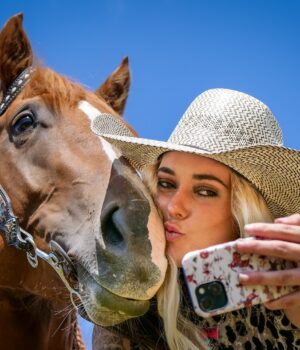
Storm Hogan fixes broken horses for a living.
The ones that shy when you raise a hand, that can’t be caught or ridden. Those hurt so badly they’ve forgotten how to trust.
She works slowly, patiently, until they learn not all humans mean harm.
Storm was just 11 years old when she got her first horse.
She convinced an old farmer to buy her a box of beer with her pocket money, then traded it for a pony born to a mare abandoned in a paddock near her best friend Nat’s place.
Storm and Nat named the pony, born in the middle of the night, Starlight.
Her parents had told her plenty of times: “No horses”. She got one anyway.
The doubters said barrel racing wasn’t a real job. So she made it one.
Everything she has, she took.
“My success is just built on rage — from people telling me, ‘You can’t do it,'” Storm, 22, says.
Storm is part of the new breed of rodeo riders, taking a sport that the RSPCA says two-thirds of Australians are against, head-first into the social media age.
Animal welfare groups say rodeos exploit animals for entertainment, leading to stress, injury and sometimes death.
Storm exposes every element of the sport she loves to her more than 125,000 followers through a curated blend of equine advocacy, rural living, and scantily clad horseback cowboy-core snaps.
Her OnlyFans account is in the top 0.5 per cent of earners on the page. Some months, that income exceeds what she makes retraining horses.
She makes no apologies for any of it.
Storm’s popularity is taking her world to the masses in ways the traditionally niche event hasn’t experienced, bringing with it a new level of visibility.
This ain’t Texas
Rodeo is having a moment.
Kevin Costner and Yellowstone made cowboys cool again. Beyoncé’s record-breaking Cowboy Carter heralded an explosion in western pop culture.
Next thing you know, rhinestones and spurs are everywhere, taking “cowboy core” from pastoral practicality to couture cool.
In Australia, the effect has been fervent and measurable.
Regional rodeos are setting new attendance records left, right and centre, welcoming a new legion of fans in shiny Ariat boots and Akubras.
City folk with their iPhones out, “dressing up like Cowboy Woody”, as one organiser put it.
The Professional Bull Riding (PBR) circuit is selling out big-city stadiums. Fans have jumped from 750,000 in 2017 to somewhere between 4 and 6 million today, according to PBR Australia.
But as rodeo grows, so does its opposition.
The number of Australians who are “concerned or very concerned” about the welfare of rodeo animals grew from 52 per cent in 2015 to 67 per cent in 2022, according to a study of nearly 2,000 people by McCrindle Research.
The RSPCA wants a national ban to align other states with the ACT, which prohibits the event.
“Contemporary animal welfare is about positive mental states,” says the RSPCA’s senior scientific officer, Di Evans.
“We don’t see evidence of any positive mental states in rodeo while those animals are being subjected to that treatment.“
The family business
Ron Woodall’s strong hands fidget, thumbnails clicking, as I rattle through a few warm-up questions.
The sun’s out. A few flies loop overhead lazily.
We chat under his back verandah in Lyons, a dot of a town barely on the map in Victoria’s far south-west.
At 83, Ron’s spent nearly 70 years in the rodeo game.
He has got the solid build of an old cowboy. He hooks his fingers through his belt loops as he walks, his legs still bowed as if he has only just got off a horse.
He’s the patriarch of Woodall Rodeos, one of Australia’s biggest rodeo companies.
The bulls, the horses, the steel infrastructure and hay bales that make regional rodeos happen — that’s Ron. Has been for decades.
“It’ll still be going after I’m gone,” he says with barely a hint of a smile.
There are plenty of Woodalls around to take over when that time comes.
His sons, Jack and Tony, were both champion rodeo riders. His grandson, Sam Woodall, currently stars on the PBR circuit throughout America and Brazil.
Ron loosens up once we hop in his four-wheeler and start fanging around his sprawling property.
The first paddock is pocked with crater-like divots you could fit a small car in. Ron delights in pointing out the biggest ones before we get to a pair of bulls, one caught in the act of creating another car-sized crater — kicking up dust in defiance.
Ron knows them all by name. That’s Point Break. Crossfire. Deadpan. That smaller one’s Cookie Monster.
In all, about 30 of the beasts share a paddock with one white donkey.
Ron says the donkey’s job is to stop the bulls fighting. I ask if he’s any good at his job.
“Nope,” he deadpans.
As we speed through thickets and weeds at perilous speed, a charge of horses thunders up a hill towards a neighbouring pine plantation.
A wedge-tailed eagle circles above. My breath catches.
For the first time, this feels less Stars and Stripes, more Man from Snowy River.
Ask Ron about rodeo’s critics and his jaw tightens.
Like the tales of electric cattle prods, ropes and other cruelties. Bulls forced to buck from rope tied around their testicles.
“That’s the greenies,” Ron says with energetic defiance.
“You can’t hurt a beast. He won’t perform. It’s the same as a racehorse. If he’s hurt, he can’t run.
“If you tied a rope around a bull’s nuts, he’d lie down, he’d be that sore.
“It’s a whole lot of bullshit.“
Ron’s been saying this for 70 years.
Not everyone agrees.
A ‘self-indulgent’ game
Untangling Australian rodeo regulation is a daily frustration for the RPSCA’s Di Evans.
It’s estimated that more than 1,000 rodeo events are held across Australia annually, subject to welfare laws that vary by state.
Rodeos are banned outright in the ACT. Have been for more than 30 years.
In Victoria and South Australia, minimum weight limits essentially ban calf-roping — a timed event where a mounted rider chases, lassos, and restrains a calf.
A short drive over the border into New South Wales or Queensland renders that law meaningless.
“They don’t feel they’re under threat,” Dr Evans said. “They feel quite self-indulgent, I guess, and privileged or entitled.”
“They feel entitled just to continue to do what they’re doing without it being questioned.“
For a brief moment, it looked like the rodeo wheels were falling off in Australia.
The Mount Isa rodeo, the largest rodeo in the Southern Hemisphere, nearly collapsed into debt but was saved by a $2 million injection of state government funding in 2024.
A reduction in funds following the pandemic’s impacts was blamed for the near miss.
Dr Evans says the issue with rodeos isn’t financial or even physical.
It’s the mental suffering caused by the use of gear like flank straps, which she says provokes the iconic “bucking” action.
“Because it’s not positive reinforcement. It’s basically a form of punishment,” Dr Evans says.
“From an ethics point of view, is the harm necessary? Can it be avoided? How’s it justified?”
Those in the sport see it differently.
They say bucking is bred, rather than forced by gear.
“You can’t make them do it … they’re nearly 1-tonne animals, you can’t force them to do anything,” says professional bullrider Sam Woodall, Ron’s grandson.
“It’s just in their bloodlines now … they’re pretty well just bred to buck, and that’s what they love to do.“
The gap between those two views — punishment versus instinct, cruelty versus genetics — is cavernous.
Country roads
Once a year, the tiny town of Branxholme puts on a rodeo. It’s the local footy club’s biggest — and only — promotional event.
The engine behind the madness is Mop Bell.
Her real name is Leonie, but everyone calls her Mop — something about her hair as a kid.
With an hour until the rodeo starts, her walkie-talkie won’t stop crackling.
She’s been moving nonstop for at least two days, staying in a caravan parked in the shade of tall gum trees behind the clubrooms.
This year, the club is fundraising to build new change rooms for female footballers.
But the rodeo’s about more than footy for Mop. It’s about community.
And family.
Mop is Nat’s mum. Storm’s childhood best mate.
Nat died of a non-riding-related brain haemorrhage in 2019, aged 13. She was a barrel racer, too.
Every year since, competitors wear a splash of blue — Nat’s favourite colour.
Nat was the girl who sat with Storm and watched as that foal — the one Storm would trade a box of beer for — was born.
The pair went everywhere together, on horseback more often than not.
When Mop watches Storm now, it’s with a sense of motherly pride mixed with something else.
A tear threatens to break through as she takes a moment.
“It’s sad because you think that’s where she [Nat] would be,” Mop says.
“But you really appreciate that everyone hasn’t forgotten about her, you know?”
Branxholme’s always been a bogey event for Storm.
National titles are won much later in the year, but for Storm, this was the real grand final.
Nearly 40 riders have signed up this year. A record crowd goes silent before the first competitor enters the ring.
Storm and Barbie — her current competitive project, a chestnut mare otherwise known as Southern Eagle — are towards the end of the running list, meaning there’s plenty of time for nerves to build as they circle behind the chutes.
Loading…
The sun sits low as she makes her run. Clumps of sand are kicked high as Barbie stretches around the 40-gallon drums.
When she passes the final checkpoint, the clock stops.
13.006 seconds. A personal best.
Storm is beside herself. Beaming unashamedly.
“She even threw a shoe,” she says to her dad, her brother and her partner Dan, a bronc rider.
They’ve all come to meet her behind the gates.
On the youngest horse in the field, a mare that’s just nine months into competition, she finished fifth.
At Storm’s home event, the place where she and Nat dreamed of dominating when they grew up.
It’s the kind of run that’s eluded them, and one that puts Storm squarely on track for a nationals appearance come the end of the season.
But before she’s had time to soak it in, Storm is back at the chute gates.
The junior girls’ barrel racing is next, and a young rider she has been helping is about to make her run.
Storm grabs the young girl’s horse’s bridle before leaning in with some words of advice. It’s a horse she knows well. Nat’s dad’s horse.
Then, she leads the pair towards the starting gates.
As she makes her run, Storm is cheering her guts out. Screaming for her to stretch. To push. To fly.
The new face of rodeo, working with the next.
Push for legislative change
Rosemary Elliott is well accustomed to a slow burn.
For more than 20 years, she has operated at the sharp end of Australia’s conscience, campaigning against inequalities and cruelties in racing, live export and even domestic pet ownership.
Now, the president of Sentient — the Veterinary Institute for Animal Ethics — has turned her focus to the dust of the arena.
She would be overjoyed if rodeo were banned outright.
Dr Elliott is a former clinical psychologist who retrained as a vet.
She takes that care — for humans and horses, alike — into everything she does.
“If you did to another animal what you were doing to the animals participating in rodeos, there would be cruelty charges,”
she said.
“I mean, throwing an animal down, dragging it by the neck, jabbing it with spurs. Imagine if you did that to another animal?”
Dr Elliott wants legislative protections for rodeos — which exempt certain elements from cruelty regulations — removed.
But it’s not just the animals she’s worried about. It’s the next generation of riders.
“Are the parents fully aware of the magnitude of the risks to the brain health of their children?” she said.
It’s mandatory for juniors to wear helmets at Australian rodeo events.
No restrictions apply beyond that.
“What responsibility should the rodeo industry have in safeguarding the health and safety of children?”
Dr Elliott said.
The PBR circuit is the commercial apex of the sport, owned by TKO Group Holdings, the same multi-billion-dollar company that manages the Ultimate Fighting Championship (UFC) and World Wrestling Entertainment (WWE).
It’s also focusing on the next generation, albeit with a different lens.
PBR runs academies for kids as young as seven, pairing them with mentors who help fast-track their professionalisation and development. It’s less country kids hopping on a wild bull, more professional athletes learning the ropes.
Glenn Young, PBR Australia’s managing director, says the welfare scrutiny that once threatened his industry has largely evaporated.
“In the last two years, I may have had one email,” he says of animal welfare complaints.
“Every event we run, you can see cameras in the backyards, cameras in the chutes.
“We don’t hide anything.“
Young speaks glowingly of commercial deals and training academies, dreaming of a free show at the MCG, packed to the brim. For him, the spotlight isn’t a threat. It’s the product.
“The more you put it in their faces,” he says, “the more people are getting interested in it.”
Making her mark
At Storm’s Port Fairy home, the salt air occasionally cuts through the smell of horse.
On a whiteboard in the lounge, her ambitions are laid bare: a handwritten list of placings and points required from the rodeo circuit before the nationals.
Loading…
But Storm isn’t just hunting buckles or a title.
She wants a dynasty.
“I want to go to the Australian finals and see my brand on a horse and be like, that’s my horse,” she says.
“To say I’ve bred these horses. And now there’s these young cowgirls riding it and winning on it.”
She also wants to do it for Nat.
Her best mate.
“Without her, I wouldn’t be where I am now,” she says.
Her old mare Starlight is still alive and kicking, living out her retirement dreams with Storm’s parents near Branxholme. She’ll get down to Storm’s place in Port Fairy soon enough.
Storm carries those memories of Nat, of Starlight being born, her first fall and her first win, all together like a talisman. A reminder of where unrelenting determination gets you.
Storm Hogan is not a woman built for compromise.
She has turned being told “no” into a brand, a calling, and a pay cheque.
Whether the sport she loves will grow with her, or eventually collapse under the weight of the scrutiny she brings, is a question for another day.
She has horses to train.
Credits
Words, pictures, video and digital production by Daniel Miles.
Subediting by Alison Middleton
Illustrations by Sharon Gordon


