
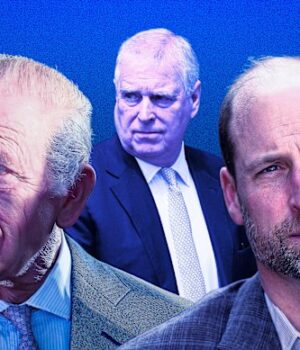
SOURCE :- THE AGE NEWS
London: Standing outside Buckingham Palace, British visitors to London’s royal precinct had a swift response to the arrest of Andrew Mountbatten-Windsor. First, they welcomed the news. Next, they had a question about the authorities: what took them so long?
“I think it should have happened a long time ago,” said Mark Hoskins, an office worker from Bristol on a visit to the capital on Thursday afternoon (London time). “They should have thrown him under a bus when it all came out years ago.”
James Burnett, a builder from Warwickshire, had the same sense of doubt about the time taken to hold the former prince to account. “It’s been a long time coming,” he said. “There was a lot of unfair protection.” In other words, this suspect was shielded from scrutiny for too long.
There is no sympathy for Mountbatten-Windsor. His arrest earlier on Thursday has come years after the revelations of his ties to sex offender Jeffrey Epstein, and years after the publication of the notorious photograph showing him with his hand on the waist of Virginia Roberts Giuffre, who accused him of sexual assault.
Born into privilege, he is now a pariah. So, what happens next in the investigation into his past? And will any of it go before a court of law in the future?
Mountbatten-Windsor looked stunned by the cold reality of police custody when he emerged from more than 11 hours of detention. He slouched in the back seat of a vehicle to try to avoid being photographed as he was driven away from a Norfolk police station.
Thames Valley Police did not name him in an official statement, but confirmed the arrest of a man “in his sixties” on suspicion of misconduct in public office. “The arrested man has now been released under investigation,” the police said. There was no mention of any charges.
Police have searched Mountbatten-Windsor’s former home, Royal Lodge at Windsor, and his temporary home at Wood Farm in Sandringham (before he moves to another home on the same country estate). The sheer length of custody on Thursday suggests the police had a long list of questions.
As the inquiries continue, more will emerge. We will find out more about Mountbatten-Windsor’s work as a trade envoy for the British government and how this gave him access to foreign leaders, diplomats, business chiefs and investors. We will find out more about the documents he received, and which ones he forwarded to Epstein.
This shifts the focus from Epstein’s sexual abuse and the accounts of women such as Giuffre. In a sense, that is because the most recent disclosures from the US Department of Justice, with millions of files released in searchable chaos, shed so much light on the way Epstein assembled a network of people with influence.
Epstein did not just message his contacts about girls. He messaged about money, and deals, and information. Those who traded with Epstein in this way are now being caught out – including former British cabinet minister Peter Mandelson and a chorus line of former political leaders and business chiefs.
The former Prince Andrew was part of this network. And he had useful information for at least a decade. He was made the UK’s special representative for international trade and investment in 2001, upon his retirement from the Royal Navy. He kept that post until 2011, when the first wave of the Epstein scandal forced him out.
His decade in that post gave him access to the diplomatic corps in an official role that added to his royal status, opening doors to investors around the world. It also coincided with his friendship with Epstein, whom he had met in 1999.
The case against Andrew
One document highlights the way Mountbatten-Windsor got in touch with his friend as soon as confidential information came his way. In October 2010, he made sure that Epstein knew the details of a trade mission to Vietnam, Singapore, Hong Kong and Shenzhen. On November 30 that year, he received a set of “visit reports” from one of his advisers about each location. He forwarded these documents to Epstein five minutes after receiving them.
Thanks to the BBC, which found these emails in the US Department of Justice searchable archive, we can see this example of the tight links between the two men. But we cannot see the documents because the attachments were not released.
Given this was almost 16 years ago, one of the challenges for the police investigation is to find out more about the documents being sent to Epstein and estimate the financial value of the information.
Later in 2010, he was in touch with Epstein about investments elsewhere. On Christmas Eve, at 3.24 in the afternoon, Mountbatten-Windsor sent Epstein a government document about opportunities in Helmand province in Afghanistan.
“Attached is a confidential brief produced by the Provincial Reconstruction Team in Helmand Province for International Investment Opportunities,” he wrote. “I am going to offer this elsewhere in my network (including Abu Dhabi) but would be very interested in your comments, views or ideas as to whom I could also usefully show this to attract some interest.”
Again, the Department of Justice files do not appear to include the attachments to the message. It will be up to British investigators to see if they can find this document and others in UK government files, or can get them from the US authorities.
What other information did the trade envoy share with his friend in New York? Was there a pattern of regular contact to forward British government documents? Everything depends on how much the British investigation can uncover about the number of documents exchanged, the importance of those documents, and any evidence from officials that might support a case that this amounts to misconduct in public office.
Without that evidence, the concerns about Mountbatten-Windsor may fall short of the key tests in the British law regarding misconduct in public office – such as the requirement that a suspect “wilfully neglects” to perform their duty.
This means Mountbatten-Windsor may be remembered as the former prince who was arrested on suspicion of misconduct, rather than being charged with misconduct, let alone being found guilty of it in a court of law.
A man shunned
But this is only one line of inquiry into Mountbatten-Windsor. The claims against him by Giuffre who took her own life in Western Australia last year, still hang over him despite his financial settlement with her four years ago. Members of the US Congress still want him to appear before their inquiry into Epstein.
The Metropolitan Police in the UK are carrying out initial inquiries into whether Mountbatten-Windsor asked members of his personal security team, while Duke of York, to look into Giuffre in an attempt to discredit her.
The concerns about Mountbatten-Windsor appear to worry a former prime minister, Gordon Brown, the Labour leader in Number 10 Downing Street from 2007 to 2010. Already incensed at the way Mandelson shared information with Epstein, Brown made another statement hours after the arrest at Sandringham.
“I have submitted a five-page memorandum to the Metropolitan, Surrey, Sussex, Thames Valley and other relevant UK police constabularies,” Brown said. “This memorandum provides new and additional information to that which I submitted last week to the Met, Essex and Thames Valley police forces where I expressed my concern that we secure justice for trafficked girls and women.”
Brown did not name Mountbatten-Windsor, but he has raised concerns in recent days that Epstein had regular access to Stansted Airport, outside London, for the private jet that became known as the “Lolita Express” because of the young girls it carried as passengers. The BBC reported last year that there were at least 87 flights linked to Epstein through UK airports including Stansted. There is still more to be investigated about the most alarming of all the aspects of Epstein’s sordid career: the reports of trafficking in girls and young women.
Mountbatten-Windsor can still be drawn into the inquiries into Epstein’s network, although the latest documents raise questions about personal behaviour rather than being proof of wrongdoing. There is the photo of the prince, as he was at the time, on all fours over a woman lying on a floor. There is the email from Epstein in August 2010 saying he has a friend – her name is redacted – who would like to have dinner in London. “She 26, russian, clevere beautiful, trustworthy,” Epstein writes, in his usual haphazard way.
One day the emails were about documents, the next they were about girls.
What next for the royal family?
The drama of the arrest at Sandringham was followed by business-as-usual at Buckingham Palace. The word from the palace was that the police had not given the royal family any advance notice that the King’s brother would be arrested, although it emerged later that the police told the Home Office. The most important message was that King Charles and Queen Camilla stuck to their scheduled events.
This led to the jarring contrast of the King attending a fashion event in London, and the Queen meeting fashion magazine editor Anna Wintour, while Mountbatten-Windsor was photographed leaving a police station. But the contrast was the point because the objective was to isolate the former prince and show the royal family will continue in an entirely different world.
The King took time to decide on this course. He took no action for much of last year, before arranging on October 17 for his brother to voluntarily give up his titles, such as the Duke of York. With more claims emerging, including in a memoir by Giuffre, the King took the tougher approach of stripping his brother of his remaining titles on October 31.
There has been no similar reluctance this year to be firm. On February 10, Charles approved a statement saying he would assist police if asked to help with any inquiries into Mountbatten-Windsor. Nine days later, soon after the arrest, he issued a statement in his own words expressing his concern about the arrest and promising “full and wholehearted” cooperation.
He referred to Mountbatten-Windsor without calling him his brother. And he concluded with this: “Meanwhile, my family and I will continue in our duty and service to you all.” The subtleties send the message that the former prince is no longer in the family.
But nobody should be leaping to conclusions about the decline of the monarchy.
Yes, the public has turned on Andrew. He is disliked by 76 per cent of British voters, says polling firm YouGov. But he no longer has any royal duties and has been stripped of his titles. And Charles remains immensely popular.
YouGov finds that 60 per cent of British voters have a positive view of the King, while 31 per cent have a negative view. This has been relatively steady over the past year of royal tumult. And the next royal generation is immensely popular, with 77 per cent of voters having a positive view of Prince William and 74 per cent being positive about Princess Catherine.
“Overall, there’s little desire to see the monarchy come to an end,” says YouGov. It finds that 64 per cent of Britons believe the UK should continue to be a kingdom, consistent with findings throughout Charles’ reign.
The British public can condemn the man they once knew as Prince Andrew at the same time they support the King and the monarchy.
Neil Gorton, a scientist from Manchester on a visit to London, said the authorities should not spare Mountbatten-Windsor. “If he’s guilty, then he deserves everything he gets under the law,” he said, as he stood near the gates of Buckingham Palace. But he added that this did not tarnish the King and Queen inside the palace gates.
“There’s always a black sheep in every family,” he said. And his support for the monarchy? “100 per cent.”
 David Crowe is Europe correspondent for The Sydney Morning Herald and The Age.Connect via X or email.

