
Source : INDIA TODAY NEWS
By the start of 2006, Tamil Nadu’s familiar two-cliff politics had acquired a small but noisy new complication. Between the two old precipices, where voters had long perfected the art of leaping from one certainty to another, Vijayakanth had now climbed onto a protruding rock, folded his sleeves, and begun signalling to the crowd that there might, after all, be another way down. Whether anyone could actually descend that route was a separate matter. But the gesture itself had altered the view.
advertisement
What followed in 2006 was not merely another election. It was the beginning of a new political grammar — one in which ideology increasingly came gift-wrapped, governance became measurable in household inventory, and the voter was no longer addressed merely as citizen, community or cadre, but as beneficiary, consumer and occasional shareholder in the democratic bazaar.
This was the foundational season when welfare stopped being merely paternal and became aggressively transactional. Tamil Nadu would later perfect this culture until it grew into today’s comic-monstrous free-for-all, where fiscal prudence often arrives only after the treasury has already been politely mugged.
Into this changing landscape returned M. Karunanidhi — old fox, seasoned administrator, compulsive writer, and now, once again, chief minister. But if his comeback seemed orderly from the Fort, the years that followed would reveal a slower disturbance underneath: a government run with procedural polish, and a party increasingly pulled by family gravity, territorial ego and inherited ambition. Administration would continue. But so would the approaching storm.
Verdict Without Victory
The 2006 assembly election did not produce a landslide. It offered something more interesting — a fractured verdict that looked unstable on paper but proved, for a time, surprisingly manageable in practice.
The DMK-led alliance, stitched together with the Congress, PMK, the Left parties and others, secured enough numbers to form the government, but the DMK itself won only 96 seats in the 234-member assembly. It was therefore not a majority government in the old commanding sense. It was a minority administration held upright by alliance arithmetic, legislative discipline and the shared fear among allies that fresh elections would benefit no one except perhaps poster printers and microphone suppliers apart from the opponent.
Jayalalithaa’s AIADMK, though defeated, was not routed. She remained very much in the game, and the verdict was narrow enough to deny Karunanidhi the swagger of overwhelming triumph. It was a comeback, yes — but not a coronation.
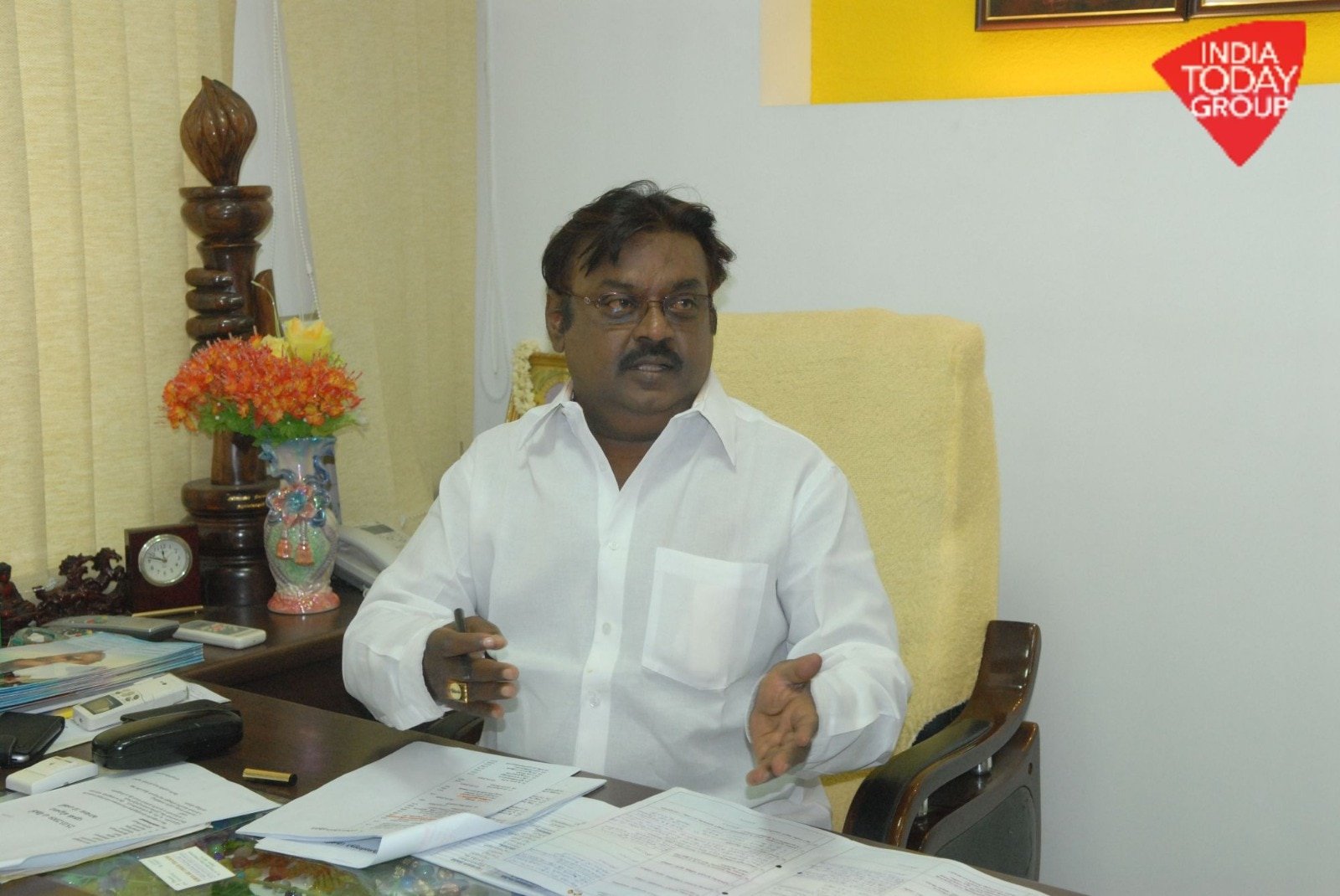
Vijayakanth was the rare outsider who didn’t just enter Tamil Nadu politics – he unsettled its certainties.
And then there was Vijayakanth, whose DMDK, contesting on its own and dismissed by many as an extended fan-club experiment, polled a striking vote share of over 8 per cent and even won a seat for its leader from Virudhachalam. In a state where third forces usually arrive with enthusiasm and leave with deposit slips or even lose that, this was no small disturbance. He had not broken the duopoly. But he had nicked it.
Thus, the 2006 result did not merely choose a government. It delivered a message in multiple dialects. The voter had restored Karunanidhi, retained Jayalalithaa, and reserved a corner glance for Vijayakanth. It was as though Tamil Nadu had said: ‘We still trust the old operators to run the machine. But do not assume we are not shopping’.
Coalition Outside, Entitlement Inside
Karunanidhi’s return also produced one of those contradictions Indian coalition politics serves with a straight face and expects no one to laugh at.
In Delhi, the DMK had long perfected the art of coalition entitlement. It wanted ministerial weight, portfolio dignity, bureaucratic leverage and federal respect in full measure. It did not merely support governments at the Centre; it expected suitable upholstery in return.
But in Chennai, after 2006, Karunanidhi did something rather different. Though his government depended on the support of allies, he kept them out of the state cabinet. The Congress, PMK and others were useful enough to prop up the structure, but not fit enough, apparently, to be invited into the kitchen.
It was a masterclass in asymmetrical coalition ethics. In Delhi, power-sharing was federal fairness. In Tamil Nadu, outside support was democratic maturity. Karunanidhi, an adept of forked tongue, sold both propositions with his usual ease, and his allies, for reasons ranging from pragmatism to fear of premature elections, largely swallowed the arrangement.
This was vintage Kalaignar. He had not merely formed a government; he had formed one on terms that preserved maximum room for manoeuvre. The minority ministry thus functioned less like a vulnerable arrangement and more like a carefully managed leasehold, renewable so long as everyone remembered who owned the building.
The Freebie Republic Begins
If the numbers were fractured, the political imagination was not. The 2006 election marked the first full and unapologetic flowering of what would become Tamil Nadu’s most enduring and imitable political export: the freebie state.
To call these promises merely ‘welfare’ would be too polite. Welfare, at its noblest, seeks to repair structural and societal inequality. What emerged from 2006 onward was something more inventive and electorally seductive — a politics of direct household enticement, where the manifesto became a catalogue and governance began to resemble direct-to-home distribution.
The emblematic promise was the free colour television. It was instantly mocked by some as frivolous, defended by others as cultural access, and understood by Karunanidhi for what it really was: a brilliant political instrument. The television was not just an appliance. It was a glowing rectangle of presence inside the home, a permanent reminder that the state had not merely spoken to the poor but entered the living room.
Alongside it came rice at subsidised rates, housing and benefit expansions, and a broader architecture of direct material promise. The DMK did not invent welfare in Tamil Nadu — no party here can make that claim with a straight face — but it certainly helped transform it into a more inventive and competitive format, where the line between social justice and consumer entitlement grew increasingly decorative.
There was political intelligence in this. Tamil Nadu had long been a state where governance was judged not by abstract reform discourse but by visible touchpoints. Karunanidhi understood that if the voter now expected delivery, one might as well deliver memorably.
But this was also the moment when democratic aspiration began tilting, ever so steadily, from ideology to inventory. Elections were no longer merely about what a party believed or even what it built. Increasingly, they became contests over what might physically arrive at one’s doorstep. Once opened, that portal would never really close. By the following decades, every party would be queuing up outside it with fresh parcels and fresh fiscal irresponsibility.
The republic of rights had morphed into a republic of receipts.
Schemes, Statutes & the Soft Return of Order
To stop at freebies alone, however, would be to miss why Karunanidhi remained such a formidable operator.
His return in 2006 was not built solely on promises. It was also built on a residual and not entirely undeserved public memory: that when it came to administration, file movement, urban planning instincts, industrial signalling and bureaucratic continuity, he could still make the state look governable.
He was not a dramatic ruler in the Jayalalithaa mould, where authority arrived with spectacle, pause and command. Karunanidhi’s strength lay elsewhere. He governed through a combination of political intelligence, procedural familiarity and relentless engagement with the machinery of state.
He liked institutions, committees, schemes, legislative process and administrative layering — not because he was above politics, but because he understood that durable politics often requires paperwork.
Thus, the early phase of the 2006 regime carried a certain steadiness. The bureaucracy, whatever its private calculations, knew the old hand was back. Files moved. Welfare schemes were rolled out with discipline. The government projected itself as practical, engaged and responsive.
The Samacheer Kalvi idea had not yet matured into later implementation, but the larger instinct toward educational equalisation, welfare reach and social access was already visible in policy thinking. Urban and infrastructure ambitions continued to receive bureaucratic attention. The state’s industrial image, carefully cultivated across previous DMK tenures, remained in service.
There was still enough faith in Kalaignar the administrator to offset, for a while, the slower discomforts gathering around Kalaignar the patriarch. That distinction will matter greatly in the very immediate future.
A Quiet City, Loud Household
Yet even as governance regained rhythm, the DMK itself was beginning to sound less like a movement and more like an increasingly crowded ancestral property with multiple claimants, each insisting they were merely rearranging the furniture for the good of the family.
For years, Karunanidhi had balanced competing centres within his domestic-political universe through a mixture of timing, ambiguity and paternal choreography. But by 2006, the old hold was beginning to strain.
At one end stood M.K. Stalin, the patient organisational climber, long schooled in party structure, cadre craft, municipal grooming and the slow, respectable route to succession. At the other stood M.K. Alagiri, the southern power centre — less institutional, more elemental, a man whose authority did not derive from committee rooms or policy notes but from territorial loyalty, fear, personal networks and the kind of command that does not need a microphone, but muscle, to be understood.
Between them sat the father, still in control but increasingly required to balance not merely ambition, but geography, ego and style.
The DMK had always been many things — ideological vehicle, social justice platform, electoral machine, literary-political enterprise. It was now also becoming, more visibly than before, a question of inheritance.
The Madurai Muscle
If Stalin represented continuity, Alagiri represented force.
His rise had been building in the background for years, but by 2006–07, it could no longer be treated as a local eccentricity confined to the southern districts. Madurai and its surrounding belt had effectively become Alagiri country — not formally separate from the DMK, but operating with enough independent might, influence and fear to resemble a regional satrapy under the broader family umbrella.
This was not just about image. It was visible in candidate selection pressures, district appointments, local police behaviour, and the unspoken but widely understood hierarchy of who mattered in the southern belt. Ministers, functionaries and petitioners learnt quickly that formal party structure and actual field authority were not always the same thing. If Chennai issued the circular, Madurai sometimes interpreted the mood.
Alagari was not, in the conventional sense, a polished politician, neither did he pretend to be one. He did not cultivate the image of administrative modernity or legislative finesse. He did not need to. His power came from a different grammar — direct loyalty, local dadagiri, factional discipline and a command style that was earthy, immediate and unmistakably territorial. If Stalin was the file, Alagiri was the fist.
Alagiri’s arrival was marked by a strange thunder. Tamil Nadu politics has seen strict district strongmen before. But this was different. He was not a mere regional heavyweight. This was the son of the Chief Minister arriving not through a formal party ladder but through accumulated brawn and unavoidable relevance. He did not seek entry through the front door. He made the building acknowledge that he was already inside.
Karunanidhi, who understood the danger of pretending not to notice reality, chose not to confront the southern surge directly. Instead, he did what he often does best: he absorbed it, delayed formal resolution, and hoped management could substitute for settlement. And for a while, it did.
A Movement of Pen, Power & Pressure
This was the subtle but important transformation of the DMK in this period. It remained, outwardly, a party of speeches, symbolism, social justice inheritance and welfare politics. But beneath that familiar surface, it was also becoming something rougher — a formation where literary pedigree, media capital and district muscle increasingly coexisted, not always comfortably, but effectively enough to win.
One might call it a party of pen, power and pressure.
Karunanidhi’s own legitimacy still rested on the older grammar — words, welfare, governance, negotiation, institutional presence. But some of the energy beneath him was now coming from different sources: the urban succession project around Stalin, the media-financial confidence of the Maran ecosystem, and the territorial assertion of Alagiri in the south. These were not just personalities. They were rival styles of future DMK power, all cohabiting under one ageing patriarch.
The contradiction, first visible, eventually turned vicious.
The Dinakaran Detonation
That trouble arrived in dramatic and deadly fashion in May 2007. A survey published in Dinakaran, a newspaper associated with the Maran family, reportedly suggested that Stalin was the overwhelmingly preferred successor to Karunanidhi, while Alagiri drew negligible support.
More provocatively, the survey also reportedly showed Dayanidhi Maran himself enjoying significant popularity — enough to suggest that the paper had not merely advertised Stalin but gently hinted that the future might be broader than the bloodline directly under siege. In a party already humming with dynastic static, this was not reportage. It was petrol with typography.
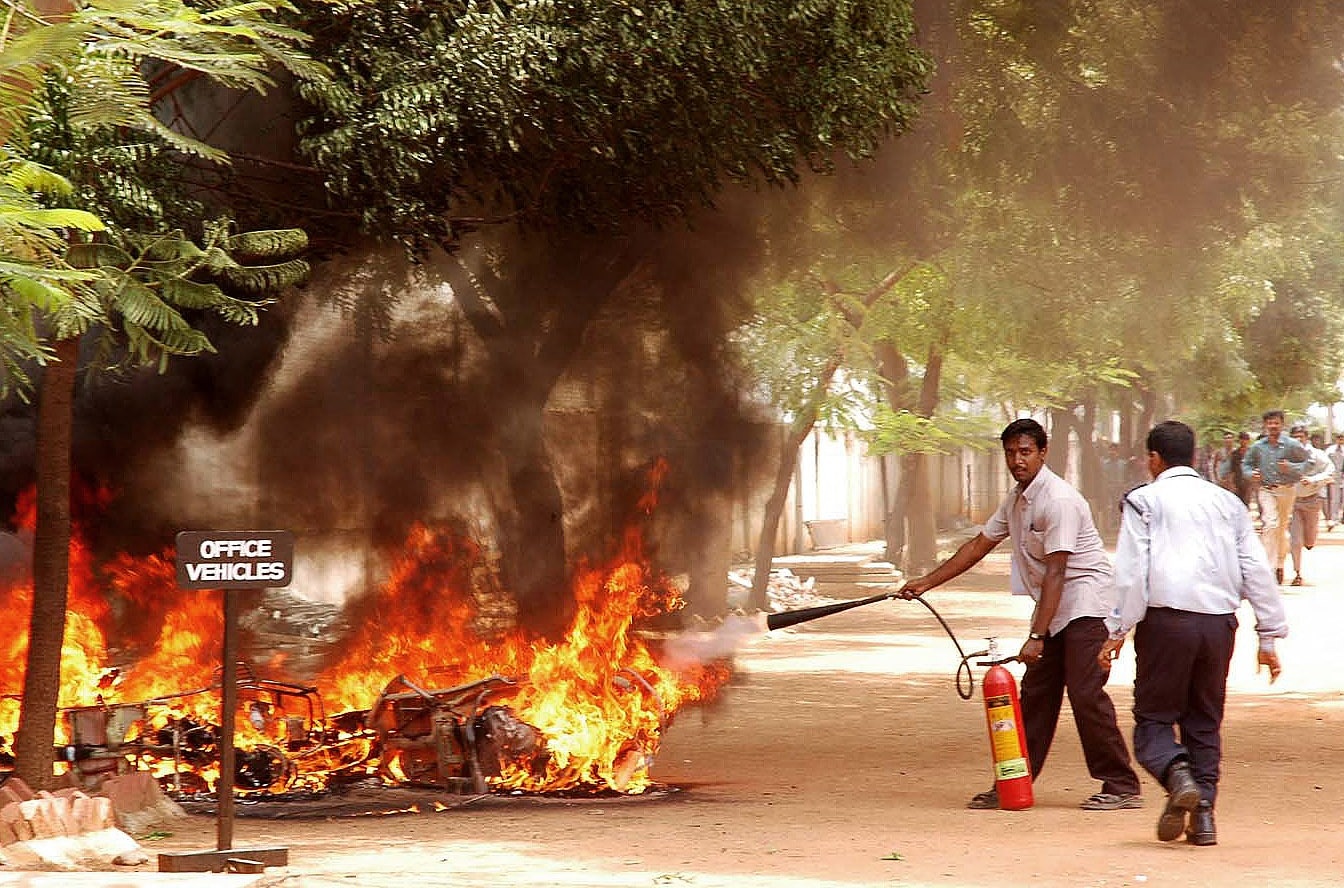
Security personnel and bystanders battle flames outside Dinakaran office in Madurai after a violent political attack, May 9, 2007. (Photo: AFP)
On May 9, 2007, the Dinakaran office in Madurai was attacked and set ablaze. Three employees were killed. They were not pollsters, powerbrokers or succession conspirators. They were workers caught in the inferno of a family feud disguised as party sentiment.
The horror of the incident lay not merely in the violence, but in what it revealed. The DMK’s internal tensions were no longer whispered. They were now combustible. The succession question had escaped the living room and entered the newsroom with explosive fuel.
For Karunanidhi, this was a deeply uncomfortable moment. The attack could not be shrugged off as opposition propaganda or routine district roughness. It was too naked, too embarrassing and too morally compromising. The old image of the DMK as a disciplined ideological machine had suffered one of its sharpest blows.
And yet, even here, the family logic remained operative. Accountability would be calibrated. Outrage would be managed. Relationships would be adjusted rather than conclusively severed. The larger imperative was not merely justice, but containment.
This was the point at which the public began to understand, more clearly than before, that the DMK’s future would not simply be about policy, governance or electoral arithmetic. It would also be about which branch of the household could bend the party without breaking it.
Marans Learn the Weather
The Dinakaran attack did not merely expose a feud. It reordered the family fortunes, in every sense.
Until then, the Maran brothers had occupied a uniquely influential place within the wider DMK ecosystem — politically useful, media-savvy, commercially ambitious and institutionally embedded. Their influence did not rest on muscle, but on something arguably more modern and, in Chennai’s elite circles, more intimidating: television, newspapers, reach, money and access.
Sun TV, which had long enjoyed a symbiotic and politically useful relationship with the DMK, had effectively functioned as one of the movement’s most powerful electronic amplifiers. The old arrangement had been simple enough: the party had politics, the Marans had transmission.
But after Madurai, the message was unmistakable. In the hierarchy of family power, media influence could still be humbled by territorial force. The Marans had not merely published a provocative survey. They had, perhaps unintentionally, tested the limits of the southern landmine— and the reply arrived in bursts and smoke.
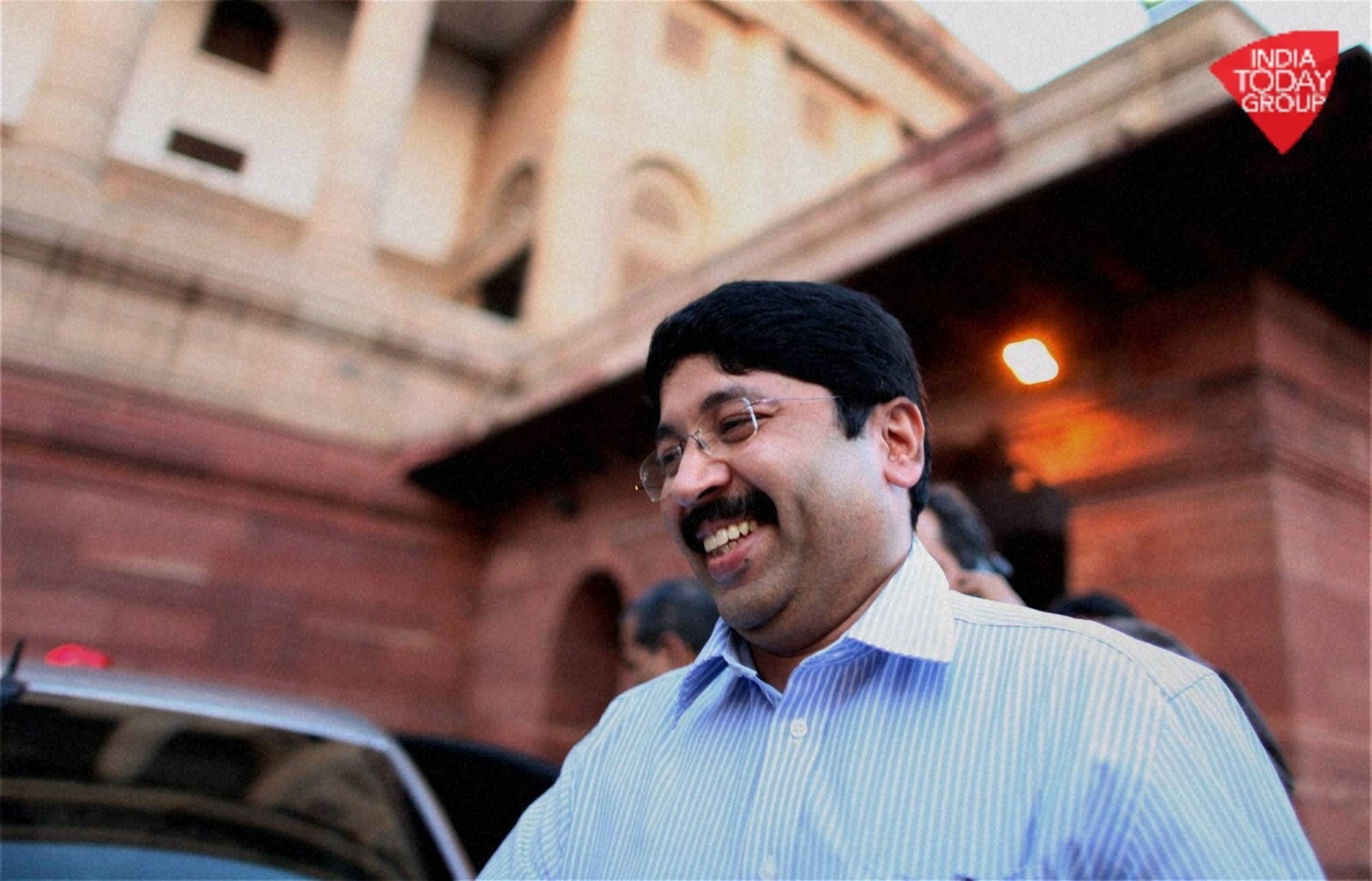
Dayanidhi Maran stands as the technocratic face of the Karunanidhi clan.
The fallout was swift. Dayanidhi Maran, then a Union Minister and one of the most visible younger faces associated with the DMK’s Delhi stature, had to quit the Union Cabinet. The break was not merely political. It was domestic, strategic and commercial. The old compact no longer held with the same ease.
What followed was equally revealing. Sun TV, which had operated from Arivalayam, the DMK headquarters in Chennai, now had to cool its heels outside the immediate sanctum. And in due course, the first family responded not with grief, but with competition. Kalaignar TV emerged as a new broadcast instrument — not just a channel, but a declaration that if media power could no longer be comfortably outsourced to the extended family, the immediate family would build its own antenna.
Karunanidhi, in effect, had been forced into a choice between son and nephew, and he chose the former. The Marans were not exiled from relevance altogether — no one with that much reach vanishes so neatly — but they had clearly been told to step away from the warmest circles of power and fix themselves elsewhere. Thus, the Dinakaran episode did not merely expose a feud. It reset the household seating plan. And those three killed in the heir-splitting did not get justice; instead the state got a new channel!
Stalin Waits as Alagiri Rises
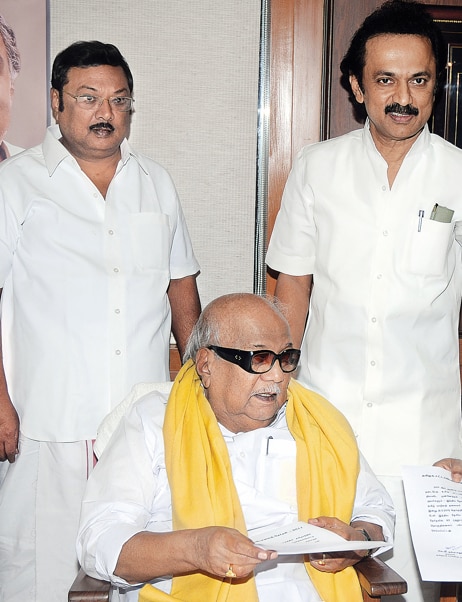
Karunanidhi with sons M. K. Stalin and M. K. Alagiri – a family frame where legacy, rivalry and succession quietly collide.
If Alagiri’s rise was loud, Stalin’s was of a different texture — slower, more procedural, and perhaps more durable for precisely that reason.
By 2006–07, Stalin had already accumulated years of municipal and organisational experience. He had served as mayor of Chennai, built a visible urban profile, and cultivated the image of a leader who understood both governance and party discipline. He was not universally loved within the movement, but he was legible to it. He looked, in many ways, like a succession in formal attire.
And that was precisely why the Alagiri factor mattered so much. Stalin could inherit the structure. Alagiri could disrupt it.
Karunanidhi’s challenge, therefore, was not simply to choose between sons. It was to prevent the party from becoming a public battleline of bloodlines before the succession had even formally begun. He managed this through a familiar family-statecraft formula: delay the final question, distribute relevance, and keep each claimant important enough not to rebel completely.
It was a tactic, not a solution. But in the short term, it worked.
Delhi as Family Extension
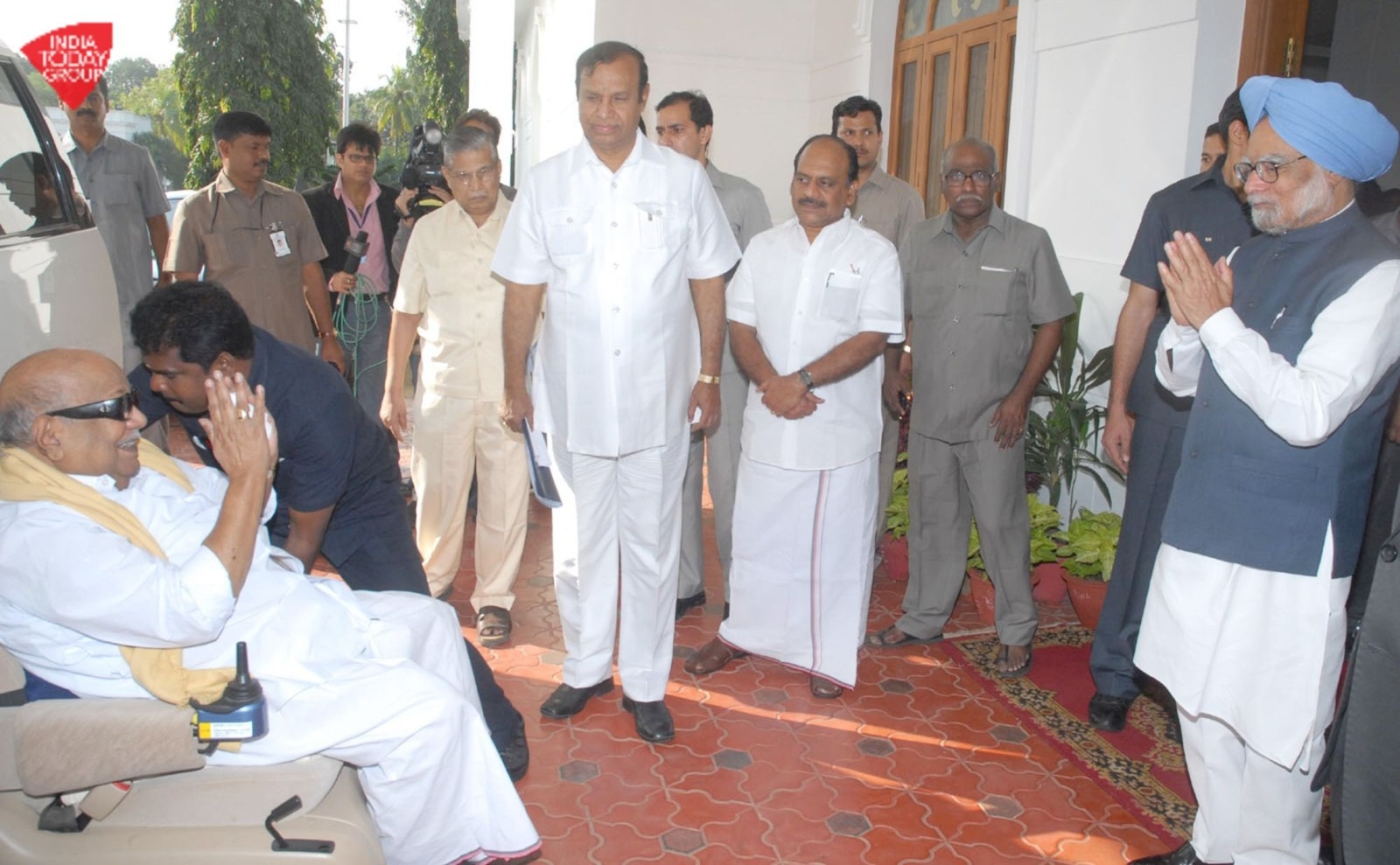
File photo of M. K. Karunanidhi with Manmohan Singh – allies in power and partners in coalition-era politics.
Meanwhile, at the Centre, the UPA government under Manmohan Singh offered Karunanidhi exactly what he valued most in Delhi: space, leverage and a prime minister too institutionally decent to turn coalition management into open warfare.
This was the age in which Tamil Nadu’s ruling party did not merely participate in Delhi — it increasingly treated Delhi as an extended negotiation chamber for state influence, portfolio relevance and family accommodation.
The mock-serious comedy of coalition politics had by then reached near-operatic levels. National governments were assembled with solemn declarations about secularism, stability and common minimum programmes, only to be sustained in practice through a far more practical set of concerns: ministries, files, influence, protection, access and the occasional ego massage performed at appropriate altitude.
Karunanidhi was particularly proficient at this form of politics because he understood a truth many northern parties kept rediscovering too late: in the coalition age, arithmetic is ideology’s landlord.
And so, even as he kept allies outside the state cabinet in Chennai, he remained fully alert to the uses of central participation in Delhi. If that looked contradictory, it was only because one was still attempting to apply moral symmetry to Indian coalition behaviour.
Jaya Watches, Sharpens Wits
Through all this, Jayalalithaa remained what she is often in opposition — quieter than expected, but far from irrelevant.
The 2006 defeat had not destroyed her. If anything, it had once again forced her into the mode she often handles best: concentrated recovery. She watched Karunanidhi’s two-digit government from the outside, waited for contradiction to ripen, and never missed a chance to mock it precisely as that — a minority government surviving on borrowed crutches while pretending to walk on its own legs.
The phrase became one of her recurring needles. She deployed it with relish, as both a constitutional jab and a political insult. For her, the DMK ministry was not merely numerically dependent; it was morally incomplete.
She had, by then, acquired a peculiar political resilience. Each defeat seemed to make her look, temporarily, more isolated. But it also tended to sharpen her. She did not need daily applause to remain viable. She only needed the ruling side to overplay its hand.
And the DMK, by 2007, was beginning to provide her with material.
The Tipping Phase
Looking back, 2006–07 now appears less as a routine chapter and more as a structural hinge in Tamil Nadu politics.
This was the phase in which freebie politics acquired durable legitimacy and quietly rewired public expectation. A minority government discovered that it could still govern with surprising confidence so long as arithmetic held and allies were kept sufficiently fed, though not necessarily seated. Vijayakanth announced himself not as a saviour, but as a nuisance with potential — a useful category in any mature democracy.
Most importantly, the DMK’s family faultlines moved from drawing-room rumour to public consequence. The old man still held the reins, but inside the ruling household, succession had ceased to be a future problem. It had become a current event with smoke damage. The redoubtable Kalaignar was being compromised by kinship.
And once the family at the helm begins producing headlines faster than its government, time itself becomes an opposition leader.
By the end of 2007, the state still looked orderly enough. But beneath the order, cash was learning to campaign, the clan was learning to fight in daylight, and the southern storm had only just cleared its throat.
Next | Thirumangalam, Telecom, Tamil in Delhi & Travel of Law
SOURCE :- TIMES OF INDIA


