
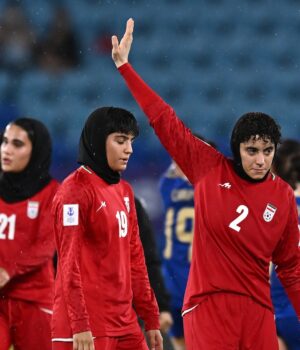
Source : ABC NEWS
There is an increasing sense of desperation and urgency among the Iranian Australian community to hear from Iran’s women’s footballers before the team leaves Australia.
The Lionesses lost their final game of the Women’s Asian Cup on the Gold Coast last night, and while it is unclear when exactly they are due to leave, there are concerns they will be punished when they return to Iran.
The players were labelled “traitors” on Iranian state TV for not singing the national anthem before their first match, as it came two days after the assassination of Ayatollah Ali Khamenei.
They subsequently sang and saluted the anthem at their next two matches.
Demonstrators surrounded the team’s bus as they left the stadium last night, chanting “lion and sun girls we support you”.
Some banged on the side of the bus saying “let them go”.
The lion and sun flag was used before the Islamic revolution in 1979 and is used as a symbol of opposition to the current regime.

Supporters approached the Iranian women’s team bus after their final game on the Gold Coast. (AAP: Dave Hunt)
Hadi Karimi is a Brisbane-based human rights activist and was part of the demonstrations.
“We surrounded the bus,” he said.
“We asked police to save their lives; their lives are in danger.”
Mr Karimi was emotional as he spoke about the situation, pleading with the Australian government and the public.
“The world should stand with Iranians now. I have been threatened with death in this country, in this city, because I am a human rights advocate, because I am a voice of the voiceless. Australia, wake up now,” he said.
It has been difficult for anyone to make direct contact with the players due to the security presence surrounding the team.
Masoud Zoohori runs a Persian-language broadcasting service called Radio Neshat out of Melbourne and has been following the tournament.
He said he was in communication with the athletes until Saturday, but they were under strict surveillance by someone he alleged was a representative of the Islamic Revolutionary Guard Corps’s (IRGC) intelligence service.
The ABC has contacted Home Affairs for comment.
The IRGC is listed as a terrorist organisation in Australia, and under Australian law, anyone with known links to the service would not receive a visa, and those found to have links while here would be deported.
“The girls are very worried; the girls are very stressed,” Mr Zoohori told ABC News in an interview in Farsi.
“They’re scared. They didn’t sing the national anthem the first match [and could face arrest upon returning home].”
Iran players did not sing the national anthem before their first game, seen as a silent protest against the regime. (Getty Images: Albert Perez)
“They told me, ‘It’s like we’re in prison … we’re constantly under control. We don’t have any word from family back home. They won’t let us leave the hotel alone. We’re under a lot of pressure.'”
He said when he tried to talk to the athletes on Friday and Saturday, the hotel security asked him to leave.
“The girls had a hard time speaking,” he said.
“They said, ‘We’re upset … they won’t let us leave; we’re constantly under control.'”
He fears the athletes will now be sent to another country before being sent to Iran. Flights to Iran have stopped due to the war.
Marziyeh Jafari spoke after the team’s final game last night. (Getty Images: Albert Perez)
Coach says ‘we want to come back’
Iran’s coach Marziyeh Jafari, who has carefully guarded her comments throughout the tournament, shared her thoughts after the game.
“We want to come back to Iran as soon as we can, and I want to be with my country and with all Iranians inside Iran. We are eager to come back as soon as we can,” she said, speaking through an interpreter.
Reza Pahlavi is the exiled crown prince of Iran, who is seen as a rallying but sometimes polarising figure for opponents of Iran’s regime.
He has posted on social media saying the team members are under “significant pressure and ongoing threat from the Islamic Republic”.
“I call on the Australian government to ensure their safety and give them any and all needed support,” he wrote.
Loading Twitter content
Speaking to ABC Insiders over the weekend, Foreign Minister Penny said “we stand in solidarity” with the Iranian people, but would not comment specifically on the team’s situation.
Over the weekend, a group of Iranian Australians started a petition asking the government to protect the players.
Many people we’ve spoken to say it’s important to understand the players may not want to seek asylum, due to the reported pressures facing their families if they don’t return.
Fans wave the lion and sun flag at one of Iran’s games during the Women’s Asian Cup. (Getty Images: Albert Perez)
Kate is a member of the Iranian diaspora in Australia, who did not want to share her real name for fear of retribution her family in Iran may face.
“If something happens to our family, we can’t live with ourselves. We can’t force [the players] to stay [in Australia]. Just give them the option,” she said.
Kate told the ABC the Islamic Republic regime was an “advanced cancer” that had been
hidden for 47 years”.
“[The regime] played the game well; they did everything they could to look normal to the rest of the world,” she said.
FIFA, AFC working on keeping players safe
The global organisation representing professional footballers, FIFPRO, says it has been unable to directly contact the players, but FIFA and the Asian Football Confederation (AFC) are currently involved.
Players saluted and sang the anthem before their games against Australia and the Philippines. (Getty Images: Albert Perez)
“We’re here to support in any way we can and to make sure that we’re continuing to put the players’ interests first and making sure that their safety is everybody’s absolute priority right now,” FIFPRO Asia/Oceania President Beau Busch said.
“And we are satisfied that is the case at the moment, but we need to continue to work towards the best possible outcome.”
Mr Busch said FIFPRO had also been liaising with the Australian government.
“We’ve been asking them to work on the players having agency,” he said.
“There may be players that want to return. There may be some players within the group that would like to seek asylum, would like to stay in Australia for longer.
It has been difficult for anyone to hear directly from the players. (Getty Images: Albert Perez)
“There may be some that are incredibly concerned about the potential journey home.”
FIFA and the AFC have not responded to requests for comment.
The ABC has also contacted the AFC about an issue Mr Zoohori, from Radio Neshat, raised about how he was treated at the press conference after Iran played the Matildas.
That was the game in which the players sang and saluted the anthem, after previously remaining silent.
“AFC told me before the press conference, ‘You can only ask about sports,'” he said.
“But as a journalist, they cannot tell me what to ask and what not to ask.”
He said he had tried to ask his question in Farsi.
“They’re not soldiers, and AFC wouldn’t [let] me finish the question and took the microphone from me,” he said.
Mr Zoohori said that the night before the press conference, Iranian state TV ran a broadcast saying that upon their return to Iran, the athletes would need to go to a “war court”, formally known as an Islamic Revolutionary Court, because the players did not sing Iran’s national anthem during the first match.
“And going to war court means they [could] face execution,” he said.