
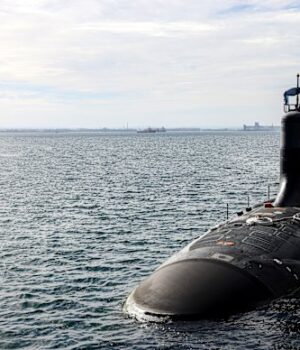
SOURCE :- THE AGE NEWS
Australia will deepen its defence ties with Britain by spending $310 million on a new stage of the AUKUS submarine project as well as launching joint work on radar systems, drones and missile tests that could help Ukraine.
The agreement was sealed in London on Monday night in a meeting between Australian and UK ministers that cleared the way for closer links in the defence industry to develop defensive weapons.
Australia has previously pledged $5 billion to help fund the development of the nuclear power systems for the AUKUS fleet, but the new spending is the first payment for equipment from Rolls-Royce to be installed in the first submarines.
The $310 million will buy the first components for the nuclear reactors to be supplied by Rolls-Royce and transferred to South Australia for fitting to the first two AUKUS vessels to be built at the Osborne shipyard.
Defence Industry Minister Pat Conroy met his counterpart, UK Minister for Defence Readiness and Industry Luke Pollard, on Monday and announced the funding after their talks.
“This is the start of the construction process for these reactors,” Conroy said in London.
“We’re on track. We’re hitting all major milestones for the AUKUS project.”
As well as claiming progress on the nuclear reactor modules, Conroy pointed to the government’s announcement last week of a $3.9 billion commitment to the construction of the Osborne shipyard, with that cost likely to increase to $30 billion over several decades.
“That announcement, and that $30 billion investment, will build the only submarine yard in the Southern Hemisphere capable of constructing a nuclear-powered submarine,” he said.
“This is a challenging project. This is a project that is the greatest industrial undertaking Australia has ever attempted, but it will also be nation-shaping in terms of modernising our manufacturing sector.”
While AUKUS is fiercely opposed by some members of the Labor Party and rejected by former prime minister Paul Keating and former foreign affairs minister Bob Carr, the government insists it is necessary for national defence and will create 20,000 jobs over the decades.
The agreement relies on help from the United States to supply interim submarines – three Virginia-class vessels – but has a long-term goal of developing a future vessel with the UK.
Australia aims to have five vessels from the early 2040s, using the same SSN-AUKUS design as the UK, which plans to have up to 12 vessels. The project is based on calculations that, without the new fleet, the UK would be more vulnerable to Russia, and Australia would be more vulnerable to China.
Conroy and his UK counterpart emerged from their talks in London with plans for joint work on other projects, including lasers and radar.
The communiqué from the meeting said the two sides would explore the potential for the UK to use radar systems developed in Australia.
Australia has a world-leading radar technology developed by Canberra-based CEA Technologies, which the federal government purchased in 2023 to ensure the intellectual property remained in the country.
On drones, the two sides plan to work on the “Ghost Bat” aerial vehicle, already being produced in Australia, so it could be fitted with missiles that complement the UK and other NATO member states’ arsenals.
“That will potentially facilitate exports of Ghost Bats to European nations who might be interested in it,” Conroy said.
British missiles set for Australian testing
The agreement in London will also see British missiles tested in Australia to help with the development of new weapons being supplied to Ukraine.
“I won’t comment about the specific UK weapon that may be tested at our weapon ranges, but there’s a number of advanced, long-range weapons that the UK is providing, or looking at providing to Ukraine,” Conroy said.
“Obviously, testing those at our world-class facilities would advantage that process and give Ukraine further assistance in their valiant struggle against Russian aggression.”
The talks also led to an agreement to do more work on laser weapons, to co-operate on the supply of critical minerals and increase the number of Australians who are “embedded” with defence company BAE Systems in the UK to prepare for the construction of the AUKUS fleet.
The joint work on the AUKUS design, with five to be built in South Australia and up to 12 in the UK, is supposed to reduce construction costs compared to each country doing its own design.
Any challenges to the UK construction timetable will have repercussions for Australia because of the shared development.
Rolls-Royce future programs director Rich Palmer told this masthead last October he was “100 per cent” sure the submarines would be delivered, despite the concerns about AUKUS in the US and the strong criticism of the project in Australia.
The British timetable depends on the country’s ability to build one new submarine every 18 months for the existing fleet before it can switch to the new fleet when the AUKUS design is decided. Industry experts are worried that each Astute submarine currently takes about 24 months to build.
Get a note directly from our foreign correspondents on what’s making headlines around the world. Sign up for our weekly What in the World newsletter.
 David Crowe is Europe correspondent for The Sydney Morning Herald and The Age.Connect via X or email.

