
Source : THE AGE NEWS
A sharp sell-off in early trade on the Australian sharemarket had eased slightly by midday after the value of the market’s key top 200 company index fell below $3 trillion for the first time since May and slumped by nearly $350 billion since the start of this month.
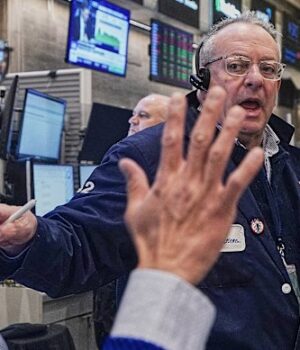
Fears from the fallout of the Iran war as it enters a fourth week and an ongoing spike in oil prices are rattling investors who reacted by marking down nine of the market’s 11 industry sectors on Monday, wiping more than $42 billion off the local bourse.
The market had plunged by $56 billion soon after opening, when the S&P/ASX 200 shed 1.9 per cent, before it pared back some of its early losses. By midday, the index was 1.52 per cent lower, near levels last seen in May.
Financial and mining stocks were punished.
Market behemoth the Commonwealth Bank fell 0.8 per cent, National Australia Bank lost 1.87 per cent, Westpac slumped 1.01 per cent and ANZ Bank eased by 0.85 per cent.
Iron ore heavyweight BHP lost 2.21 per cent, Rio Tinto was down 2.34 per cent and smaller rival Fortescue fell 1.34 per cent. The selloff was worse for gold miners. Northern Star plunged 6.43 per cent and Evolution Mining shed 7.33 per cent.
Energy stocks made only slight gains despite surging oil and gas prices. Woodside Energy was largely unchanged, Santos gained 0.31 per cent, Yancoal was down slightly (0.6 per cent) and Ampol climbed only 0.54 per cent.
Tech stocks fell across the board, with WiseTech down 4.72 per cent, Xero down 0.36 per cent and NEXTDC shedding 4.24 per cent.
Oil prices remained steady on Monday morning after trading cranked up following a weekend break. Brent, the international standard, was down 0.82 per cent to $US111.37 a barrel while US oil dipped 0.04 per cent to $US98.19 at midday. The Australian dollar is trading at US69.97¢ at 12.45 AEST.
Trading in US equity futures, Treasuries and crude resumes on Sunday evening (US time) after a week in which stocks and bonds were sold off in tandem, gold notched precipitous declines and oil surged. Bitcoin also fell as investors pulled back from risk assets, with the cryptocurrency falling below $US69,000 ($98,420).
“Pulling back on this war is not Trump’s sole decision,” Matt Maley, chief market strategist at Miller Tabak, said in an interview. “Uncertainty has been increasing for three weeks, and the uncertainty took a big jump now. Even if people don’t sell, they are not going to be buying – and if there’s no bids, it creates a vacuum.”
Another climb for oil prices shook Wall Street on Friday, as hopes collapsed for a possible cut to interest rates this year by the Federal Reserve.
The S&P 500 fell 1.5 per cent to close its fourth straight losing week, its longest such streak in a year. The Dow Jones fell 443 points, or 1 per cent, and the Nasdaq composite tumbled 2 per cent as oil prices strengthened.
Stocks bent under the weight of leaping yields in the bond market. Treasury yields have been jumping on worries that the war with Iran will cause a long-term spike in oil and natural gas prices that drives up inflation.
Worries have got so high that traders have cancelled nearly all their bets that the Federal Reserve could cut interest rates this year, according to data from CME Group. Some even think the Fed could raise rates in 2026, a nearly unthinkable scenario before the war began.
“I think it would be market shaking,” Ann Miletti, head of equity investments at Allspring Global Investments, said about a rate hike. But she also said that if oil prices stay high for a long time, they would probably drag so much on the economy that the Fed would not raise rates.
Lower interest rates would give the economy and investment prices a boost, and they’re something Trump has angrily been calling for. Before the war, traders were betting heavily that the Fed would cut rates at least twice this year.
But lower rates risk worsening inflation. And investors now see little room for central banks worldwide to cut interest rates to help their economies. Besides the Federal Reserve, central banks in Europe, Japan and Britain also held their interest rates steady this past week.
The US sharemarket has a history of bouncing back relatively quickly from past conflicts in the Middle East and elsewhere, as long as oil prices don’t stay too high for too long. Oil prices aren’t at a red-flag point yet, Miletti said, but “we’re getting close if the duration is long enough”.
“If three months from now we’re in a similar situation, not only myself but a lot of other investors will be much more cautious,” she said.
On Wall Street, about three out of every four stocks in the S&P 500 fell. Stocks of smaller companies, which can feel the pinch of higher interest rates more than their bigger rivals, led the way lower. The Russell 2000 index of smaller stocks fell a market-leading 2.3 per cent.
When bonds are paying more in interest, they make other investments less attractive in comparison. That’s particularly the case for things such as gold, which pay their investors nothing at all. Gold’s price finished the week at $US4574.90 an ounce, hurting its reputation as a safe place for money during uncertain times. Earlier this year, gold was setting records and briefly topped $US5400 an ounce.


