
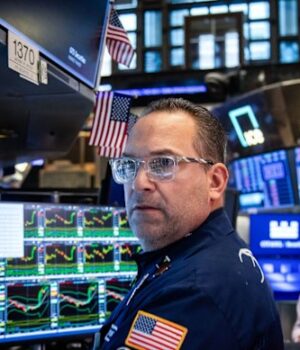
Source : THE AGE NEWS
The Australian sharemarket slid in morning trade as oil prices spiked yet again following attacks on some of the Middle East’s most important energy facilities, raising concerns of a more lasting economic fallout from the almost three-week-old Iran war.
The S&P/ASX 200 fell 137.60 points, or 1.6 per cent, to 8503 as of 11.39am AEDT, following two days of modest gains. The Australian dollar was trading at US70.38¢.
With the geopolitical uncertainty and concern about exploding energy costs weighing on the market, investors also noted the nation’s latest unemployment figures. The unemployment rate unexpectedly rose from 4.1 per cent to 4.3 per cent in February, the Australian Bureau of Statistics said this morning. Economists had expected it to keep steady.
Nine of the 11 industry sectors on the ASX declined, with only being winner being energy, which climbed again in line with oil prices.
Oil and natural gas prices surged after Iran carried out an attack on a major LNG site in Qatar, after earlier warnings from Tehran on threats to energy facilities across the Gulf. The most-active contract for West Texas Intermediate advanced as much as 3.3 per cent to $US98.60 a barrel in early Asian hours, after Brent oil earlier climbed 3.8 per cent to settle at $US107.38.
Australia’s biggest oil and gas company, Woodside, jumped 4.8 per cent, while the second-biggest, Santos, climbed 3.2 per cent. Refiners Ampol and Viva Energy surged 5.4 per cent and 12.1 per cent, respectively. Coal producers also rose, with Yancoal up 5.9 per cent and Whitehaven up 4.3 per cent.
Energy and utilities were the only green island in the ASX’s sea of red in early trade.
On the downside, miners led the declines, with iron ore giants BHP (down 3.3 per cent), Fortescue Metals (down 2.3 per cent) and Rio Tinto (down 2.9 per cent) all trading lower amid concerns a war-induced slowdown in the global economy will hurt demand.
Gold producers Northern Star, Evolution Mining and Newmont tumbled 8.6 per cent, 8.3 per cent and 5.4 per cent, respectively, after gold declined for a sixth day, its longest losing streak since late 2024. Federal Reserve Chair Jerome Powell said overnight higher energy prices will push up overall inflation and called for mildly restrictive US interest rates, which sent bullion down by 3 per cent as it’s priced in US dollar and typically performs well in a lower-rate environment.
The crucial financial sector was also lower, with CBA, National Australia Bank and ANZ Bank all down 0.3 per cent and Westpac shedding 0.8 per cent. Though those are smaller movements, the sector has an oversized weight on the direction of the market, making up a third of the ASX.
Meanwhile, interest-rate sensitive sectors posted some of the ASX’s biggest declines. Software makers WiseTech Global and Xero led the tech sector lower with falls of 4.2 per cent and 1.9 per cent, and AI data centre operator Next DC dropped 1.2 per cent. On the consumer front, Bunnings and Kmart owner Wesfarmers lost 2.2 per cent, electronics retailer JB Hi-Fi fell 2 per cent and furniture seller Harvey Norman shed 1.2 per cent.
Data centre and warehouse owner Goodman Group paced losses for property stocks with a 4.4 per cent slump, followed by Westfield shopping centre landlord Scentre, which lost 2.9 per cent.
On Wall Street overnight, US stocks slumped after a report said inflation was primed to worsen even before the war with Iran caused oil prices to spike. That and comments from Fed chief Jerome Powell pushed Wall Street to see less chance of getting the lower interest rates it loves.
The S&P 500 fell 1.4 per cent and flipped to a loss for the week so far. The Dow Jones dropped 768 points, or 1.6 per cent, and the Nasdaq composite slid 1.5 per cent.
The losses deepened after the Fed decided to keep its main interest rate steady, instead of resuming cuts meant to give the job market and economy a boost. Fed officials are still penciling in one more cut by the end of 2026, but Powell suggested those projections may be worth less than usual because of how much more uncertainty exists about inflation and the economy.
“We just don’t know,” Powell said about what will happen with oil prices, along with how long President Donald Trump’s tariffs will take to work their way fully through the system.
Oil prices have soared because the war has disrupted the Persian Gulf’s energy industry. If the disruptions keep oil and gas prices high for long, they could create a debilitating wave of inflation for the global economy.
A report released on Wednesday morning showed inflation pressures in the US economy were already building before the war began. It said inflation at the US wholesale level unexpectedly accelerated last month to 3.4 per cent.
Such numbers were likely factors in keeping the Fed on hold Wednesday. Powell said the rule of thumb has been for the Fed to look through jumps in oil prices, which could be only temporary, but he said that works only if expectations for upcoming inflation don’t spike themselves. He also noted that several Fed officials downgraded their forecasts for rate cuts this year to one from two, even though the overall median Fed official is still calling for one.
That pushed traders to slash their own expectations for a single rate cut by the Fed this year. They’re now betting on less than a coin flip’s chance of that, 49 per cent, down from the 95 per cent probability they saw a month ago, according to data from CME Group.
That sent Treasury yields upward in the bond market, along with the higher-than-expected update on inflation at the wholesale level. The yield on the 10-year Treasury climbed to 4.26 per cent from 4.20 per cent late on Tuesday and from just 3.97 per cent before the war with Iran started. Higher Treasury yields grind down on prices for all kinds of investments, from stocks to crypto to gold.
Despite its reputation as a safe haven during uncertain times, gold looks less attractive to investors when Treasury bonds are paying more in interest because it pays its owners nothing.


