
Source : THE AGE NEWS
The Australian sharemarket has started the week with a bang to regain the bulk of Friday’s heavy losses this morning, following on from Wall Street’s rally to close the week.
The S&P/ASX 200 was up 155.9 points, or 1.8 per cent, in early trade, with all 11 industry sectors in positive territory. It comes after the ASX plunged 2 per cent on Friday.
Tech stocks rebounded after heavy losses on Friday. WiseTech jumped 3.8 per cent, Xero climbed 1.4 per cent, TechnologyOne surged 5.6 per cent and NextDC added 5.1 per cent
Mining stocks surged thanks to surging commodities prices with Fortescue leading the iron ore heavyweights with a 2.8 per cent gain, while Rio Tinto and BHP each added 2 per cent. Gold stocks also advanced, with Northern Star jumping 2.8 per cent and Evolution Mining adding 3.7 per cent. Silver major South32 rose 4 per cent.
Financial stocks extended early gains to be firmly in the green, with Commonwealth Bank gaining 0.7 per cent, Westpac rising 0.9 per cent while National Australia Bank added 1.1 per cent and ANZ Bank jumped 1.7 per cent. Consumer finance company Pepper Money jumped 25.6 per cent after rival Challenger lobbed a takeover bid. Challenger shares fell 4.2 per cent.
Energy stocks are higher, with Woodside Energy rising 1.8 per cent, Santos adding 1.7 per cent and Yancoal up 2.3 per cent in early afternoon trade.
The Australian dollar was trading at US70.18¢ at 12.30pm AEDT.
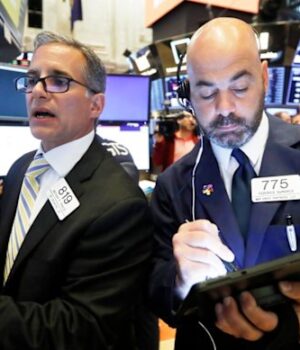
On Friday in New York, the S&P 500 rallied 2 per cent for its best day since May. The Dow Jones soared 1,206 points, or 2.5 per cent, and topped the 50,000 level for the first time, while the Nasdaq composite leaped 2.2 per cent.
Chip companies helped drive Wall Street’s widespread rally, and Nvidia jumped 7.8 per cent to trim its loss for the week, which came into the day at just over 10 per cent. Broadcom climbed 7.1 per cent and erased its drop for the week.
They were the two strongest forces lifting the S&P 500, and they benefited from hopes for continued spending by customers diving into artificial-intelligence technology. Amazon CEO Andy Jassy, for example, said late Thursday it expects to spend about $US200 billion ($285 billion) on investments this year to take advantage of “seminal opportunities like AI, chips, robotics, and low earth orbit satellites.”
Such immense spending, similar to what Alphabet announced a day earlier, is creating concerns of its own, though. The question is whether all those dollars will create big enough profits to make the investments worth it. With doubt remaining about that, Amazon’s stock dropped 5.6 per cent.
Bitcoin, meanwhile, steadied following a weeks-long plunge that had sent it more than halfway below its record price set in October. It climbed back above $US70,000 on Saturday after briefly dropping close to $US60,000, It was trading at $US70,361 at 10.32am AEDT.
Prices in the metals market also calmed a bit following their own wild swings. Gold rose 1.8 per cent to settle at $US4979.80 per ounce, while silver added 0.2 per cent.
Their prices suddenly ran out of momentum last week following jaw-dropping rallies, which were driven by investors clamouring for something safe to own amid worries about political turmoil, a US stock market that critics called expensive and huge debt loads for governments worldwide. By January, prices for gold and silver were surging so quickly that critics called it unsustainable.
On Wall Street, the recovery for bitcoin helped stocks of companies enmeshed in the crypto economy. Robinhood Markets jumped 14 per cent for the biggest gain in the S&P 500. Crypto trading platform Coinbase Global rose 13 per cent. Strategy, the company that’s made a business of buying and holding bitcoin, soared 26.1 per cent.
A preliminary report from the University of Michigan suggested sentiment among US consumers is improving slightly, when economists were expecting to see a drop. The improvement was strongest among households that own stocks, which are benefiting from the S&P 500 setting a record late last month.
To be sure, sentiment “remained at dismal levels for consumers without stock holdings,” according to Surveys of Consumers Director Joanne Hsu.


