
Source : THE AGE NEWS
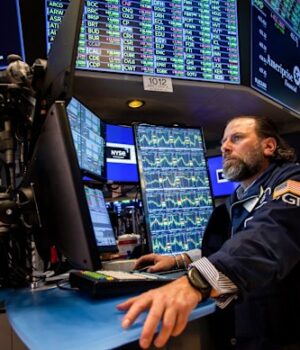
The Australian sharemarket extended its declines at lunchtime as consumer-dependent companies, travel stocks and miners declined amid worries that the Iran war will drag on, clogging the flow of oil, disrupting global transport and making inflation even worse.
The S&P/ASX 200 fell 122 points, or 1.3 per cent, to 9078.90 as of 1.30pm AEDT in a broad-based sell-off, with all 11 industry sectors in the red. The bourse had edged higher on Monday. The Aussie dollar traded at US70.98¢ as of 1.31pm AEDT, up 0.1 per cent.
Futures contracts for Wall Street’s S&P 500 Index and the Nasdaq 100 also edged lower after the US market erased initial losses to close little changed overnight. Bond yields went up as concerns that spiking energy costs would fan inflation curtailed hopes for rate cuts in the world’s largest economy.
Traders are now pricing in a first US rate cut in September, with bets on a third reduction this year fading. That shift comes on top of global equity markets already unsettled by the billions companies are pouring into artificial intelligence and concerns over the technology’s disruptive impact.
“There are more questions than answers right now,” said Chris Larkin at E*Trade from Morgan Stanley. “A stabilising energy picture could have a positive ripple effect, while concerns about a longer-term disruption could have the opposite.”
Gold stocks stepped back some of their gains from Monday as the rally in gold prices moderated. Bullion climbed as much as 0.9 per cent to around $US5360 an ounce, having added more than 3 per cent over the previous four sessions.
Traders weighed the prospect of tighter Fed policy to tame inflation spurred by the conflict in the Middle East, which boosted the US dollar as a safe haven alternative. Northern Star Resources fell 4.2 per cent, Newmont lost 3.4 per cent and Evolution Mining slumped 5.4 per cent.
Meanwhile, silver prices fell, sending down South32 – which owns Australia’s biggest silver mine – by 4.6 per cent. Iron ore giants BHP, Fortescue Metals and Rio Tinto were also lower amid the global economic concerns, down 2 per cent, 3.4 per cent and 1.9 per cent, respectively.
Interest rate speculation also weighed on companies dependent on consumer discretionary spending, as higher borrowing costs would leave households with less money to shop. Australia’s interest rate-setting board is “very alert” to the potential implications for inflation expectations from the Middle East conflict and is “well positioned” for a policy response if required, Reserve Bank governor Michele Bullock said at a business summit in Sydney this morning.
Wesfarmers, the owner of the Bunnings, Kmart and Officeworks chains, lost 2.9 per cent. Electronics retailer JB Hi-Fi was down 2 per cent and furniture seller Harvey Norman lost 1.7 per cent.
The interest-rate-sensitive tech sector also declined, wiping out early gains.
Life 360 shares slumped 9.5 per cent even after the family tracking app provider said it had swung into the black last year with $US150.8 million ($210.4 million), boosted by a one-off tax gain. Without that, it made a $US32.5 million profit, up from a $US4.6 million loss in 2024, as sales jumped 32 per cent. The company flagged sales growth of 31 per cent to 39 per cent this year.
WiseTech, the nation’s biggest tech concern, dropped 0.7 per cent and AI data centre operator Next DC shed 1.5 per cent.
Airline and travel stocks extended their falls, with Qantas down 2.7 per cent and major Qatar Airways code-share partner Virgin Australia losing 6.4 per cent, as the escalating conflict sent oil prices surging and continues to disrupt flights via the region. Flight Centre lost 1.3 per cent.
Oil climbed further as the US and Israel stepped up their war against Iran, while Tehran threatened a full closure of the Strait of Hormuz. Brent rose toward $US79 a barrel, after spiking about 7 per cent overnight, while West Texas Intermediate was near $US72.
President Donald Trump said he expected the attacks could last four to five weeks, but “we have the capability to go far longer than that.” At least 11,000 flights to and from Middle Eastern countries have been cancelled, affecting more than 1 million travellers worldwide, according to Cirium, an aviation data firm.
On Wall Street overnight, the S&P 500 fell as much as 1.2 per cent at the start of trading, with cruise lines and airlines leading the way lower. But it quickly erased those losses, in part because past military conflicts haven’t usually created sustained drops for the market, and finished the day with a gain of less than 0.1 per cent.
The Dow Jones Industrial Average dipped 73 points, or 0.1 per cent, and the Nasdaq composite rose 0.4 per cent. Both also came back from steep early losses.
Past military conflicts in the Middle East have not caused long-term drops for markets. For this war to knock down Wall Street in a significant and sustained way, the price of oil would perhaps need to jump above $US100 per barrel, according to strategists at Morgan Stanley led by Michael Wilson.
That helped the US stock market pare some of its steep opening loss. Morgan Stanley says the S&P 500 has climbed an average of 2 per cent, 6 per cent and 8 per cent in the one, six and 12 months following “geopolitical risk events” historically. That’s going back to the Korean War, which began in 1950, and the 1956 Suez crisis.
At the moment, though, fear is still running through Wall Street.
Stocks of airlines were some of the sharpest losers there overnight. Not only do higher oil prices threaten their already big fuel bills, the fighting in the Middle East also closed airports and left travellers stranded. United Airlines fell 2.9 per cent, and American Airlines lost 4.2 per cent.
Helping to limit Wall Street’s losses were oil companies. Exxon Mobil climbed 1.1 per cent, and Occidental Petroleum rose 2.1 per cent.
Companies that make equipment for the military also strengthened. Lockheed Martin climbed 3.3 per cent, and RTX rallied 4.7 per cent.
Palantir Technologies, whose software helps global defence agencies, jumped 5.8 per cent for the biggest gain in the S&P 500.
Big Tech stocks also helped to support the market. Nvidia rose 2.9 per cent and was the strongest single force pushing upward on the S&P 500.


