Source : the age
A few years after Emma O’Halloran decided to have a crack at writing an opera, she became the first Irish composer to be nominated for a Grammy. Her double-bill, Mary Motorhead and Trade – among five contenders for the 2026 award – is nothing like the opera Australia knows. And it’s about to land in Melbourne.
“Emma O’Halloran is probably going to be a major composer of this half-century,” says Linda Thompson, founding director of the Australian Contemporary Opera Company, which is mounting the two works at the Malthouse next month. That’s not just PR guff: the president of Ireland wrote to O’Halloran following her Grammy win, and The Los Angeles Times declared: “No Irish opera has entered the standard repertory. But that is about to change.”
The standard repertory in Australia is generally stuck in the past, concentrated on works created centuries ago; companies of all sizes risk alienating subscribers if they stray too far from the well-trodden path.
Mary Motorhead and Trade fearlessly stride into uncharted territory; their Irish conductor, Elaine Kelly, suggests they might not even be considered opera at all. Kelly earned her second Grammy nomination for the double-bill, and is in Melbourne this month to lead the local production.
“We are very much leaning into the fact that it’s theatre first,” she says. “It’s theatre with a bit of voice. If opera scares people, it’s not opera. It’s theatre with all the other elements that are involved.”
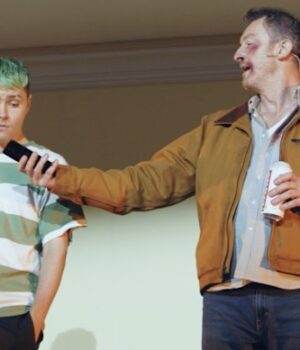
The most striking departure from classical convention is in the stories O’Halloran has chosen to tell. The first work takes us into the prison cell of a woman (Australian mezzo soprano Emily Edmonds) jailed for introducing her husband’s head to the pointy end of a carving knife. The second follows the burgeoning relationship of a closeted man (baritone Christopher Hillier) – and the young sex worker he’s invited to a seedy hotel room. None of it sounds very Verdi.
“Emma didn’t want to write operas about kings and queens, and that’s the appeal, that combination of ordinary and extraordinary that opera can do,” says Thompson.
The starting points for both works were plays of the same name by O’Halloran’s uncle, Irish actor and playwright Mark O’Halloran. His niece says she was inspired to adapt these short, dark works partly because they gave her the chance to explore psychological complexity in a way that’s rare in opera.

“I haven’t been imprisoned for a violent crime. Um, yet,” she says. “But I think these characters all have feelings that we have felt and can relate to, like hope or disappointment, things that you wished would happen and might not have worked out the way you wanted them to.”
Regarding Mary Motorhead, she recalls a quote by the American poet Henry Wadsworth Longfellow: “‘If we could read the secret history of our enemies, we should find in each man’s life sorrow and suffering enough to disarm all hostility.’ That’s what it’s about, creating a container for the audience to go, ‘OK, I can understand why she’s in jail now. I might not agree with what she did or how she did it, but I can feel where she’s coming from.’”
Halloran’s score also veers far from the familiar. There are guitars and saxophones and synths and pop samples, with a 10-piece band accompanied by prerecorded electronics. “It elevates the piece even more,” says Kelly. “The live instruments on their own are already fantastic and they help tell the story. But just that little punch of electronics, it just makes it pop.”
Then there’s the singing. Both works are very much rooted in inner-city Dublin, says their conductor, and the voices that carry them are as well. “In opera, we don’t ever really use our own accents.
In English, in particular, we use accents that are more operatic and neutralised. So we really punched in the Dublin accent here, and that was really intriguing to people … We’re very much in Ireland, and these pieces are so deeply cultural.”
Where classical opera tends to be big on the grand gestures, O’Halloran is more fascinated by the possibility of interiority and nuanced emotion as expressed through music. “Previous operas are a little bit more action-based, and there’s a conflict and then this happens and then that. I’m just not really interested in that. I really want to get to know the inner worlds of the characters,” she says.
Music, after all, is one of the most powerful methods we have of exploring our most private sides. “As a kid, I don’t think I had a great ability to articulate how I was feeling, to be able to use words to put a shape on things,” says O’Halloran. “I definitely gravitated towards music because it was a non-verbal thing. I was a sensitive little kid and had big feelings, and music was my way to capture the complicated nature of feeling and being alive.”
Kelly trained as a violinist before turning to conducting, and says that music also has a recognisable emotional pull for her. “I’ve always loved orchestra music, but I never loved playing violin on my own. It was always best when I was part of a team, when I was playing chamber music or orchestra music.”
The teamwork has clearly paid off. Kelly has so far conducted the work across Ireland as well as in New York and Los Angeles. Of course there was also that trip down the Grammys red carpet alongside the likes of Beyoncé and Chappell Roan. There were 88 albums in the running for best opera recording this year, and to make it to the top five was “a nice boost”, Kelly says.
“It means that you’re doing the right thing, and what you’re doing is connecting with other people.”
Ireland has never been known for its opera scene, but O’Halloran, Kelly and their colleagues are increasingly drawing attention to the Emerald Isle. Could Australian composers follow suit?
Thompson says the Australian Contemporary Opera Company’s embrace of cutting-edge contemporary works harks back to a period when Australia held its own on the world stage. Her own singing career started off under the likes of Barrie Kosky, Baz Luhrmann and Gale Edwards. They’d probably struggle to mount those daring early productions today.
“We’re stuck in systems that were set up in the 1980s. I think the world has moved on, and we’ve got to shake something up somehow. That’s how Mary Motorhead and Trade got here.”
Mary Motorhead and Trade, Malthouse, March 6-13.