SOURCE :- THE AGE NEWS
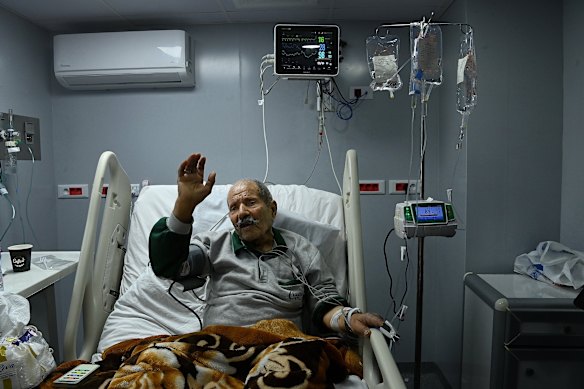
Beirut: The young farmworker heard no warning when a blast tore through his group of farmhands in southern Lebanon on Sunday. Now he lies in a hospital ward in the nearest town, trying to survive the war unleashed across the Middle East when missiles slammed into Iran less than two weeks ago.
Ali Hussein, 20, is a Syrian who sought a life in a rural area of Lebanon with others from his home country. He is one of about a dozen Syrian workers who were targeted by the Israel Defence Forces while unloading poultry from a truck at a chicken farm.
“We were working when the jets struck. It was at six in the evening,” he says from his hospital bed. “Two of my friends were martyred, the rest are still alive. And I don’t know why we were targeted.”
Hussein has shrapnel wounds to his chest, right leg and right arm. His doctor says he will recover. But he is another victim of the violence that is spreading through the region and bringing danger to the world.
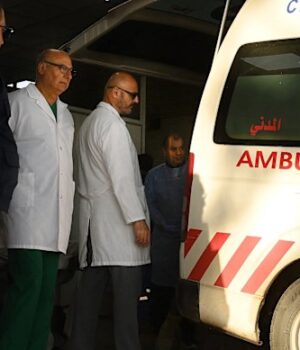
We are at al-Najdah Hospital in Nabatiyeh, close to where Hussein and his friends were attacked in the village of Yohmor al-Shaqif, which is within 20 kilometres of the borders of both Israel and Syria. The threat of war is all around us: the streets are empty, the shops are closed and dogs roam the pavements, their owners nowhere in sight.
The medical director of this hospital, Alchafii Fouani, says the district is home to 200,000 people but now has fewer than 15,000. Amid the evacuation, however, the casualties still mount because some families cannot bear to leave. Fouani says up to 20 patients are rushed to the hospital each day after drone and missile strikes.
“There are no light injuries, they are all heavy,” he says. “Most of them die, and for the others, the injuries are quite heavy.” He talks of missiles destroying large homes and trapping occupants with serious wounds.
Some of the Syrian workers were as young as 13 or 14, says Fouani. Two died and 13 others were injured – and the survivors were left on the farm for six hours while emergency workers waited to reach them. They were only recovered after urgent calls between Israel, Lebanon and international agencies to allow the ambulances into the area.
On the third day of the war, says Fouani, a father died in a strike on his house. His wife survived with their son, 4, and their daughter, 1. “For some of them, they prefer to stay in their homes,” he says. “They have no money to spend for rent elsewhere. And some of them have no cars to leave the area.”
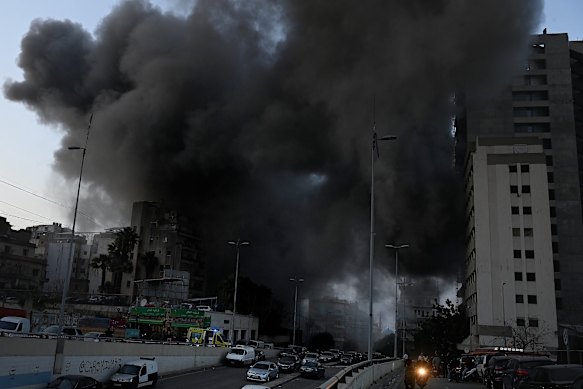
An explosion erupts and the doctor pauses. We go to the window to see black smoke rising behind the hills across a small valley. It looks to be four or five kilometres away. Fouani watches quietly; he knows the ambulances will be on their way.
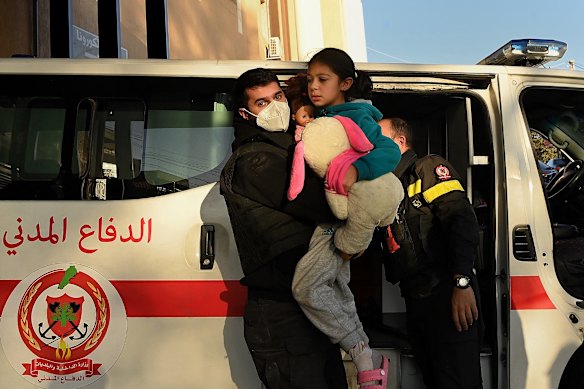
The first one arrives within 20 minutes. A Nissan van pulls up and reverses into the emergency bay, followed soon by four others. Some patients are taken into the hospital out of public view, but others make their own way inside. An elderly woman walks with assistance from a van to the casualty ward, followed by an old man in a black cap. A tall ambulance worker in a black bulletproof vest carries a young girl wearing pink sandals and holding her teddy bear.
Here, in what is thought to be the safest place in the district, staff and residents stand near the hospital entrance to watch the airstrikes. One man points out what he saw while we were inside: “Here, and here, and here, and here.” Four strikes. Then there is a low rumble. It is a fifth strike, this one more distant.
There is no surprise and no public grief. One man tells us he thinks the attacks are timed for late afternoon on most days, when families gather for iftar, the meal served at sunset to end the daily fast during Ramadan. It is Wednesday afternoon; it seems just another day in what could be a long war.
Meanwhile, in northern Israel, families shelter from rockets and drones being launched from Lebanon. The Hezbollah militia in Lebanon, loyal to Tehran and its brand of Shiite Islam, began sending rockets and drones into Israel on March 2 to show solidarity with Iran. On Wednesday alone, say Israeli authorities, Hezbollah fired 200 rockets and 20 drones into Israel. A house was destroyed by a missile in Moshav Haniel, in central Israel. Hundreds of thousands of people took shelter.
Determined to smash Hezbollah after decades of conflict, the Israel Defence Forces fly surveillance drones over neighbourhoods across Lebanon. They send attack drones in the night to target Hezbollah leaders, and order jets into the air to pound neighbourhoods with missiles.
The death toll in Lebanon increases each day. It now stands at 687, at least, according to the latest statement from the Lebanese government about the deaths since March 2. This includes 98 children and 52 women. In all the conflict across the region, from drone strikes on Dubai to the attacks on ships and the closure of airports, the one in Lebanon now has the grim status of being the deadliest outside Iran itself.
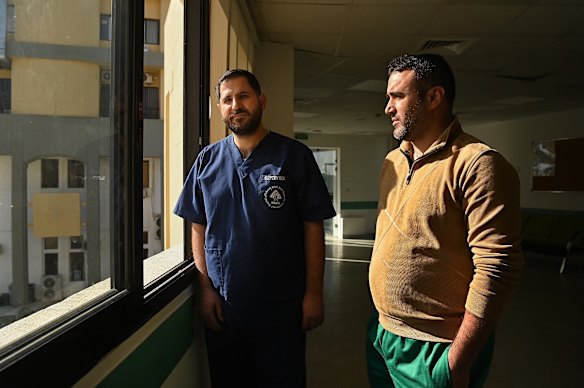
The nurses of Nabatiyeh, working at the Nabih Berri Governmental University Hospital, witness the devastation. “One day, we were actually picking up pieces of a human, the parts from little children and babies, totally torn apart,” says Hassan Baz, the supervisor and disaster manager at the hospital.
We are standing near the burns unit of the hospital, where two patients are being treated after being caught in the flames from an Israeli attack. Most patients are transferred to specialists in Beirut, where they will undergo skin grafts. The task at this hospital is to offer immediate treatment and prepare patients for their recovery away from the fighting.
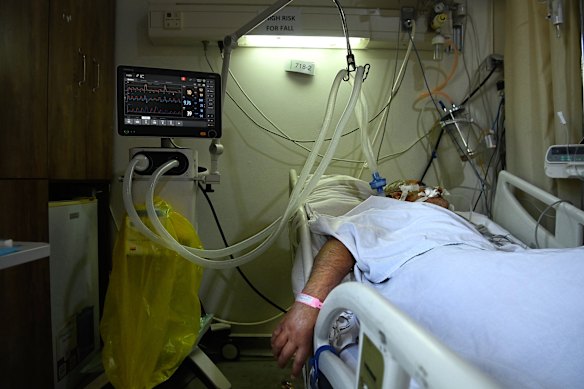
One man, however, cannot be moved. He lies in a coma after suffering smoke and chemical inhalation. He has been in a coma for 10 days.
“Absolutely, definitely, these are war crimes,” Baz says. “The attacks are targeting civilians, families, children, women. They are not targeting fighters. Many of the families tried to leave, but they couldn’t find places to shelter, so they came back to live in their houses. And they are being targeted and killed.”
Another nurse, emergency supervisor Ali Omeis, says this hospital has treated 65 cases of second-degree burns. He has reached a disturbing conclusion about the weapons being used against civilians.
“Most of the cases are phosphorus,” Omeis says. He is referring to the chemical that is added to bombs and missiles to ignite when combined with oxygen, setting fire to targets and magnifying the damage from each strike. It is illegal to use white phosphorus in populated areas because of international agreements to avoid civilian harm.
Omeis says he knows phosphorus is being used. There is the smell, for one thing. And there is the colour and nature of the wounds. “The burns occur only when phosphorus bombs are used, or other chemicals cause fire,” he says.
This is direct testimony about the war – and it tallies with other analysis. Human Rights Watch, a non-government organisation, says it has verified eight images that show airburst white phosphorus munitions being deployed in southern Lebanon on March 3.
“The Israeli military’s unlawful use of white phosphorus over residential areas is extremely alarming and will have dire consequences for civilians,” said Ramzi Kaiss, Lebanon researcher at Human Rights Watch, on Monday.
In response, the Israeli military says it is unaware and cannot confirm the use of shells that contained white phosphorus in Lebanon. As the war goes on, the anxiety about the weapons will only increase.
One feature of this war is beyond dispute: the attacks are intensifying by the day. Whatever is said in the White House about the purpose of the war on Iran, and whatever Trump claims about how soon the strikes on Tehran will end, the battle between Israel and Hezbollah is a lasting enmity that will not end soon.
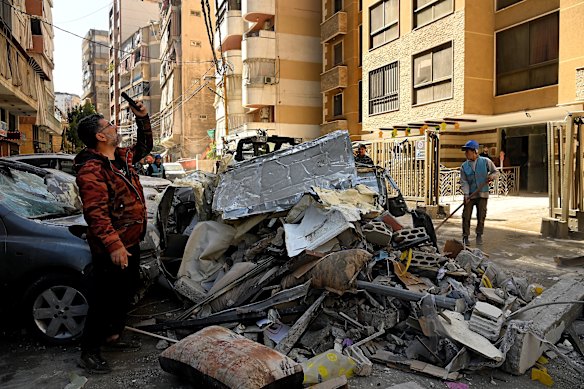
That means civilians wait in the sure knowledge that an airstrike will come. In the ancient city of Tyre, also known by its Arabic name of Sour, residents at the old port share warnings about an impending strike after the IDF issues an alert. Some walk out to the sea wall, next to the fishing fleet in the harbour, to find a safe distance from the city across the bay.
First, we hear the low roar of the jets. The aircraft are rarely seen, and the missiles are too fast for the naked eye at a distance. The first proof of the attack is a plume of smoke above the buildings behind the beach. Then comes the sound of the explosion. Then, the rise of a thick, black cloud that drifts over the city.
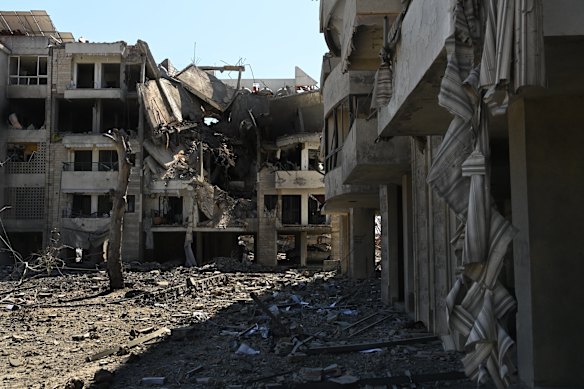
When the airstrike is over, a young couple walk back along the sea wall; the woman is visibly distressed at what is happening to her country.
With every strike, Israel demonstrates the power to bring Lebanon to its knees. The tempo is quickening in response to the volley of strikes from Hezbollah into Israel, and Israeli Prime Minister Benjamin Netanyahu could widen the target list if he chose to inflict even greater pain on civilians. His message to the government of Lebanon is simple: disarm Hezbollah, or we will punish you.
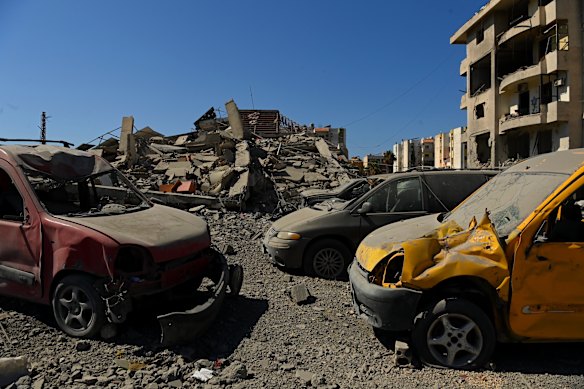
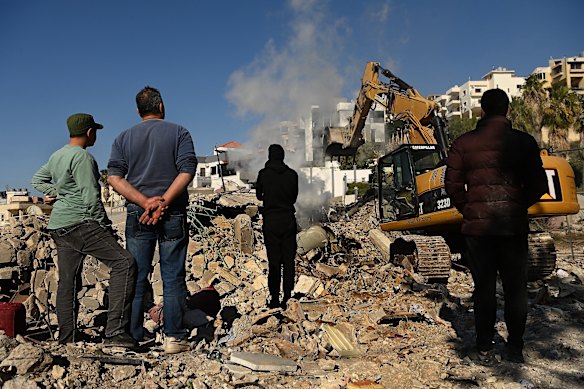
In the hills above the Mediterranean, a woman stands in the rubble of a family home and tells us what she thinks of Israel and this war. Um Qassem, 55, is grieving her brother, who died in an airstrike here the previous day, and she is praying for her nephew, whose body lies somewhere beneath the broken concrete and twisted metal.
“It’s not about the calamity of what’s happening, like this destruction of houses,” she says. “It’s the resistance. It comes from inside. It comes from the need to protect the dignity and honour of the people.” She means the resistance to Israel – the same cause that has driven Hezbollah for decades.
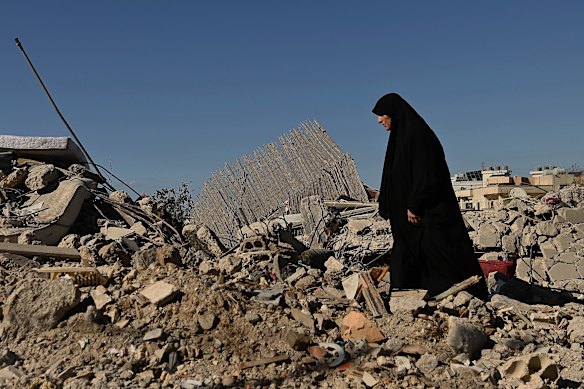
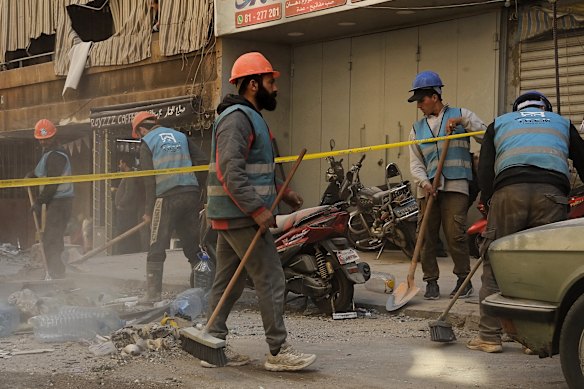
We are in Ghaziyeh, just south of Sidon, the Old Testament city known in Arabic as Sayda. Workers operate an excavator to clear debris, while flames rise from some of the broken furniture. This was the home of four brothers, one of whom died in the blast. Six displaced people from southern Lebanon were staying, including three sisters. Two of the sisters lost their lives.
There is no time for sorrow when there is so much anger. Um Qassem is burning with fury over the attacks on the Shiite Muslims of Lebanon. She talks of the 1982 invasion when Israeli forces overran the country and came to the edge of Beirut, and she says she remembers being denied the right to say “Allahu akbar” in the mosques.
“We are not fighting for Iran,” she says. “We are fighting for ourselves, for our honour, for our dignity. If anyone would attack us, I want my husband and my son to go and fight to defend our dignity.”
Others share this righteous anger in response to the escalating attacks of the past two weeks. In a shelter for people who have fled their homes, a woman tells us she will send her son to war if Israel does not stop. Others talk of resistance. Every attack from one side deepens the grievances that trigger attacks in reply.
The dust from the explosion covers the lemon tree in the neighbouring yard, turning its leaves grey. The windows are shattered in most of the nearby buildings, and some are partially destroyed. Two brothers, Zaher and Samer al-Nassar, have already begun reconstruction on their home next door.
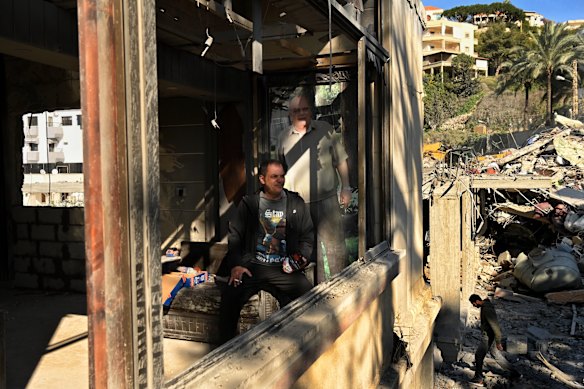
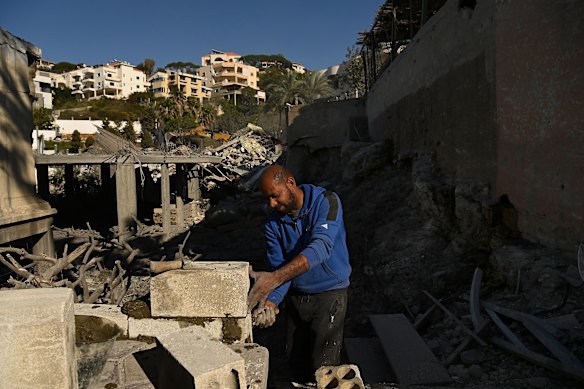
The young man beneath the rubble is Mustafa, who ran a small store in the district. One neighbour, Mohammed Ali Ghaddar, 26, cannot believe that his childhood friend is gone. “He was about to get engaged in five days,” he says. “He’s the most pure person I’ve ever known. He’s super calm, doesn’t do any trouble.” Mustafa was asked to sleep over at the Ghaddar family house on the night before the airstrike, but wanted to stay home.
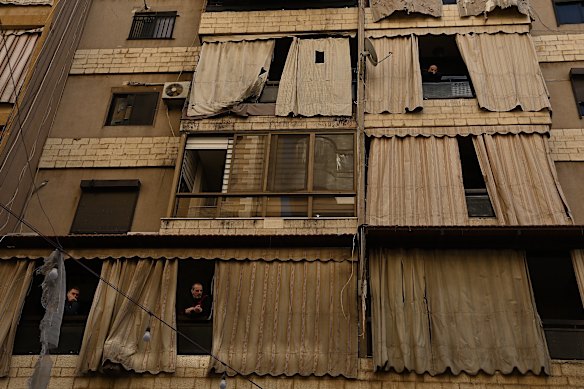
“This is a residential area,” says a municipal worker visiting the destroyed home. There is no evacuation order here, but death visits anyway. About 80 per cent of the people in this neighbourhood have fled.
The strain on Lebanon is immense. The government says more than 800,000 people are now registered as displaced, while 120,000 are now living in shelters. What the official statistics do not show is the number of families living in tents, or merely on synthetic blankets, on the streets of Beirut.
Every attack compounds the pressure on the government to act against Hezbollah, but the national army lacks the strength to control a militia that operates almost as a separate state, tied to Iran. In its regional strongholds, such as the south of Lebanon and the Bekaa Valley in the east, Hezbollah intensifies its fight against Israel.
Lebanon has to manage the differences between Shiite and Sunni Muslims, Alawites, Druze and Christians, including Maronites, Armenians and Greek Orthodox. Every community suffers while Hezbollah and Israel wage a new phase of a conflict that goes back decades.
Lebanese President Joseph Aoun, a Maronite and former army general, criticises Hezbollah for attacking Israel but seems unable to stop it. French President Emmanuel Macron tries to support Lebanon by warning Hezbollah to stop the rocket strikes. Syrian President Ahmed al-Sharaa is offering to help Lebanon stop Hezbollah. Netanyahu is intent on destroying the militia once and for all.
It is no exaggeration to say that many fear a new outbreak of civil war if the government tries to move against Hezbollah in concert with neighbours – including Syria – and with approval from Israel. The cost of stopping the strikes from outside the country may be a violent breach of the delicate balance inside.
There is also the prospect of an Israeli ground invasion across the border into Lebanon in the area bordering Syria, reprising the violence of the 1980s. With every airstrike, Israel is telling the people of Lebanon that it will keep battering cities and towns – and even chicken farms – to eliminate Hezbollah and stop the rockets that threaten the communities of northern Israel.
In al-Najdah Hospital in Nabatiyeh, in a ward near the young farmhand, an old man lies on a hospital bed. Some have died, he tells this masthead, and some have had their homes destroyed. “The war is targeting all people,” he says.
In Lebanon today, nobody can feel safe.
Get a note directly from our foreign correspondents on what’s making headlines around the world. Sign up for our weekly What in the World newsletter.