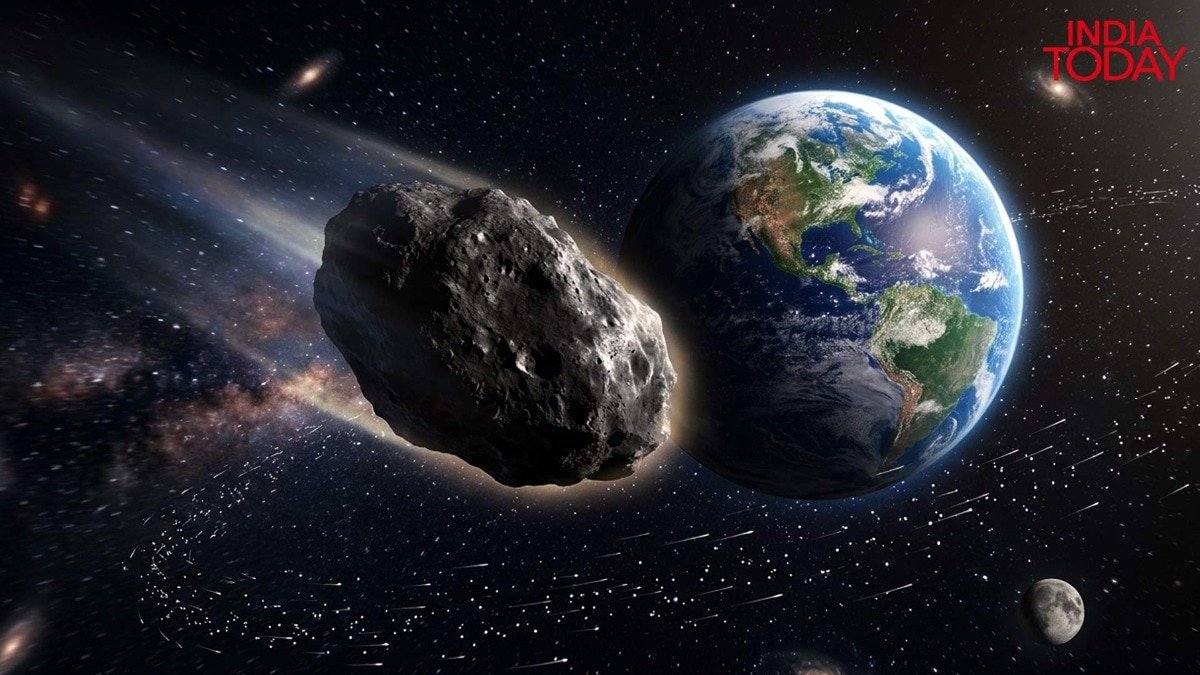
Source : INDIA TODAY NEWS
There are moments when the universe reminds you it is not empty. On Monday, May 18, an asteroid will zip past Earth at a distance so close it will be well inside the orbit of many of our own satellites.
And while that sounds terrifying, there is genuinely nothing to worry about.
advertisement
The asteroid, officially named 2026 JH2, was discovered on May 10 by astronomers at Mount Lemmon Observatory in Tucson, Arizona, as part of a sky-survey programme called the Catalina Sky Survey.
Eight days. That is all the notice we got. And yet, scientists say that is enough.
WHAT IS ASTEROID 2026 JH2, AND HOW BIG IS IT?
Think of 2026 JH2 as a large boulder drifting through space. It is estimated to be roughly 15 to 35 metres wide.
A standard cricket pitch, from stump to stump, measures just over 20 metres.
This asteroid, at its widest estimate, is not much longer than that. You could, in theory, fit one or two cricket pitches across it.
It belongs to a category called Apollo asteroids, which are near-Earth objects whose orbits around the Sun cross Earth’s own orbit.
Crossing orbits does not mean a collision, just as two roads crossing does not mean two cars will crash. Timing is everything.
For context, the Chelyabinsk meteor that exploded over Russia in 2013, injuring around 1,500 people and shattering windows across an entire region, was about 20 metres across.
This one is in the same size class. Not a planet-killer. Not even a city-killer. But certainly something you would not want landing on your head.
HOW CLOSE IS CLOSE?
At its nearest point, around 9.53 pm IST on May 18, 2026 JH2 will be approximately 91,000 kilometres from Earth.
The Moon, for comparison, sits about 3,84,000 kilometres away. So this asteroid will pass at roughly one-quarter of the Earth-Moon distance.
It will also be travelling at about 9.14 kilometres per second, or nearly 33,000 kilometres per hour. Fast, but predictable.
Planetary scientist Richard Binzel of the Massachusetts Institute of Technology has explained that the orbital calculations used to track such objects are the same physics that guide spacecraft on pinpoint missions to the Moon.
The maths, in other words, is trustworthy.
CAN YOU SEE THE ASTEROID?
At its brightest, 2026 JH2 will reach an apparent magnitude of about 11.5.
Apparent magnitude is the measure of how bright an object looks from Earth.
The lower the number, the brighter it appears.
Magnitude 11.5 means it will not be visible to the naked eye, but a modest amateur telescope should reveal it in the constellation Ursa Major, the Great Bear, in the northern sky.
The Virtual Telescope Project in Italy plans a live stream of the flyby, making it accessible to anyone with internet access.
WHY THIS MATTERS
Close flybys like this are rare scientific gifts. Without sending a spacecraft anywhere, researchers can study a small asteroid at relatively close range, gathering data about its brightness, surface reflectivity, and trajectory.
They also highlight how rapidly detection technology is improving.
The upcoming Vera C. Rubin Observatory in Chile and Nasa’s Neo Surveyor space telescope will soon be able to spot objects like weeks or months earlier, giving scientists far more preparation time.
For now, enjoy the cosmic close shave. It is a reminder that our solar system is a busy neighbourhood, and we are finally getting better at watching it.
– Ends
SOURCE :- TIMES OF INDIA