
Source : INDIA TODAY NEWS
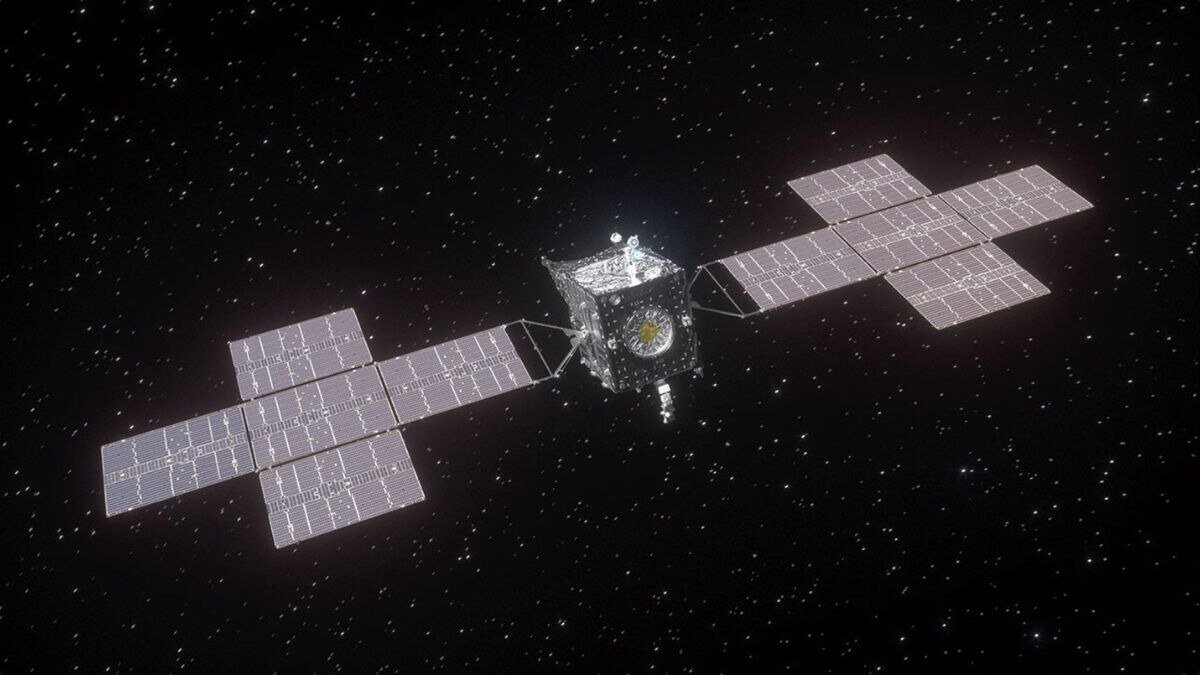
Something remarkable is about to happen today. Around 12:30 pm IST on May 15, 2026, Nasa’s Psyche probe will swing past Mars, not to visit the Red Planet, but to steal something from it. Speed.
This elegant celestial manoeuvre, known as a gravity assist, is one of the most beautiful tricks in space exploration.
Think of it less as a slingshot and more as a cosmic handshake, where Mars quietly donates a sliver of its momentum to the spacecraft as it passes by.
HOW DOES A GRAVITY ASSIST ACTUALLY WORK?
As Psyche approaches Mars, the planet’s gravitational pull will accelerate the probe, much like a ball rolling down a hill gains speed.
But here is the clever bit: Mars itself is moving around the Sun at roughly 24 kilometres per second.
When the probe enters Mars’ gravitational embrace and then departs, it will leave with more speed relative to the Sun than it had when it arrived. No fuel burned. Just physics.
The probe will pass just 4,500 kilometres from the Martian surface, traveling at roughly 19,848 kilometres per hour. That is closer to Mars than either of its two moons, Phobos and Deimos.
WHY DID PSYCHE NEED A PUSH FROM MARS?
Psyche uses Hall thrusters, which are ion engines that work by ionising xenon gas (stripping electrons from xenon atoms to create electrically charged particles) and accelerating those particles to tremendous speeds using electricity from solar panels.
These engines are remarkably efficient but produce very low thrust. A single Mars flyby delivers a burst of velocity, what engineers call a delta-v or change in velocity, that would otherwise take many months of continuous ion engine firing to achieve.
Simply put: Mars is about to save Psyche enormous amounts of fuel, time, and mission resources.
WHAT IS PSYCHE ACTUALLY GOING TO?
The spacecraft is bound for 16 Psyche, a 280-kilometre-wide metallic asteroid in the main asteroid belt between Mars and Jupiter.
Scientists believe it may be the exposed nickel-iron core of an ancient protoplanet, its outer layers stripped away over billions of years of cosmic collisions.
Nothing quite like it has ever been visited before.
WHAT ELSE WILL HAPPEN DURING THE MARS FLYBY?
The team at Nasa’s Jet Propulsion Laboratory will use this encounter to stress-test the science payload. The magnetometer will likely detect Mars’ magnetic field redirecting charged solar particles, and the gamma-ray and neutron spectrometer will monitor how cosmic ray flux changes during the flyby.
Cosmic rays are highly energetic subatomic particles that stream in from interstellar space.
The multispectral imager will perform satellite search observations around Mars as practice for hunting for possible moonlets orbiting the asteroid Psyche later in the mission.
Scientists are also curious whether Psyche might spot a faint dusty ring, or torus, around Mars.
Researchers believe micrometeorites striking the Martian moons, Phobos and Deimos, may throw dust particles into space, and the right angle of sunlight during the flyby could make that dust visible.
Engineers will confirm the flyby’s success by monitoring the Doppler shift of Psyche’s radio signals, a technique that measures changes in signal frequency caused by the spacecraft’s movement, accurate to within millimetres per second.
Principal investigator Lindy Elkins-Tanton of the University of California, Berkeley, put it plainly: the only reason for this flyby is to get a little help from Mars. But calibrating instruments along the way? That, she said, would be the icing on the cake.
The metal world awaits.
– Ends
SOURCE :- TIMES OF INDIA