

Source : PERTHNOW NEWS
Georg Baselitz would frequently make an insistent point that he had” no talent” and that he had” no talent,” sometimes as a taunt or as a shield.
He was turned down at the age of 17 by the Dresden Academy of Fine Arts, and he managed to get into an East Berlin college before being expelled two years later for” political immaturity.”
He recalled that he was” stupid.”
” I was a rebel, but I had no education.”
From that revolution, Baselitz developed a job that transformed the Nazi Germany student who was raised under Soviet communism into one of the determining artists of postwar Germany.
The artists and artist, who is renowned for his representations of natural bodies and inverted landscapes, passed away at the age of 88, according to German paper Die Welt.
No indication of a cause of death was given.
Hans-Georg Bruno Kern was born on January 23, 1938, in the Saxon town of Deutschbaselitz, a title he afterward adopted.
Hans-Georg’s conception was recorded in his father’s journal, a town schoolteacher and Nazi Party member.
He apparently gave beginning to none of his various four children, according to a report from the Sächsische Zeitung newspaper in 2018.
His dad was prohibited from teaching after the battle.
Baselitz’s mom took over his responsibilities at the institution.
Baselitz spent his early years in the cruel regime of Nazi Germany, and his later years in the wreckage and intellectual repression of the nation’s Communist occupation zone.
He afterwards recalled that” I was born into a destroyed attempt, a ruined landscape, a damaged people, and a destroyed society.”
And I didn’t need to re-establish an order because I had already seen enough of the so-called purchase. I had to question everything, get “naive,” and start over.
He moved to West Berlin after being expelled from the East Berlin club, where he continued his studies and absorbed minimalism in a way he described as an abrupt air intake.
He recalled the horror of seeing Jackson Pollock and other intangible expressionists ‘ works as proof that, despite what he had been taught, the United States had a significant society.
However, Baselitz turned to European sources to refute US standards and draw inspiration from folk art, folk culture, and visuals that critics frequently label as unpleasant or even “degenerate”
Officials seize his canvases The Big Night Down the Drain and The Naked Guy on profanity basis at a 1963 single show in Berlin.
Both hastily produced works feature “erections emerge from utter systems,” as The Art Newspaper put it.
Baselitz became popular as a result of the event.
Popular opinion was that the first images were provocative, with raw bodies, stunted masculinity, and abrasive humor.
They are also viewed as a sharp report on post European life: damaged, compromised, and struggling to find a new home, according to supporters and gallery designers.
His mid-1960s Champions drawings, which depicted hulking, damaged figures who appeared less like victims than survivors stumbling out of a defeated national story, had that sense in them.
However, Baselitz started turning the tables on himself in 1969 with his most recognizable of his plays.
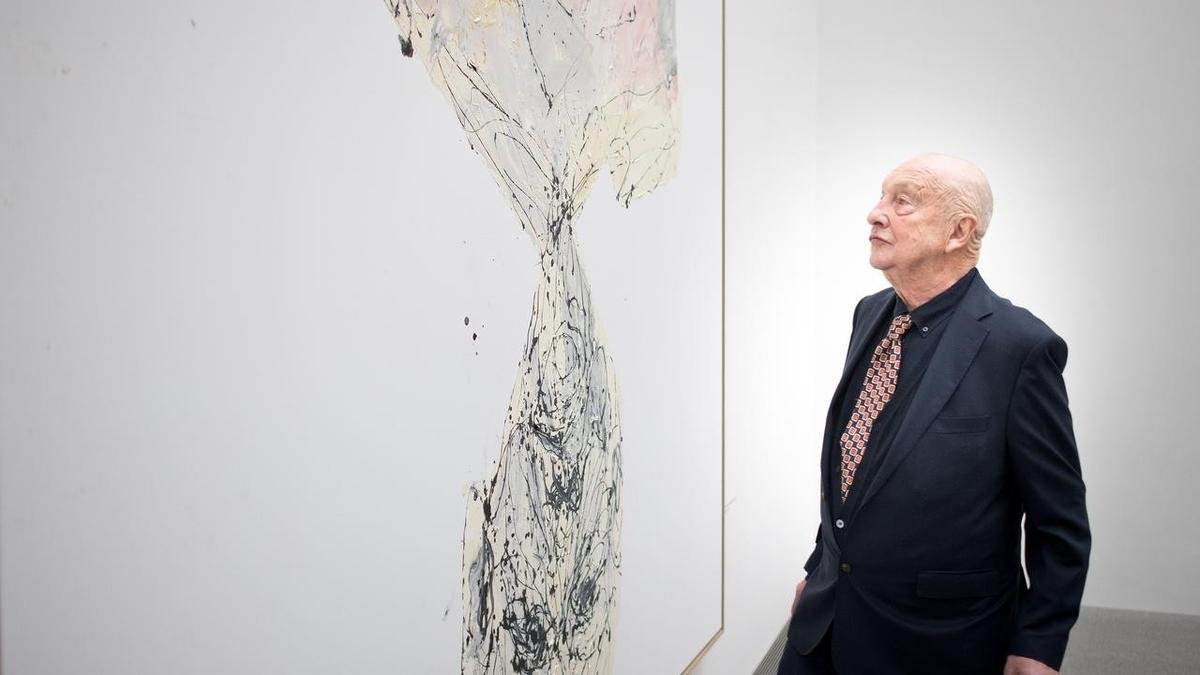
He created completely inverted plays like The Wood on Its Mind and The Man by the Tree after earlier tests that produced half inverted or fractured numbers.
He didn’t just roll the finished pictures; he created and painted them inverted right away.
How visitors read his works altered as a result.
By distorting reputation, it forced attention to the mechanics of painting, which were the color, balance, and structure.
Because it is inadequate as an object, an image painted upside down is not suitable for painting, according to Baselitz.
In the 1970s and 1980s, Baselitz became a global figure as the market and institutions that previously treated him since shocking gradually made him a pillar of German post art.
Later, Baselitz moved his brushes and paints in a rolling cart and moved large canvases from his wheelchair.
In my case, the wise thing would naturally be to say,” I stick to small formats,” he told El Pais at the age of 87.
” But of course, I don’t act in a way that’s logical.” What’s best for me is the absurd.