
source : the age
Aboriginal and Torres Strait Islander readers are advised that this story contains an image of people who have died.
My grandfather as a boy in the late 1800s lived on a farm that sat on the bank of a river, the family homestead occupying a rise above a spread of the stream so wide it deserved to be called a lake.
It brimmed with fish. Yabbies dug into its banks and waterbirds of all manner were drawn to it.
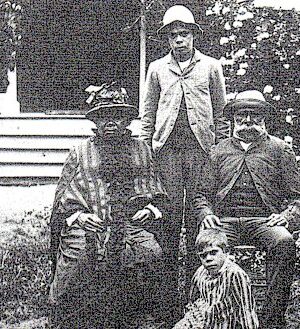
When the season was right, a woman named Kitty Wallaby – always known in our family as Mrs Wallaby, though she undoubtedly had an Indigenous name – set up camp by the lagoon, building a fire and a lean-to from bark.
She was given to puffing on a clay pipe as she contemplated whatever it was that built an air of serenity around her.
My great-grandmother, a woman of country generosity, ordered my grandfather and his brothers to go down and offer Mrs Wallaby a meal from the homestead.
My grandfather, late into his life, told the story many times.
‘This is my country, you know.’
Quote attributed to Kitty Wallaby
Mrs Wallaby, he said, announced she needed none of their food. She caught her own fish, thank you, and reached under the banks with her toes to fetch out freshwater crayfish.
“This is my country, you know,” my grandfather recalled her announcing.
The boy was offended. No it’s not, he argued. His father had bought this land. It was their farm. He’d been born there.
“No,” said Mrs Wallaby. “This is my country.
“But you are welcome to stay.”
My grandfather always thought this was amusing, and I’m not sure he ever quite got his head around its deeper meaning.
Kitty Wallaby was born not far from the river around 1834, the same dread time as Europeans set up permanent camp nearby at what would come to be known as Portland.
She managed to survive on the wetlands and the volcanic stone country of Victoria’s far south-west, marrying an Aboriginal man known as Billy Wallaby.
They had two children and were forced to live at the Lake Condah Mission, where the Wallabies gained a reputation for rebelling against the oppressive laws of the white managers, earning them frequent denial of rations.
The years passed. Billy Wallaby died. Kitty Wallaby took to travelling along the river in her traditional country, feeding herself and contentedly smoking her pipe.
And yes, she told my family, late arrivals to her world, that they were welcome to stay. Call it Kitty Wallaby’s welcome to country.
Recent events have stirred the memory.
Those who seem not to understand the word welcome and misconstrue the Indigenous meaning of Country have taken to booing today’s form of welcome, even in the dark of an Anzac dawn.
Adding dog-whistling and opportunistic weasel words, a politician who wants to lead Australia, the One Nation-spooked Angus Taylor, says he understands “the frustration Australians feel about overuse” of Welcome to Country ceremonies.
Overuse?
It’s a breathtaking observation from a politician who sits in a parliament that opens proceedings each day with a recital of the Lord’s Prayer, as it has done since 1918 (and since 1903 in the Senate).
Should any welcome be observed sparingly?
When I was a boy, no one crossed our doorway without being offered a handshake, a cup of tea and a seat at the kitchen table, where cakes or scones were placed before them.
It was such a ritual, this welcome to our little world, that once, when a pair of Jehovah’s Witnesses turned up at precisely the wrong moment and were ordered by my father to get off the property – he had just skinned his knuckles trying to get a water pump working – my mother demanded he go after the pair and apologise.
“We’re not like that,” she said. Civilised people, my mother meant, always had a welcome prepared for visitors to their home, whoever they were.
There is no culture across all the continents, surely, that does not have its welcome ritual.
The Maori people of New Zealand, for instance, practise the hongi – the rubbing of noses to share the breath of life between host and visitor. You’d be a brave fool to boo that ceremony.
The New Zealanders get quite a few things right – you needed only to hear the nation’s ethereal anthem, written in 1878, sung in the Anzac dawn or at the MCG for Saturday’s Anzac game. Half of it is sung in the Maori language.
Australia’s formal Welcome to Country, detractors moan, was created only in 1976 by Aboriginal artists Ernie Dingo and Richard Walley. It was to ensure Maori performers felt welcome at the Perth International Arts Festival.
The complaint is the denying of evolution. The 1976 welcome with which we have become familiar is simply a modern progression of rituals practised by Aboriginal people for tens of thousands of years.
In Victoria, each Aboriginal language group, or “nation”, observed elaborate welcome ceremonies to ensure the comfort of both hosts and visitors.
One such ritual was known as tanderrum, observed and recorded in 1845 by William Thomas, assistant protector of Aborigines in the Port Phillip region.
“There is not, perhaps, a more pleasing sight in a native encampment than when strange blacks arrive who have never been in the country before,” Thomas wrote. “Each comes with fire in hand (always bark), which is supposed to purify the air …
“They are ushered in generally by some of an intermediate tribe, who are friends of both parties, and have been engaged in forming an alliance or friendship between the tribes.
“The visitors are attended on the first day by those whose country they are come to visit, and not allowed to do anything for themselves; water is brought them which is carefully stirred by the attendant with a reed, and then given them to drink … victuals are then brought and laid before them, consisting of as great a variety as the bush in the new country affords.
“During this ceremony the greatest silence prevails, both by attendants and attended.”
We might dream of such a silence today as the ignorant, the boorish and the reprehensible stoop to booing one of the oldest ceremonies on this old land.
Get the day’s breaking news, entertainment ideas and a long read to enjoy. Sign up to receive our Evening Edition newsletter.
 Tony Wright is an associate editor and special writer for The Age and The Sydney Morning Herald.Connect via email.