
SOURCE :- THE AGE NEWS
April 30, 2026 — 5:00am
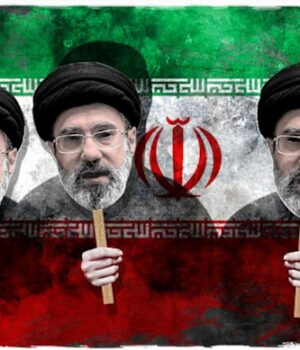
A recent video out of Iran has drawn attention over its inclusion of Supreme Leader Mojtaba Khamenei in a commemorative display of top regime figures martyred in the war.
Since he was elected in March following the killing of his father Ali Khamenei, Mojtaba has been neither seen nor heard by a nation at war and under fire, emerging only in cardboard cutout form in a viral clip (that later turned out to be AI-generated) which inspired derision, countless memes and parodies at diaspora anti-regime protests.
Mojtaba was elected by Iran’s Assembly of Experts, a body largely made up of ultra-loyalist clerics, some of whom reportedly had to be strong-armed by the Islamic Revolutionary Guard Corps into choosing him.
Reuters has published reports that Mojtaba is receiving treatment for severe limb and facial injuries sustained in the bombing that killed his father. Quoting sources within the regime, The New York Times has claimed that the new supreme leader is sequestered away in a high security medical facility being treated by doctors including, bizarrely, current Iranian President Masoud Pezeshkian, who in his former life was a heart surgeon. As a fig-leaf leader with seemingly even less power than before the war, one can imagine that Pezeshkian would have the time.
While “Mojtaba” has released several written statements that have been read aloud by anchors on state television, no definitive proof of life has been offered. As time passes, the nickname “cardboard Ayatollah” seems more apt.
While regime propaganda emphasises that Mojtaba is lucid and making decisions, it appears that at most there is some ventriloquy at play, in which case the most interesting question is: who is writing the statements? The other possibility is perhaps the most obvious one: Mojtaba is dead, and it suits the regime to create an interregnum of sorts to postpone the inevitable scramble for power that will ensue after the war is over.
The Islamic Republic has long featured multiple and competing centres of power, often played off against each other by the supreme leader in a chaotic yet effective strategy of divide and rule that prevented any one faction from becoming more powerful than the regime itself. This is why Iran has a duopoly of armed forces, intelligence organisations, clerical advisory bodies and even court systems.
For instance, if Iran’s regular military, the artesh, is in constant competition with rival armed factions within the revolutionary guard, the likelihood that either will stage a coup or otherwise challenge the authority of the supreme leader is thought to be less.
Now the puppet-master at the top of this organised chaos has effectively been eliminated, unless Mojtaba – like Shiism’s revered Hidden Imam – emerges from occultation in his hospital bunker to lead the faithful once more. Trump has remarked that “nobody knows who is in charge, including them” claiming that there is “tremendous infighting and confusion” within the regime’s leadership. He had earlier wondered whether the US and Israel had killed too many political leaders, lamenting that, “We want to talk to them, but there’s nobody [left] to talk to.”
Much of this could be written off as typical Trumpian bluster, of course. If Trump was sophisticated enough to plan his Truth Social posts in advance, they might even be characterised as deliberate psychological warfare.
His statements have clearly touched a nerve – on Sunday a string of senior Iranian leaders, all posting on X despite a complete internet shutdown, published the same message in a show of unity: “In Iran there are no ‘hardliners’ or ‘moderates’. We are all Iranians and revolutionaries. With ironclad unity of nation and state and obedience to the Supreme Leader, we will make the aggressor regret. One God, one nation, one leader, one path; victory for Iran, dearer than life.”
It’s true that there no longer seem to be any moderates worthy of the name left within the regime, if there ever were any. But disunity among the disgruntled and paranoid band of hardliners who remain has become harder to disguise since the ceasefire took effect. Some of these hardliners had decamped to Islamabad, Pakistan, for talks with “the Great Satan”, only to be undermined by those who had remained behind who claimed negotiators were crossing red lines supposedly set by Mojtaba around Iran’s right to uranium enrichment.
Some have asserted that Iran should refuse to place the issue of the country’s nuclear program on the table at all, whereas others within the negotiating team adopted a more pragmatic position, aware that the US would likely walk away otherwise.
Reports are swirling about a top-secret letter written to Mojtaba by senior officials involved in the negotiations, including President Masoud Pezeshkian, Foreign Minister Abbas Araghchi and Parliamentary Speaker-cum-internet-troll Mohammad Bagher Ghalibaf, who led the delegation. In it, the Supreme Leader is warned of imminent economic collapse unless Iran agrees to negotiate with the US over its nuclear program. Another hardliner jostling for power, Iran’s former chief nuclear negotiator Ali Bagheri Kani, is reported to have refused to sign the letter and instead leaked it to even harder hardliners to depict the signatories as insufficiently loyal to the elusive supreme leader.
This squabbling among hardliners is probably one reason the Islamabad talks fell apart. It also points to a serious vacuum at the very top. During the negotiations over the 2015 Joint Comprehensive Plan of Action nuclear agreement, supreme leader Ali Khamenei was ultimately able to push the deal through despite entrenched opposition from hardliners and the Islamic Revolutionary Guard. It appears now that each faction has its own interpretation of Mojtaba’s negotiating position, made all the more confusing still by the fact he is evidently not available to clarify it.
During the war, Iran’s “mosaic defence” strategy of decentralisation successfully limited the impact of efforts to decapitate the regime from the top. However, Islamabad has shown us that mosaic negotiations are a recipe for little more than division and infighting. With the cardboard Ayatollah unable to impose his authority from either morgue or hospital bed, Trump may have to wait for the regime’s squabbling hardliners to have it out before meaningful progress can be made on bringing the war to an end.
Kylie Moore-Gilbert is a research fellow in Security Studies at Macquarie University and a regular columnist for The Age and The Sydney Morning Herald. She is the author of The Uncaged Sky: My 804 Days in an Iranian Prison.
The Opinion newsletter is a weekly wrap of views that will challenge, champion and inform your own. Sign up here.
 Kylie Moore-Gilbert is a research fellow in Security Studies at Macquarie University and a regular columnist for The Age and The Sydney Morning Herald. She is the author of The Uncaged Sky: My 804 Days in an Iranian Prison.

