
Source :- THE AGE NEWS
At first glance, Woori Yallock looks like a normal grassroots club.
Nearly 72 kilometres from the heart of Melbourne, it has the typical wooden honour board in the clubrooms, the same canteen and traditional black-and-white photos of local footy club legends – more than 100 years of history lined up sequentially on the staircase wall.
But women’s footy player Emily Spicer says there is one crucial difference that sets Woori apart from other clubs – the culture.
“See that there,” she said pointing at the freshly renovated change rooms. “We asked for doors on the showers and walls in between each cubicle, and the new president agreed to put them in … That doesn’t happen often.”
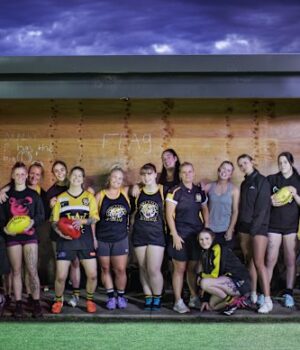
Woori Yallock women’s team comprises 22 players – 18-year-olds through to mums in their early fifties. Many of these women have defected from their former football clubs after experiencing inequitable treatment or inappropriate behaviour.
They say they’ve come to Woori to experience a better and safer culture – one that prioritises women’s footy.
Spicer is one of them.
The 35-year-old left her former club, Yarra Junction, after experiencing a “horrible environment” and inequitable treatment.
Spicer – who served as Junction’s women’s football coordinator – said the team’s requests for more oval space were knocked back, and some within the club made off-hand jokes about “women belonging in the kitchen”.
Other incremental things followed. The women’s team asked for drink bottles and didn’t get them until the second-last game of the season. Despite ordering their uniforms in January, the women didn’t get the jumpers until May, while the men’s teams got theirs in March, before the season started.
On one occasion, Spicer said the women’s team was bumped off a Saturday timeslot in favour of two under-18s boys teams from a different club.
Towards the end of 2023, Spicer and 11 other players left Yarra Junction; shortly after, the team folded.
The negative experiences extended beyond Yarra Junction. Spicer said during her time at the club, an opposition coach yelled abuse at her on the field.
Following a similar experience with the same coach after she moved to Woori she took to social media to air her complaints. It resulted in the league finding her in breach of its social media code, and she was banned for two matches. She said Woori supported her throughout the process.
Spicer’s Woori teammate Rachael Lee also played for Yarra Junction, and described the club as having “a very negative perception of women’s footy”.
“On Thursday night dinners, you’d go to the club, and we just weren’t acknowledged by the rest of the club or other teams,” she said. “We were very separate.
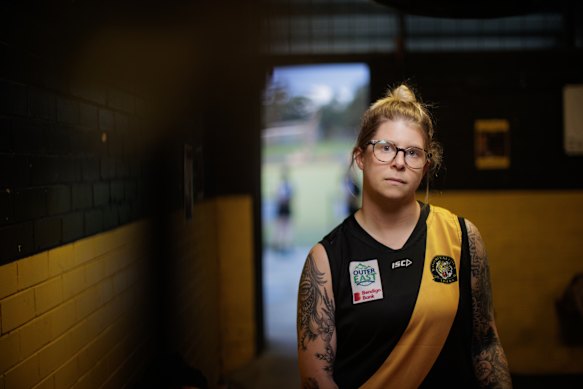
“For canteen duty, we were expected to have three or four girls on canteen every week. Whereas, the men’s had two full sides of men and netball had four teams. It felt like it wasn’t equal in taking those jobs around the club.”
Another Woori player, Alex McInnes, who previously played for another footy club in the Outer East Football Netball League, described the environment at her previous club (which she declined to name but is not Yarra Junction) as disrespectful.
“During some of our games, the men would line up on the sidelines and laugh or heckle at us if anyone made a mistake, that was really awful,” she said.
If she or another player tried to raise their concerns about the lack of available training space or lack of uniforms, they were told not to bother complaining because “the men brought all the money in”.
Since moving to Woori, McInnes has noticed a fundamental difference in the way women’s footy players are treated.
“The culture is amazing, you feel really welcomed and embraced and actually treated like a footy team, not a burden.”
This masthead sent Yarra Junction questions about the club’s culture and treatment of their former women’s team, including the specific issues raised by Spicer and Lee.
In a statement, the club said it did not need to address the allegations “nor expend too much energy on it.
“There is 90 per cent fiction and 10 per cent truth in what has been sent through, including allegations that are not within our control whatsoever (game times and shipping of jumpers),” the club said.
“We would be very happy for you to speak to other women who played in that team, who are still involved heavily in our club today and/or, speaking to our netballers who were here then and are still here now, to see how they feel around our football/netball club.
“These false accusations are attempting to drive a narrative and turn this into a men vs women battle, which is disappointing. I gather this is what the article is insinuating also.”
This masthead asked Yarra Junction for the contact details of female footballers who would be happy to comment. The club did not respond.
Why are women leaving local footy clubs?
Following the launch of AFLW in 2017, women’s and girls’ participation in footy skyrocketed, from 600 teams in 2015 to more than 2500 in 2022.
However, in 2026, this number has slightly decreased to about 2380 teams (with some junior competitions numbers still being finalised).
In 2022, the AFL Commission approved an investment of more than $5 million for phase one of the Women and Girls Action Plan, designed to drive equal participation and representation for girls and women in grassroots football by 2030.
Despite the huge cash injection, many women’s sides across Australia, especially in regional areas, are folding or merging due to low numbers. Anecdotally, more stories have emerged of women leaving footy clubs because of unequal treatment, sexism and poor culture.
In dozens of interviews with female footballers, former AFLW players, VFLW umpires and other footy figures, this masthead found a common issue was allocation of resources, including limited or no access to facilities such as change rooms, toilets and training grounds.
Another factor was a perceived “boys club” culture, including instances of sexual harassment, inappropriate behaviour or sexist comments. This masthead has respected the wishes of those who have suffered alleged sexual harassment and has not detailed their experiences.
Many women said when they raised concerns with their club or escalated the matter to the league, they were not sufficiently supported.
Former VFLW umpire Sean Lowe has umpired more than 500 local women’s footy games and has seen both sides.
“There are clubs who really separate themselves from the women’s program, they hold separate presentation nights and separate social nights,” he said.
“But I also know of women’s programs [where] … with the boost in memberships, they’ve financially saved clubs and been embraced.”
When asked why some clubs struggled to embrace women’s teams, Lowe paused.
“That’s a big question,” he said. “I think some people have been at those footy teams a long time, for generations and then all of a sudden, there’s a women’s team, and sometimes, they don’t like that.
“It’s hard to shift a culture once it’s set into a club and they’re happy the way it is, especially when they think there’s not a problem.”
AFL executive manager of game development Rob Auld said the league was committed to providing a safe, inclusive and respectful environment for women and girls at all levels, noting participation had increased by 45 per cent since 2022.
“While we have seen significant growth, and in general clubs are embracing women and girls’ football and the opportunities it brings, we recognise there are challenges in some regions and that cultural change takes time,” he said.
Sexism and harassment within local footy
In March, footage of an Australian rules official in NSW making derogatory remarks about female players’ bodies went viral.
The commentary was captured on a video at a Collingullie Wagga Demons women’s match, where the official could be heard referring to women as “breeders” and saying a female player should lose weight.
“She could be a good player if she lost a bit of weight. She just can’t [expletive] move,” the official said.
“We’ve got a real issue in our society overall, the body shape of women … they’re our breeders, mate … because of the food they’re eating, even the young girls, the shape’s all wrong.
“You think about when we were growing up … the body shapes of girls … you hardly saw any fat girls. It was rare.”
The Collingullie Wagga Demons posted a statement confirming the official had “stepped down from all club duties effective immediately,” and said the behaviour was unacceptable.
A member of the Collingullie Wagga Demons women’s team, whose name was withheld for privacy reasons, said none of the players wanted to revisit the painful incident, but commended the club for acting quickly.
“It was dealt with straight away by the club and they did a fantastic job at doing so,” the player said.
Many female footballers from leagues across Australia said it was common to hear derogatory remarks or sexualised comments about female players’ bodies from crowd members or club officials.
Others reported incidents of sexual harassment from male players or senior figures within the club.
Former AFLW player Ashleigh Guest told this masthead she was heckled and spat at by a group of young men while playing in her local league’s grand final in 2025.
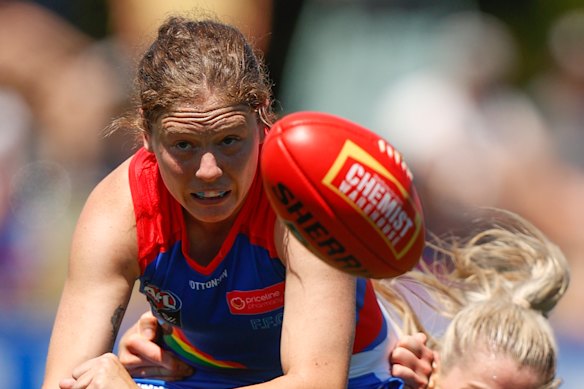
During the decider between Yarraville Seddon Eagles and Caroline Springs, Guest said the group jeered and heckled her from the sidelines and during the final quarter she heard them spit at her.
“I jumped up straight away and was like, ‘Did you f—-ing spit at me?’ and they just laughed,” she said.
The incident was reported and the Western Football Netball League investigated but concluded there was not enough evidence to substantiate the claim.
Guest was disheartened by the incident and did not return Yarraville for the 2026 season.
“It was really degrading, I’m bending down … and a man standing over me and spitting, it was pretty horrific,” she said.
When contacted by this masthead, the WFNL said following a “thorough review process, including consideration of available vision and relevant witness accounts”, the allegation could not be substantiated.
“The WFNL is committed to providing a safe, inclusive and respectful environment across both football and netball, particularly for women and girls, and works closely with clubs to reinforce standards of behaviour and promote a culture of respect, safety and inclusion for players, officials and spectators,” the league said.
The battle for space, resources and investment
When Aaron Donatti got the call in 2025 to be become the head coach for Kingsley Football Club’s women’s team in Western Australia, he was overjoyed.
The former player was keen to progress his coaching career and to guide Kingsley – a prominent club in Perth’s northern suburbs – to success. He had previously worked as assistant coach for the reserves and had already noticed a stark difference in the way the women were treated compared to their male counterparts.
During the 2024 season, Donatti said the club held a ladies’ day on a date when both women’s footy teams were playing 40 minutes away.
“I thought, oh that’s just poor planning, or maybe limited calendar space, so I let it go, but then more stuff came up,” he said.
“The reserves girls were playing in six-year-old jumpers with mixed or missing logos, which wasn’t great.”
On behalf of his players, Donatti brought concerns to a 2024 AGM and thought he’d see a change. However, issues worsened during the 2025 pre-season.
Donatti said the two women’s teams, made up of about 50 players, had to train together at Barridale Park, away from the club’s main oval, where a public toilet was the only option for a change room.
Despite repeated requests, Donatti said the club was unwilling to negotiate shared training spaces or alternative solutions. The issue came to a head at a meeting where he and the playing group raised concerns around training at the separate oval and the lack of resources.
“It turned a little bit heated and the club came back with rebuttals to all of the suggestions and said ‘Oh no, this is how it’s always been’,” Donatti said.
“As a male footy player, I was like, well, we’ve never had this issue before.”
Days later, Donatti received a phone call informing him he’d been let go.
Donatti’s departure triggered a mass exodus from Kingsley women’s football team.
“It was heartbreaking,” Donatti said. “I was in a state of shock and had a bit of a downwards spiral”.
Donatti has moved on to coach another women’s team at North Beach Football Club. He says problems within grassroots footy will continue to exist if clubs refuse to adapt.
When contacted by this masthead, Kingsley said the 2024-25 pre-season was “a challenging period” for their women’s program and the club.
“A breakdown in communication led to frustration for some players, and despite genuine efforts to address the concerns including a PFL [Perth Football League]-led mediation, we were unable to reach a resolution for everyone involved,” they said.
“While a number of players sadly chose to move on, others remained, and their views were not reflective of the entire group. We have apologised both privately and publicly to those who felt unheard and wish them all the best.”
Kingsley said they had learned from the experience and have implemented improvements, including better communication processes and appointing a Women’s Liaison Officer.
More than 5000 kilometres away in far north Queensland, veteran footy player Kareena White also fought for more resources and support from her club.
After winning four premierships and playing more than 200 games for the Manunda Hawks, White made the painful decision to leave in 2025, when the club declined to invest more women in the women’s side.
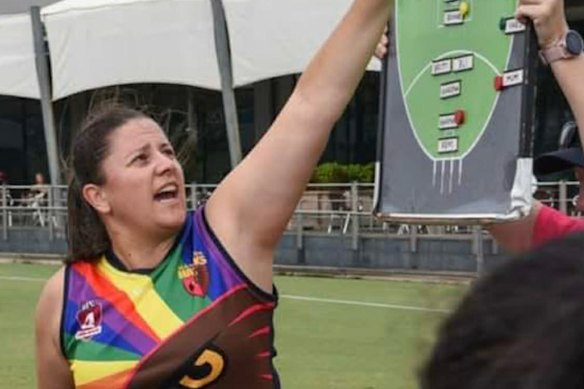
After a merger of the Hawks’ women’s and men’s operations under one committee in 2024, White said issues emerged around training ground availability and resources.
White approached the club and asked for “maybe 30 per cent” of the men’s budget in the hope of getting better equipment and paying some of their top players around $50 per game.
“For example they’d allocated $66,000 to the senior men’s team to player payments and approximately $1200 to the women.”
White said the club refused to invest any more money in the women, despite the team’s ongoing success.
“We didn’t expect to be paid the same as the men’s team,” White said. “But we were hoping to have a dialogue with the club so we could keep building.”
White and women’s coach Ryan Galea and other players left the club. Despite meditation attempts from AFL Cairns, the club was unable to field a team in 2025.
The Manunda Hawks told this masthead that after withdrawing their women’s team in 2025, they were determined to field one in 2026 and they now have the second-highest registration for senior women in the Cairns league.
“We remain committed to creating a safe and inclusive environment for women and girls at our club, while also acknowledging that cultural change can take time and is a work in progress,” they said.
White now lives in Hervey Bay and she and her partner are eagerly awaiting the birth of their second child.
When asked if she had started playing footy again, White paused.
“No, but the neighbour is trying to convince me,” she laughed. “I think I’m probably still a bit hurt by everything.”
The club without a men’s team
Thornton Eildon, nestled on the banks of the Goulburn river, has a population of only 311. But the change rooms at Thornton Recreation Reserve are chaotic on game day.
It’s a sun-soaked Saturday afternoon and the women’s footy team are getting ready to face the Wandin Bulldogs. The Shinboners had a huge changeover in players last year, so for many, this is their first game of Aussie rules.
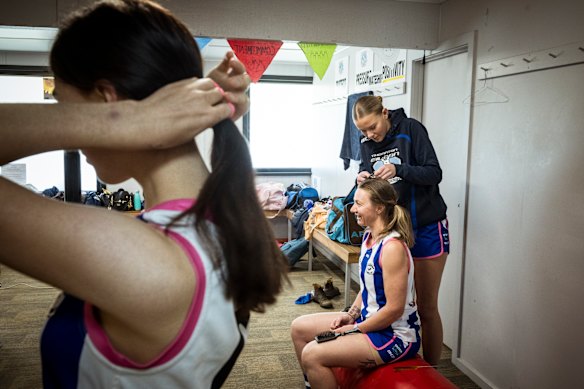
Girls line up to get their hair braided, while others take turns strapping their shoulders and feet with pink tape, while the group’s Spotify playlist blasts in the background.
In 2020, the men’s footy side and netball teams folded after struggling with numbers. There are no men’s footy teams in Thornton Eildon, but their standalone women’s team is thriving, and the club has always supported the idea of bringing a men’s team back.
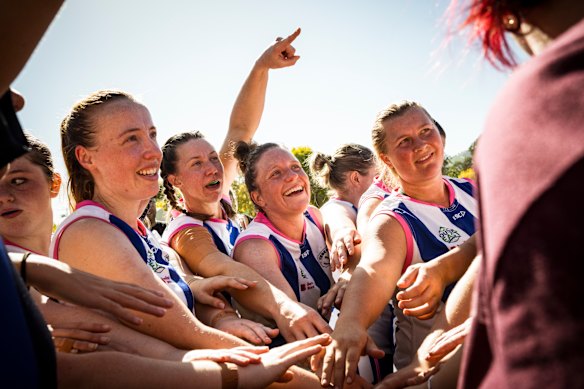
Magenta Connolly moved to Eildon in 2018 after quitting her Melbourne job.
She didn’t know anyone but says the women’s footy team welcomed her and the inclusive club environment is defined by acceptance and camaraderie.
Officials have applied for grants to hire babysitters, so players can train in the evenings, while older kids are welcome to join in and help out with drills.
Connolly is aware of the difficulties other women’s teams have experienced, but notes cultural change will take patience and time.
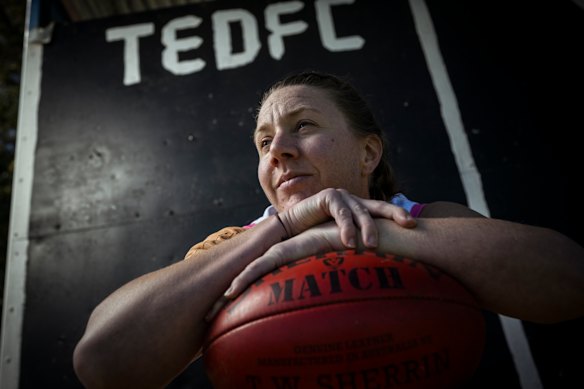
“Footy is very generational and there’s still very much an old guard standing in the way saying ‘that’s not how they did it in my day’,” she laughs.
“You’re not going to miraculously change somebody’s mindset that they’ve been in for the last 50 years.”
She hopes that more footy clubs will see the benefits of welcoming women’s teams.
“Here at Thornton, we are bringing the next generation of juniors through that club, whether they be female or male,” she said. “We’re bringing a new generation of footballers through, and that’s really exciting.”
Keep up to date with the best AFL coverage in the country. Sign up for the Real Footy newsletter


