
source : the age
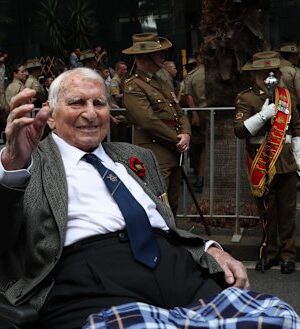
Roy Pearson, 99, sat in a wheelchair near the start of the Anzac Day march in Sydney’s city centre with slippers on his feet, medals on his chest and a red poppy crocheted by his late wife as a buttonhole. As the military bands warmed up, the WWII veteran smiled and spoke of peace.
“War never solves anything,” Pearson, who served as a machine gunner in the airforce, said. “We need to wake up to ourselves.”
Pearson was one of many thousands who gathered in ceremonies across the country on Saturday to honour Australians who have served and died for their country. The day was marked by music and banners, hearty greetings, tears, the singing of hymns and the laying of wreaths – as well as outbreaks of loud booing from some during Aboriginal acknowledgments of Country.
In Sydney police confirmed a 24-year-old man was arrested for “an alleged act of nuisance” and others were moved on from the dawn service at Martin Place.
Betty Niblett, a 92-year-old veteran of the Women’s Royal Australian Army Corps, said she was glad to see young people involved in the defence forces and sorry that national service was no longer in place.
“The world’s all upside down, isn’t it,” she said. “You’ve got to be prepared. Don’t get caught with your pants down.”
By 4:20am, large crowds had already assembled in the dark for the dawn service at the Martin Place Cenotaph, wearing everything from neatly-pressed uniforms to hoodies. A camera drone winked above the proceedings, whose attendees included Premier Chris Minns, opposition leader Kellie Sloane, federal Social Services Minister Tanya Plibersek, Governor Margaret Beazley and acting head of the RSL, Brigadier Vincent Williams (retired).
“It’s much bigger than I thought,” said John Murray, a Vietnam veteran who made the trip from Brisbane to see what he believed was the biggest dawn service in Australia. The son of a Rat of Tobruk, Murray wore a blue RAAF cap and a row of medals pinned to his coat, including a British Empire Medal for his services in medical evacuation.
“They do it very well here,” he said of the ceremony.
The minute of silence was solemn, unbroken. But earlier, a number of crowd members booed loudly and repeatedly during an Acknowledgment of Country by Uncle Ray Minniecon.
Minniecon, whose grandfather served with the Light Horse Brigade, continued despite the interruption and was applauded when he finished.
“We have experienced this type of racism for over 200 years,” he told media after the service. “One of the questions that we have in our minds is: What crime did we commit to attract this kind of racism?”
NSW Police in a statement said officers responded to an alleged act of nuisance and arrested a 24-year-old man.
Welcome to Country addresses in Perth and Melbourne were also interrupted. At Melbourne’s Shrine of Remembrance, a small group of men booed again when Victorian Governor Margaret Gardner acknowledged the Bunurong people of the eastern Kulin nation at the start of her speech. Last year, a Welcome to Country during a dawn service in Melbourne was booed by members of the neo-Nazi National Socialist Network.
Official reaction has been fast and furious. Defence Minister Richard Marles branded the booing “deeply disappointing”.
“Acknowledgements of Country are just an act of respect – and what characterises today is, it is a day of respect,” Marles told ABC TV. Premier Chris Minns said he, too, was disappointed by the actions of a small number of people.
“Whilst I’ve never before heard booing like that at a dawn service, I’ve also never heard a crowd spontaneously applaud as they did for Uncle Ray Minniecon,” Minns said.
Victorian Premier Jacinta Allen said that booing “disrespects everyone who fought and died for our freedom” and that “politicising this sacred day is bastardry”.
On Saturday morning, the organiser for the anti-immigration March for Australia movement, Bec Freedom, posted on Telegram “Sydney boo’d”, followed by a salute emoji.
March for Australia is closely linked to the National Socialist Network, which claims to have disbanded to avoid being proscribed as a hate group.
Emile Tauati, a warrant officer in the navy, said everyone was entitled to their opinion but “I do believe there’s a time and a place”. Tauati woke at 2am to attend the “very moving” service, his first in his hometown of Sydney after 16 years of military service. In previous years he was away, on base or at sea.
Paul Simpfendorfer, a warrant officer in the army who most recently deployed to South Sudan, said he was there to “remember people I’ve served with”, some of whom had lost their lives in operations, others in training.
“For me, it’s paying respect to my forebears,” Simpfendorfer said. For Jermia Nona, who has spent three years in the airforce, Anzac Day builds a sense of camaraderie between the different parts of the defence force. “This is where we all get to come together and remember.”
Stacey Nicholson attended her first service with her partner and two-year-old son Bodhi, who sucked on a pacifier while toying with a commemorative sprig of rosemary.
“I think it’s always important to honour our history,” Nicholson said. “We are very, very lucky in the life we have.”
Where to commemorate Anzac Day in Sydney?
The major official commemorations are taking place at the Martin Place Cenotaph and near the Anzac Memorial in Hyde Park.
NSW will have a public holiday on Monday, April 27, as April 25 falls on a weekend this year. The Monday public holiday is part of a two-year trial that will also capture Anzac Day falling on a Sunday in 2027.
The dawn service was followed by a march along Elizabeth Street at 9am, before a commemoration service at the Pool of Remembrance, near the Anzac Memorial in Hyde Park at 12.30pm. A sunset service will take place at the Martin Place Cenotaph at 5pm.
Other community events are being held around the state by RSL sub-branches. In Parramatta, a march gathered at the town hall at 4am, proceeding to Prince Alfred Square before a dawn service at 4.30am.
In Penrith, the dawn service assembled outside the Penrith RSL club before a silent march to Memory Park.
A Newcastle dawn service commenced at 5am at Camp Shortland on Nobbys Beach, before a march from Perkins Street to Civic Park at 9.15am and a commemoration service at Civic Park Cenotaph at 10am, featuring an RAAF flyover.
A Wollongong dawn service, also at 5am, was held at the MacCabe Park Cenotaph on Church Street, followed by a march on Crown Street at 10am.
How to get around the city on Anzac Day
Major road closures are in place throughout the day and public transport is encouraged. Travel is free for veterans, currently serving ADF personnel, and their families. Eligibility applies for people in uniform, wearing their medals or with proof of military service.
Additional services are running to Martin Place, but light rail services will pause between 12.30pm and 1.30pm. Buses through the city may take different routes and stops.
What’s open and closed on Anzac Day?
Anzac Day is a restricted trading day. Major retailers, including supermarkets and department stores, will be closed all day.
Small shops, chemists, newsagencies, service stations, cafes, takeaway food outlets and licensed venues can open. The public holiday on Monday is not a restricted trading day.
Where can I play two-up?
Chances are if a pub is open on Anzac Day you’ll be able to play two-up there. It’s one of the three days of the year the game, played by World War One Diggers, is allowed.
Venues don’t need a permit but have to ensure the game is played in its traditional format. Liquor & Gaming NSW inspectors will be checking.
with Holly Thompson
Start the day with a summary of the most important and interesting stories, analysis and insights. Sign up for our Morning Edition newsletter.
 Jack Gramenz is a breaking news reporter at The Sydney Morning Herald.Connect via email.

