
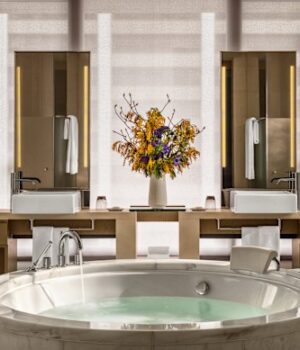
Source : the age
When Mandarin Oriental The Landmark, Hong Kong reopens on June 1 after an extensive renovation, it will carry forward a story that closely mirrors the city’s own across the past couple of decades.
Mandarin Oriental The Landmark, which opened in 2005, is the sister property to the Mandarin Oriental, Hong Kong, which opened in 1963. It is part of the Landmark development in Central, which emerged in the 1970s as the district was becoming a financial centre. The complex quickly established itself as one of the city’s defining commercial addresses. At the same time, a different kind of traveller was arriving in Hong Kong, not just passing through, but staying, working and returning.
The Landmark was shaped by that. It wasn’t conceived as a grand, harbour-facing address like its venerable sister, but as something embedded in the city’s daily life – a place to stay with a sense of privacy and residence. Since 2005, the hotel has functioned as a base for guests who return often and stay long enough to settle into the city’s rhythms. It has also tracked those rhythms, shaped by the rise of Mainland Chinese luxury travel, the expansion of Central as a retail and dining capital, and a growing emphasis on design-led hospitality.
The Landmark precinct has also evolved in parallel, becoming one of the city’s most tightly curated luxury enclaves, where global fashion houses, fine dining and wellness sit side by side.
Sign up for the Traveller Deals newsletter
Get exclusive travel deals delivered straight to your inbox. Sign up now.
That’s all key to the 2026 reopening of Mandarin Oriental The Landmark. The redesign, led by Hong Kong interior architect Joyce Wang, introduces a new arrival via Queen’s Road Central, where a mansion-like foyer creates a gradual transition from the street into the hotel. Wang, who has offices in Hong Kong and London, is known for beautiful retail, restaurant and hotel projects. Her portfolio includes award-winning work at the Hollywood Roosevelt and The Berkeley, London.
“For this latest renovation, we were inspired by the identity of our hotel as a pied-a-terre for our guests to feel the pulse of Hong Kong,” Wang says.
The interiors draw on local references such as historic residences, local materials and commissioned artworks in public areas and rooms.
“The curated pieces are windows into expressions of our city through the lenses of both local and international, and emerging and established artists,” Wang says. “As you journey through the hotel, we hope these storied perspectives fill you with curiosity and contemplation.”
The rooms, which start at 42 square metres, are designed as urban sanctuaries, with softened palettes, tactile finishes and custom detailing.
Food has long been central to the hotel’s identity, and that remains unchanged. Under star chef Richard Ekkebus, the property has developed one of the most concentrated fine-dining line-ups in the region. Amber, with three Michelin stars and a Green Star, sits alongside Sushi Shikon, Kappo Rin and SOMM, together forming a destination that draws diners from across the city and beyond.
New additions, including a dedicated champagne bar and an artisan coffee space, extend that offering into more informal territory.
A revitalised spa and wellness program, opening shortly after the hotel, reflects another layer of how the property has evolved alongside its guests. Facilities now include dedicated studios for Pilates and yoga, alongside treatments that combine Eastern and Western approaches to wellbeing.
The setting, of course, remains constant. The Landmark complex has come to represent Hong Kong’s position as a global centre of commerce and luxury retail, maintaining a close relationship with the city around it. And as the city continues to shift, the hotel’s role remains much the same: a place not to observe Hong Kong from a distance, but to live within it.
 Julietta Jameson is a freelance travel writer who would rather be in Rome, but her hometown Melbourne is a happy compromise.Connect via email.