source : the age
Australian and international cultural authorities have called for an end to “tribal auctions”, as well as the return of culturally significant objects that are being sold on the open market to wealthy art collectors and investors.
So-called tribal auctions are held around the country, and a recent event by McKenzie Auctioneers held in Perth advertised a number of items from Papua New Guinea, Indonesia, Fiji, and Indigenous communities across Australia. The objects for sale included a didgeridoo, a magician staff, message sticks and a bridal veil.
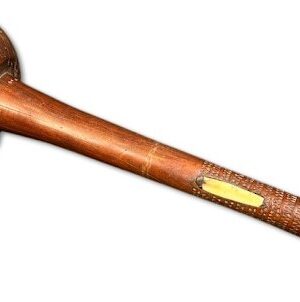
One object featured in an advertisement in a newspaper servicing Perth’s wealthy western suburbs was a Fijian throwing club – or an ula – which was typically carried by warriors and was used a ceremonial object. It sold at the Claremont-based auction for $800.
West Australian Fijian Association secretary Iliseva L Qalovaki said the community would like to see the ula handed back.
“This piece holds deep cultural, historical and ancestral importance to our community,” she said.
“After consultation with key community members, we kindly request that the artefact be repatriated to Fiji where it can be preserved and cared for within its cultural homeland.”
Another Fijian object – a Kinikini war club, which was crafted for Fijian chiefs and priests – fetched $8000 at the same auction. The clubs are considered by auctioneers and other valuers as “highly valuable collectables”, and are made of hard wood with ivory inlay.
A number of Indigenous artefacts were also on display at the auction, including shields, baby carriers and glass spearheads, from locations around the country including the western desert, the Kimberley and southern Australia.
Tom Lawford, a spokesman and cultural advisor for the Kimberley Aboriginal Language and Cultural Centre, said he was disappointed the items were up for sale, and said the practice of tribal auctions needed to end.
He said in particular, a 1920s-crafted Wunda shield and glass spear points that were advertised by the auction – and have since sold for $1400 and $600, respectively – should have been handed back to Kimberley communities.
“They shouldn’t be auctioned at all,” Lawford said. “We need the points and the shield back.”
Lawford said if auctioneers intended to sell off culturally tied or significant objects, they needed to consider the impact.
“They should stop auctioning tribal stuff, period,” he said.
“Or contact us if they have cultural objects that they want to auction.”
A spokesperson for McKenzie Auctioneers said they had a system to follow when it came to objects of cultural significance.
“Vendors sign a declaration with us that they possess and can pass good title. It goes without saying, if we had any doubt, we would not act as agent for the seller, in short, we wouldn’t accept the item,” she said.
“We accept [Lawford and Qalovaki’s] point, cultural sensitivities apply.
“You will notice, ceremonial items are not illustrated and are not on public view. A request is required for a private viewing. Generally, such items are used once – in our Indigenous cultures – and are then generally abandoned.
“Or, as with most tribal items are either gifted, sold or traded.
“For your information, Wunda shields are not rare. They were widely sold, traded, gifted, et cetera. The same with Pacific Island paddles, clubs, et cetera. These practices have continued ever since European contact and will likely continue into the future.”
The spokesperson stressed the items were not ill-gotten, and nor were they stolen.
“The owners often inherit them or have bought them. We regularly hear stories from descendants who remember their parents buying a raft of Aboriginal items when they drove across the Nullarbor plain in the 1960s and beyond,” the spokesperson said.
“There have been such schemes in the past to repatriate old tribal items.
“Perhaps a good story to follow up on, these past endeavours, to see just where such donated items ended up.
“We believe there should be a call for donations, but then as well a review of administrating dispersal to ensure these items do not end up on the public market again.”
McKenzie Auctioneers said, ultimately, they had never experienced pushback from Aboriginal entities or corporations, who had in fact “bought many items” from the seller.
“In summary, it is our contention, that the possessor is the rightful owner, if they have ‘good title’. It is their right to deal with their legally and morally owned possessions, as they wish,” the spokesperson said.
“They have been grateful to be able to do this.
“They have never expressed any disapproval of us selling or displaying such items. I cannot minimise this point. They were grateful to be able to view and have the opportunity to acquire such items via a public forum where the market has dictated the price.”
A West Australian Museum spokesperson said there was no formal best practice guide on how tribal auctions could be conducted with minimal harm in the state.
The museum currently holds many Indigenous artefacts in its collection.
“We would hope that any auctioneer would establish, in the first place, that any items had been acquired legally and ethically, and in the second, that they would check with the appropriate communities in regards to their perspective on such a sale,” they said.
The WA Museum said it was always happy to help members of the public repatriate objects back to their appropriate country.
“This is, however, only possible if key details of the object are known, such as how and where it was acquired, and if the appropriate community has the capacity to receive and care for the object,” a spokesperson said.
Get the day’s breaking news, entertainment ideas and a long read to enjoy. Sign up to receive our Evening Edition newsletter.