Source :- THE AGE NEWS
April 21, 2026 — 7:34pm
We want to hear whether he was having an influence or whether he may have whispered something during the match.
We would like to hear if he had drank an illegal drug or been eating. Or if those choices are excluded, whether his incident was in some way connected to a prescription drug.
We want to know what led to him acting strangely, flapping his wings like Jim Carrey, while watching a crowd of almost 80, 000 and a million people compete in a physical challenge.
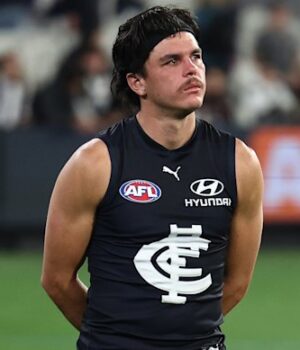
More significant than the supply of Hollands ‘ problems is the series of events that led to Carlton’s social failure to remove an sick football player from the area, on the chair, in the rooms, on the industry, and in the team’s box.
We are aware that Hollands ‘ doctors evaluated him during the game, called the appropriate psychologist, and allowed him to play on the field.
We are aware that Hollands informed the physicians that he was having problems.
And we are aware that despite his failure to do or lead, Carlton’s game-day activity, led by Michael Voss and his coaching staff, allowed him to continue playing.
So, it appeared as though the issue was one of silence rather than actions. All indications point to contact issues, judgmental errors, or both. Nearly no one on the American continent who watched the behind-the-scenes or social media images would resound in their opinion that allowing him to play on the field was acceptable.
Of course, it is possible or probable that the Blues weighed in on the fact that a ) Hollands had been productive this year following his pre-season restraint, b ) that he had had issues with games in the past and overcame them, and most importantly c ) that the medical team and psychologist have treated him in the past and do not believe they could override experts on performance or welfare grounds.
What is more important is the connection between the parties responsible for this embarrassing guilt for the club and Hollands. Carlton’s accounts may include who was aware of what during the game, what they exchanged with other players regarding Hollands ‘ position, and why the decision to leave him on the industry for so much was finally made. The AFL requests complete answers to all of those issues.
At the time of reading, Carlton’s top athletes ‘ roles are largely unknown. It would be comforting to know that Hollands ‘ struggles were noticed by colleagues and particularly team leaders and that they raised some concerns. They won’t have the might, as Voss and his team might, but it would be comforting to know that they will. If elucidate us rapidly, Patrick Cripps, and Jacob Weitering.
This is secondary to the fact that some Collingwood people thought Hollands was tipy or no: that they had noticed that he was acting strangely. If opposing players were more attentive to Hollands ‘ troubles than his colleagues, it would be incredible.
Hollands, whose problems with substance use and mental health have been reported to this mast, was lucky to be given a second opportunity by the Blue this year. Given that some calls were made before Carlton reinstated him on the list, it would be acceptable for teammates to subject them now.
Although remarkable in various ways, Carlton’s choice to show devotion may have been ineffective in Hollands ‘ interests because he wanted to keep him on the field and to support him in turning things around.
Voss would have been asked in his post-game press conference why the person had been yanked off in the middle of the match if he had been quietly removed at half-time, like a sub out participant who don’t feel it.
The answer that comes to mind may be” He was unwell.”
What did he do bad, exactly?
The manager may have made an omission or given no further details. No one would doubt the removal of a person who had not yet touched the game during the first crowded hours.
The Carlton Football Club could have saved the person and themselves from the continuous consequences, which include distraction, a media carnival, a negative reputation, and prospective career damage, that both parties are currently facing.
 Jake Niall is The Age’s general AFL author and Walkley award-winning activities blogger. Use X or contact to join.