
Source : INDIA TODAY NEWS
“Earlier, whatever I earned, I would somehow save and send Rs 5,000 home to Bihar every month. That amount has now come down to Rs 3,000,” says a worker at a ceramic factory in Uttar Pradesh’s Khurja. “On the one hand, the cost of refilling cooking gas has jumped from Rs 90 per kg to Rs 400. On the other hand, the prices of groceries and vegetables have surged. On top of that, the kilns no longer burn the same. The LPG situation has weakened the fire,” he adds.
advertisement
The diminished heat of these kilns is now worrying the factory owners too. A ceramic factory owner, speaking to India Today Digital, says supplies of 422-kg LPG Hippo cylinders have been delayed by a week. “We’re now relying on costlier PNG. The godown is full of finished cups, mugs and vases, but there’s been a sharp dip in sales. And a majority of my workers, who are from West Bengal, have gone to vote in the Assembly elections,” adds the ceramic factory owner, who employs 15 people. Before the LPG crisis hit due to the war in the Middle East, his factory would produce 3,000 ceramic cups a day.
Just 85 km south-east of the national capital, New Delhi, stress has gripped both workers and factory owners in Khurja, aka India’s ceramic city. Since the onset of the US and Israel’s war on Iran, the supplies of LPG, which fires the kilns, have tightened. The other fuel, PNG, supplied by Adani Total Gas Limited, comes with its own set of challenges. Costs of raw materials, linked to petrochemicals, have risen, and demand has weakened. And the West Bengal Assembly elections have triggered a labour crunch, adding to the crisis in the ceramic city.
From the chai cups in our homes to the lassi kulhars sold at food carts, dinner sets, coffee mugs, garden pots and chic terracotta wall hangings, all kinds of ceramic products are made across the 300 units in Khurja, located in Uttar Pradesh’s Bulandshahr district. The shiny insulators on the electric poles are also produced in the MSMEs of Khurja. On e-commerce and quick-commerce platforms, most crockery you see likely comes from Khurja.
But the combination of demand and supply shocks has hit business hard. And 90% of the manufacturing units in the cluster now face a temporary shutdown for the next 20 days, until the workers return from West Bengal. “Even if the workers return, there’s no guarantee the other factors will improve. We can only hope things get better,” the factory owner, who runs his facility at Taina Gaospur on the southwestern outskirts of Khurja, tells India Today Digital on condition of anonymity.
While diesel has been allowed as an alternative fuel to ease the situation, Mohammad Naved Ansari, the owner of India R Ceramics, says “the bigger worry is what lies ahead if the choking in the Strait of Hormuz continues.”
The Middle East war-induced LPG crunch, rising power and raw material costs, the West Bengal polls, and weak demand have not only pushed the industry into distress, but also taken a toll on the businesses of ceramic factory owners and the lives and wellbeing of the workers who keep it running with their blood and sweat.
While Khurja’s situation and challenges are specific to its ceramic industrial cluster, they seemingly reflect the pressures and strains that other manufacturing centres in India might already be facing or could soon face.
While most products made in Khurja are not essentials but discretionary goods — typically in demand when consumers have disposable income — the town could, in a way, be a microcosm of the stress visible across industrial clusters in India, from the diamond and gold jewellery manufacturing units of Mumbai’s Zaveri Bazaar to the electronics hubs on Delhi’s eastern outskirts in Ghaziabad and Noida, and the cycle industry in Punjab’s Ludhiana.
Both factory owners and migrant workers in Khurja are under strain, but the latter are more vulnerable and have been hit harder.
KHURJA WORKERS HIT BY DOUBLE BLOW OF LABOUR CRUNCH AND LPG SHORTAGE
With many of Khurja’s ceramic workers — most of them from West Bengal — having returned to their villages to vote, several factories have either scaled down operations or shut temporarily. This has left the remaining workers from Bihar and Uttar Pradesh, who stayed behind, with little to no work. The LPG crunch has only added to their hardship.
“The workers who once earned Rs 500-600 a day are now left with zero wages. Many of them are highly specialised in ceramic work, but with kilns running below capacity or not at all, their skills are lying unused. Shifting to other sectors isn’t easy either. Their expertise does not readily translate into alternative jobs,” Shalabh Gupta, the owner of Srinivas Earthenwares, tells India Today Digital.
Even for those still employed, the pressure has mounted. Household expenses have surged. “The LPG cylinder refill cost has jumped from around Rs 900 to nearly Rs 2,500 (on the black market), while the cost of rations, fruits, vegetables and other daily essentials continues to rise. And I’ve four family members to look after here in Khurja and the extended family back home,” says a worker employed at a factory in Khurja’s Munda Khera Road.
The video shows Khurja’s ceramic units wearing a deserted look. The factory assembly lines lie empty, with finished goods left in the godown. (Video: Meenal Sharma)
The squeeze has forced families to rethink strategies. “Some have turned to small-scale farming in their accommodation premises to avoid buying vegetables, while others are picking up whatever work they can find,” the worker adds.
“The burden of the crisis has fallen more heavily on contract workers, who make up the majority of Khurja’s ceramic workforce. Unlike the relatively small number of regular, salaried employees, whose incomes have not been hindered, the workers hired on a thekedari basis are paid by the day and per piece of work. With factories scaling down or shutting kilns, their earnings have all but disappeared,” the Khurja-based factory owner tells India Today Digital.
A few out-of-work ceramic workers in Khurja have started working with new gig options like Blinkit, which began operations in the town barely two weeks ago. Others have taken labour-intensive but low-paying jobs, like milk delivery, to keep some money coming in.
However, there has been some respite on wages. “Labour wages have been increased by 5 to 15% across the units in Khurja,” says Mohammad Naved Ansari, owner of India R Ceramics.
While the situation has hit the workers, the owners of the ceramic manufacturing units of Khurja have their own share of things to look after in these turbulent times.
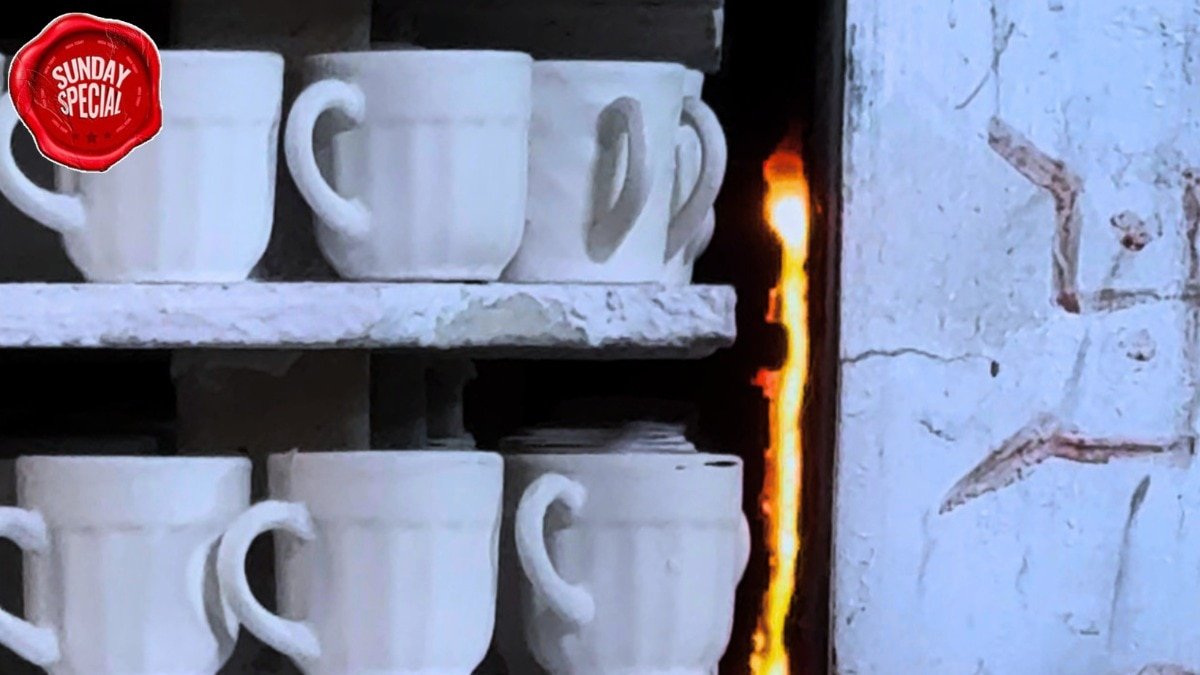
The video shows how cups are made. Clay is mixed in a rotating mixer, shaped in moulds, given finishing touches, then dried and fired in kilns. (Video: Meenal Sharma)
HOW LPG SHORTAGE FORCED KHURJA CERAMIC UNITS TO SHUT TEMPORARILY
“Around 20,000-25,000 workers are employed across nearly 300 ceramic and terracotta units in Khurja,” says Ravi Rana, the president of the Pottery Manufacturers Association.
The ceramic cluster produces everything from high-end tableware supplied to corporates, hotels and hospitality chains, to mass-market products sold in local stores, wholesale markets and flea markets across India. A portion of the output is also exported to West Asia, which is now hit by a war.
Since the second week of March, LPG supplies to ceramic manufacturing units tightened sharply. It hit production.
“For nearly two weeks, no LPG trucks reached many units in Khurja. Around five to six factories, who had then written to the District Supply Officer (DSO) seeking assured LPG supply, are continuing to receive them. Many others have been forced to shift to alternatives like piped natural gas (PNG) supplied by Adani Total Gas or diesel,” Guljeet Singh Minhas, the secretary of the Khurja Exporters’ Association and owner of Minhas Pottery, tells India Today Digital.
“While the cost of commercial ‘Hippo’ LPG cylinders of 442 kg rose from about Rs 67 per kg to Rs 109.38 per kg. PNG, the other key fuel, comes with its own challenges,” adds Minhas.
“Payments for the Adani Total Gas have to be made daily, which many units find unviable. Further, its pricing is uneven. Units that used Adani Total Gas PNG between September 2025 and February 2026 are getting about 65% of gas at an older rate of Rs 49 per unit, while those shifting from LPG now are being charged around Rs 83.9, plus GST,” Rahul Agarwal, the owner of Bhatwara Industries, tells India Today Digital.
For manufacturers of high-end ceramic ware, like Minhas Pottery, the market pricing situation is even tighter.
“We operate on pre-fixed annual contracts with brands like Fab India. Prices are locked in at the start of the year. These cannot be revised mid-cycle and has left us operating on a no-profit, no-loss, despite rising input costs. While we are relatively insulated from the labour crunch because we don’t have many workers from West Bengal,” says Minhas.
BENGAL ELECTION RESULTS IN SHUTTING OF 90% KHURJA CERAMIC UNITS
But for other manufacturing units, the West Bengal Assembly elections scheduled on April 23 and 29, forced them to put out the kiln fires.
A large number of migrant workers have returned home, and they are expected to return on May 5. Rahul, a Bengali worker in Khurja, tells India Today Digital last week that he had little choice but to leave.
“If I don’t go and cast my vote, I fear my name could be removed from the voter list. It might even affect my citizenship,” says Rahul, a native of West Bengal, adding that while migrants like him usually go home only during Durga Puja, “This time, after the SIR exercise, it has made going back almost compulsory.”
The result is a near shutdown. Nearly 90% of Khurja’s ceramic units are either temporarily shut or operating at minimal capacity. Only those with alternative labour or fuel arrangements have managed to function normally, though at a steep cost. The rest of the ceramic and terracotta manufacturers have been hit by a double blow: a shortage of workers and no reliable fuel supply.
Even a hike in wholesale prices by the industry bodies in March has offered limited relief. The markets, because of weak demand, have not fully absorbed the 10% increase in wholesale prices.
Even when the workers return, ceramic kiln owners will face a battle for survival if the raw material situation, including fuel supplies, does not improve.
Realising this, manufacturers have already sought government support, including a revision of PNG billing cycles from daily payments to a 15-day schedule to ease cash flow pressures, according to Ravi Rana, president of the Pottery Manufacturers Association.
Amid a situation that stakeholders fear could worsen further, Khurja’s kilns are running on a low flame.
It is caught between a war 2,200 km away and an election at home. Fuel shortages, weak demand and an absent workforce are each feeding into the other, leaving little room for short-term recovery for terracotta and ceramic factory owners. And for the worker who once sent Rs 5,000 home but now struggles to send even Rs 3,000, the crisis has become a fight for survival.
– Ends
Must Watch
SOURCE :- TIMES OF INDIA