
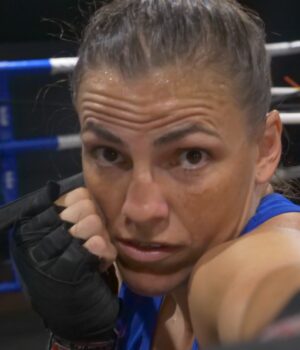
Source : ABC NEWS
As a professional boxer, Jess Messina knows a win in the ring is only half the battle as she works to make a name for herself in women’s boxing.
Like many female boxers, Jess — who is based in Port Macquarie on the New South Wales Mid North Coast — struggles to find an opponent in her weight division.
The Australian champion in the welterweight division (66.6 — 67kg) dropped down to super lightweight, (63.5kg) for her upcoming bout against Ireland-born Louise Creavan from the Gold Coast, to open more opportunities.
“It’s actually been extremely hard for me to find opponents to fight — a lot of the fights … we’ve had to pay for ourselves,” Jess Messina said.
This latest fight is no exception, costing the Port Macquarie Boxing Club $20,000 to host, without significant commercial backing.
Boxing NSW secretary Dean Groth — who also runs the gym — said it fundraised to pay for opportunities for local boxers.

Despite the challenges, Jess Messina trains twice a day, six days a week. (ABC Mid North Coast: Wiriya Sati)
“One thing we don’t do is, we don’t restrict someone’s opportunities,” he said.
“Jess has had nine professional fights, and she hasn’t earned any money.”
Messina said finding other women to spar was especially tough in the regions.
“I usually have to travel to spar other women, whether it’s Sydney or the Gold Coast or Newcastle,” Messina said.
“I usually spar a lot of the boys at the gym, which I’m really grateful for.”
Being a pro doesn’t always mean getting paid
Jess Messina said there were very few female boxers earning a high income.
She said that because professional boxing was a business, “it comes down to how promotable you are”.
“It does all come back to your saleability and how many people you bring in to watch your event,” she said.
Rasa Kabaila, pictured at the MBA Golden Gloves 2023, says has stopped competing due to the pressures and health risks. (Supplied: Masters Boxing Australia Inc, MBA Golden Gloves 2023.)
Australian National Boxing Federation president Andrew Campbell said professional boxers’ pay varied, determined by the licensed promoters, which was mostly associated with promotability.
“It very often is not related to capability, but how well the boxers are known,” Campbell said.
“The general consensus is that men do get paid more than women [boxers].
“Generally, women fight for a reduced time, and the pay does reflect that, plus the amount of money they bring through the gate and through TV.
“I think the industry is very conscious of that and are doing what they can to promote women’s boxing.”
Female participation in on the rise
Women’s boxing was only legalised in NSW in 2009 when a 23-year ban was lifted.
Former Olympic and Commonwealth Games boxer Shelley Watts said she had seen “a very big change” since she started in 2010.
“Now there’s a lot more girls that are fighting, there’s a lot more women competing and there’s a lot more money that’s going into it,” Watts said.
Watts won gold when women’s boxing made its debut at the 2014 Commonwealth Games.
The first women’s boxing competition was introduced to the Olympic Games in London in 2012, in which one Australian athlete competed.
Since 2012, the International Olympic Committee has doubled weight categories from three to six to make the sport more inclusive for women of varying builds.
Women now have the same number of weight categories as men.
Twelve years later, the Australian Olympic team said it had six women competing across all six weight classes at the Paris 2024 Olympics.
Dean Groth says he is hoping to “kick some goals next year with women in the sport”. (ABC Mid North Coast: Wiriya Sati)
Groth said there was still work to do to increase female participation, with women boxers make up 10 per cent of the NSW competitive amateur boxers.
Boxing NSW has received state government funding for a development day training 20 women officials, coaches and referees, achieving their goal to reach 40 per cent females within the sport.
“The more women they see in the sport, the more women they’ll get in the sport,” Groth said.
Rasa Kabaila struggled with competing and one reason was the health risks mostly during training. (ABC Mid North Coast: Wiriya Sati)
Health risks of sparring with men
Nurse practitioner and amateur boxer Rasa Kabaila, who coaches at the same Port Macquarie gym, said the shortage of female boxers could put women at risk.
“As a woman competing in combat sports, because the pool [of women] is so small, you then have to spar with men, and that’s normal,” Kabaila said.
“Women can hit hard, however men have an average of 75 per cent more muscle mass than women.”
Sports medicine expert Andriy Boyko says while research is not specific to combat sports, women are at higher risk of concussion than men by one and a half to two times.
“When concussed, their symptoms do last longer and often are higher severity,”
Dr Boyko said.
“Repetitive impact at a higher force can increase your risk of concussion, so a woman sparring against a male counterpart will be experiencing a higher degree of force.
“There are now rules about concussion in boxing and stand-down periods after bouts, knockouts and technical knockouts, now in the last decade.”
Despite these risks, Jess Messina says she loves her boxing and will not let anything stop her.
“It’s the competitiveness of it, I love everything about it. I love training, I love sparring, and I just love fighting,” she said.
“I want to be world champion, that’s all I’m looking forward to.“