
SOURCE :- THE AGE NEWS
Good morning. Bianca Hall here, taking over our rolling coverage of conflict in the Middle East from Anthony Segaert.
It’s been an eventful 24 hours. Here are the latest developments from overnight and this morning.
- Iran has declared the Strait of Hormuz is fully reopened, at least for the duration of its current ceasefire with the US and Israel.
- Speaking after a “very positive” meeting of international leaders, Prime Minister Anthony Albanese said some 50 nations had a common objective to ensure Iran did not impose tolls on ships, which would raise the cost of essential goods like oil and fertiliser.
- Australia had not committed to sending naval vessels to the region, Albanese said.
- US President Donald Trump confirmed the commercial re-opening, but said the US naval blockade of Iranian ports would continue until a peace deal is agreed.
- Speaking after a gathering of some 50 countries, including Australia, French President Emmanuel Macron and UK Prime Minister Keir Starmer said the strait must be reopened permanently, and they would keep planning a mission to restore maritime security.
- In response to the re-opening, oil prices fell more than 10 per cent on Friday (New York time), and share markets rallied.
- Australia has 46 days of petrol in stockholding, eight more days than last week, and 10 days more than on February 28 when the Iran war began.
- There are 31 days’ worth of diesel in stockpile, which is the same as last week and 30 days of jet fuel, up by two days on last week.
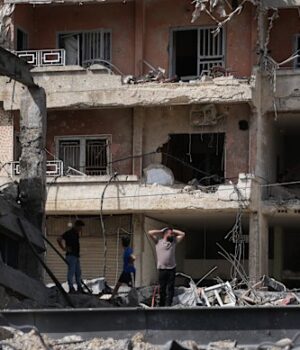
A 60-year-old woman did not know what she would find when she returned to her home in Srifa, a village in southern Lebanon.
The woman, Mona Nazal, had fled north in early March, when the war between Israel and Hezbollah reignited. She had not been back since. But as a temporary ceasefire went into effect Friday morning, she rushed to her car and drove for six hours until she reached the village entrance.
There, her heart sank.
Along the main street, there was almost nothing left. The pharmacy was a pile of rubble. The produce shop and tobacco stores had been cleaved in half. The roof of the wheat mill had partially caved in. Not a single building was intact.
The bombs have stopped, the strait is notionally open and the price of oil is down. Donald Trump called it “a great and brilliant day for the world”.
And we are told – by the US president at least – that a peace deal is all but done. So, is this the end of his Iran “excursion”? Or is it too good to be true?
A certain scepticism might arise from the fact that Iran has quickly disputed much of what Trump has claimed about where things stand.
That includes his claim that Iran has agreed to surrender its “nuclear dust”, or the highly enriched uranium still in its possession – most of which is believed to be buried under what’s left of the nuclear facilities at Isfahan.
US President Donald Trump has just spoken to reporters on Air Force One, concluding his remarks with a threat to “start dropping bombs again” if Iran blockaded the Strait of Hormuz.
“I don’t know,” he said.
“Maybe I won’t extend it, but the blockade is going to remain. But maybe I won’t extend it, so you’ll have a blockade, and unfortunately we’ll have to start dropping bombs again.”
He also said the US would claim Iran’s “nuclear dust” after a deal was signed with Iran, but did not elaborate when asked how this would be achieved.
“I ended eight wars, and it may be a little early to say this, but if we add Iran and Lebanon that will be 10 wars ended and many, many millions of lives saved,” Trump claimed.
US President Donald Trump says Chinese President Xi Jinping was “very happy” about the status of the Strait of Hormuz, and that he looked forward to their meeting in China.
“President Xi is very happy that the Strait of Hormuz is open and/or rapidly opening,” Trump said on Truth Social.
“Our meeting in China will be a special one and, potentially, Historic. I look forward to being with President Xi — Much will be accomplished!,” he added.
Reuters
It’s been more than 24 hours since air raid sirens went off in any part of Israel — and that last time, very early on Friday morning (Middle East time) in a small community at the border with Lebanon, turned out to be a mistaken identification.
Since the Iran war started on February 28 Iran, then Lebanon-based Hezbollah militants, and eventually the Houthis in Yemen, sent barrages of missiles and rockets into Israel, sometimes more than a dozen times a day. Hezbollah kept up firing right until a ceasefire went into effect on Friday.
In Israel’s major metropolitan areas of Jerusalem and Tel Aviv, but also in villages in the country’s desert south and hilly north, sirens and alerts sent residents to bomb shelters and safe rooms throughout the day and night.
The strikes have killed 23 people and wounded about 600 more in Israel, according to Israel’s emergency services.
AP
Despite Iranian officials’ assurances on Friday that the Strait of Hormuz would be fully open to commercial vessels during the 10-day ceasefire in Lebanon, questions lingered on Saturday about how much freedom ships actually had to transit the waterway.
Live marine trackers show dozens of international vessels have approached the crucial body of water, through which 20 per cent of the world’s oil is shipped, including crude oil tankers, LPG tankers and container ships.
All appear to have either turned back or stopped on the approach.
Iranian officials and US President Donald Trump traded social media blows over the opening of the strait; each claiming to have control of the passage.
Iranian Foreign Minister Abbas Araghchi posted on X that ships would use routes designated by the Islamic Republic, in co-ordination with Iranian authorities. It was not clear if vessels would have to pay tolls.
Good morning. Bianca Hall here, taking over our rolling coverage of conflict in the Middle East from Anthony Segaert.
It’s been an eventful 24 hours. Here are the latest developments from overnight and this morning.
- Iran has declared the Strait of Hormuz is fully reopened, at least for the duration of its current ceasefire with the US and Israel.
- Speaking after a “very positive” meeting of international leaders, Prime Minister Anthony Albanese said some 50 nations had a common objective to ensure Iran did not impose tolls on ships, which would raise the cost of essential goods like oil and fertiliser.
- Australia had not committed to sending naval vessels to the region, Albanese said.
- US President Donald Trump confirmed the commercial re-opening, but said the US naval blockade of Iranian ports would continue until a peace deal is agreed.
- Speaking after a gathering of some 50 countries, including Australia, French President Emmanuel Macron and UK Prime Minister Keir Starmer said the strait must be reopened permanently, and they would keep planning a mission to restore maritime security.
- In response to the re-opening, oil prices fell more than 10 per cent on Friday (New York time), and share markets rallied.
- Australia has 46 days of petrol in stockholding, eight more days than last week, and 10 days more than on February 28 when the Iran war began.
- There are 31 days’ worth of diesel in stockpile, which is the same as last week and 30 days of jet fuel, up by two days on last week.
Unleaded petrol with higher sulphur content can now be sold until the end of September, Energy Minister Chris Bowen said.
He announced that a temporary lifting of sulphur limits would be extended from the initial deadline of the end of May until the end of September.
“Early in this crisis, I lifted the allowed minimum standard from 10 parts per million to 50 parts per million until the end of May,” Bowen told reporters on Saturday.
“International uncertainty is continuing, and we continue to face pressures in the international supply chain. I have now extended that to the end of September.”
Returning to the meeting last night of an international coalition of about 50 nations, Albanese said the forum did not canvass specific measures to secure shipping via the Strait of Hormuz, which is the key shipping channel from the Middle East.
Albanese described the meeting as a “very positive” meeting of nations with the common objective to ensure Iran did not impose tolls on ships, which would raise the cost of essential goods like oil and fertiliser.
But he confirmed Australia had not committed to taking actions like sending naval vessels to the region.
“We will continue to be a constructive contributor to that debate, but it certainly at this stage it wasn’t the forum where people were committing specifics,” he said.
“Australia obviously is a long way away as well from the strait, compared with European nations. It’s fair to say that we’ll give consideration to requests which are made when we come together.”
The PM declared there would be no need in the next week to escalate the country to stage three of the fuel security plan, which would involve voluntary fuel-saving measures like carpooling and releases from the strategic stockpile.
However, Albanese said that if shipping from the Middle East remained shut for weeks into the future, further fuel saving may be needed.
“There may be difficult times ahead,” he said. “That is why we want to see an end to this war.”