
Source : INDIA TODAY NEWS
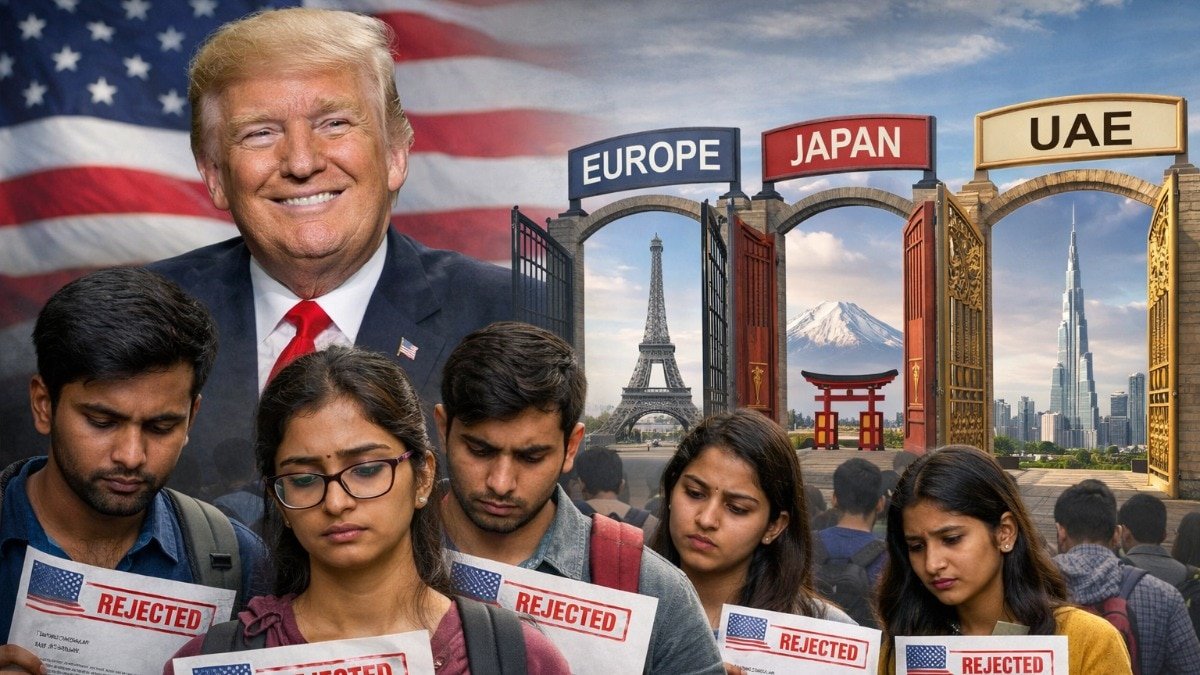
US visa applicants from the Global South, including India, are facing rejection rates crucially higher than those from Europe or North America. The pattern which is “structurally concentrated in specific regions,” comes from a recent report by Shorelight, titled ‘Beyond the Interview: A Decade of Student Visa Denials and What Comes Next’, based on data obtained through a public information request to the US Department of State.
advertisement
The report, developed in partnership with the Presidents’ Alliance on Higher Education and Immigration, shows that visa denials have not only increased over time but have also become unevenly distributed, raising questions about whether access to US education is being shaped less by merit and more by geography.
A DECADE OF RISING REFUSALS
The numbers trace a steady climb rather than a sudden spike, with F-1 visa refusal rates overall rising from around 23% in 2015 to nearly 35% in 2025, while 2025 alone recorded a 50% increase in refusals compared to 2015 levels, marking one of the steepest shifts in recent years.
What stands out within this broader increase is the regional disparity, as Asian applicants faced refusal rates of around 41%, nearly double those from regions such as North America, South America, and Oceania.
The number of European applicants continued to record the lowest refusal rates at roughly 9%, a figure that has remained relatively stable over the past decade.
For India, the numbers are sharper. Visa rejection rates have increased from 53% to 61% in one year, placing Indian students, who form the largest segment of international students in the US, among those most affected by the tightening visa environment.
“For three decades, the US was every Indian student’s default dream and the formula was simple. In mid-2025, over 6,000 international students had their legal status cancelled overnight while already studying in the US. Most got it back through courts, but the psychological damage to an entire generation of aspirants was real and lasting,” says Ashish Gupta, Co-Founder & CEO EdNex Global.
The trend extends across South Asia, where students from Nepal saw rejection rates rise from 59% to 81% within a year. Bangladesh and Pakistan recorded refusal rates of 73% and 71%, pointing to a broader regional pattern rather than isolated cases.
AFRICA AND ASIA: THE SHARPEST IMPACT
The shift is even more pronounced in Africa, where refusal rates that stood at around 43% in 2015 have climbed to nearly 64% in recent years.
The data suggests that while global refusal rates are rising, the burden of this increase is not evenly shared, with students from Asia and Africa facing a majorly higher likelihood of rejection compared to their counterparts in Europe, where over nine in ten applicants continue to receive approval.
Despite the tightening visa landscape, the United States remains a primary destination for Indian students, a trend supported by government data presented in Parliament.
Indian students make up nearly 30% of all foreign enrolments in the US the backbone of American graduate programmes and research labs. When that pipeline shrinks, American universities lose between $3 and $8.6 billion in revenue, research output thins, and lab capacity weakens.
The number fell from 378,787 in February 2025 to 352,644 in February 2026.
According to data from Institute of International Education, Indian student enrolment in US graduate programmes fell by 9.5% in 2024/25.
Parliamentary data further indicates that the number of Indian students going to the US has dropped by around 28% in the past year.
Overall enrolment trends show a decline of nearly 45% in certain segments, reflecting a combination of visa challenges and policy uncertainty.
THE PRESSURE SYSTEM IS FACING
The implications extend beyond student mobility, as Indian students account for nearly 30% of all international enrolments in the US and form a substantial share of graduate-level STEM programmes, contributing to research, workforce pipelines, and long-term economic activity.
“Two things that students urgently need to know first, social media is now effectively a visa document. Consular officers are screening applicants’ entire digital history for anything perceived as anti-US sentiment. One old post can end an application. Second, India is not on the Special Scrutiny country list today, but Pakistan, Bangladesh and Nepal already are with rejection rates above 70%. The trajectory is uncomfortable,” adds Gupta.
Data from multiple sources, including the IIE Open Doors report and analyses cited by BBC, indicate that Indian students make up over 70% of enrolments in some advanced STEM programmes.
This is nearly half of STEM-OPT participants, and close to 75% of H-1B visa recipients, particularly in the technology sector.
“For India, the damage is more psychological. A US degree was never just a qualification it was a signal of ambition for an entire generation of middle-class families. When that pathway becomes unreliable, it unsettles how a generation thinks about their future. The deeper concern is innovation. A disproportionate share of cutting-edge research in AI, biotech, and semiconductors at American universities is carried by Indian graduate students,” opines Gupta when answering what impact India and the US will have.
Many experts are now emphasising that at a time when AI is expanding rapidly and its growth is clearly visible, India is positioned at the forefront, and the skills and research experience brought back by the previous generation will prove valuable in shaping the country’s future.
HOW ARE INSTITUTES RESPONDING?
Amid the major shift, universities have begun adjusting the approach kept before and are focusing on communication, student support, and career guidance, as policy uncertainty reshapes the expectations of the students.
John Anderson of the Fletcher School at Tufts University, speaking to The PIE News, noted that while institutions cannot control federal policy, they are adapting their responses by strengthening support systems and refining career pathways in response to changing conditions.
At the same time, the US Department of State has maintained that all visa applications are reviewed on a case-by-case basis in accordance with US law, rejecting the suggestion that decisions are influenced by applicants’ country of origin.
The Shorelight report at the same time frames the current moment not as a short-term tightening.
Also, there is a structural shift warning that rising refusal rates, particularly in India where they approach 60%, risk disrupting a long-standing talent pipeline that has supported US universities and industries.
The broader concern, as outlined in the report, is that in a global competition for skilled talent, sustained barriers to entry could redirect students towards alternative destinations.
– Ends
Must Watch
SOURCE :- TIMES OF INDIA