
Source : the age
THEATRE
SISTREN
Belvoir downstairs, April 11, until May 3
Reviewed by KATE PRENDERGAST
★★★★★
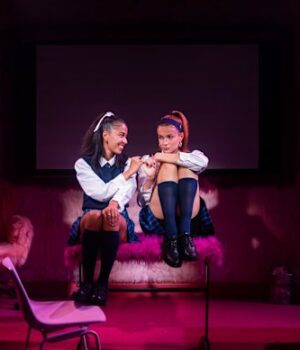
There’s a moment in Sistren when, after laying down some home truths, Isla glances to her bestie Violet, anticipating a salty comeback. Instead, Violet looks down at her open-palmed hands. “You’ve licked the plate clean,” she admits. Isla inspects the imaginary dish, too. “No crumbs!” she agrees, and Violet tosses the plate behind her to a slapstick crash. The timing is perfect. The audience howls, rocks in their seats.
Serving absolute excellence, Sistren is the must-see debut from Iolanthe (a certified up-and-killing-it icon), with director Ian Michael making space for the girls to give their all. This blazingly fierce, fresh and of-the-moment work from Green Door is in its own class of excellence in new Australian theatre.
Through the tangled sisterhood of its two 17-year-old South London divas, one black, the other trans, and with two incandescently fabulous leads, we get schooled through an intersectional lens in the pain and the immeasurable value of being seen – if never truly known – by the people we love.
How it starts: rebellious ride-or-dies since forever, Isla and Violet (Iolanthe and Janet Anderson) have been ordered to separate indefinitely by their villainous school principal under threat of suspension. They ignore him, of course, and Isla finds Violet in their secret spot after hours. It’s a cosy girl-power sanctuary (from Emma White) – everything pink and fluffy, from the desktops to the back wall.
For about the first 40 minutes we get familiar with the play’s two baddies and the joy-fuelled phenomenon of who they are together – chaotic, irreverent, uncontainable. It’s not a closed universe, either – Sistren has its characters seeing “us lot”. With the fourth wall casually demolished, the audience is transformed into a collective of active witnesses – addressed intermittently, with some individual audience members teased directly (much to their delight).
The show makes divine playfulness a priority, in physical comedy, speech, sound and lighting. In surreal cuts, the two will suddenly catapult to an alternate reality to play out a conceit from the conversation they’re having: Isla on trial for being “on the wrong side of history” for assuming everyone’s a paedophile, for example.
Hugely entertaining as all this is, Sistren fully comes into itself when the friendship gets tested. Isla and Violet may be “soulmates” but there are unbreachable distances between them – in their backgrounds, beliefs and bodies, in their relationship to community and identity. Old wounds are opened, fresh ones made.
There are unforgettable scenes of combative truth-telling – foremost when Isla confronts Violet about a remark she made almost a decade ago, and it leads into a debate about authenticity, gender affirmation and black appropriation via BBLs (with a blackboard chart to demonstrate).
THEATRE
ENGLISH
Reginald Theatre, April 11, until May 2
Reviewed by JOHN SHAND
★★★★
“When you speak another language … you go years without making anyone laugh,” Marjan says towards the end of this play, in which she helps four Iranian students in Karaj prepare for their Test of English as a Foreign Language exam. Her statement is mildly ironic, given her teaching capacity, and dramatically ironic because the play often does make us laugh. It’s also a profoundly sad observation.
Iranian-US playwright Sanaz Toossi won the 2023 Pulitzer Prize for English, which, on its surface, is an unassuming little piece comprising short classroom scenes set across a six-week course. Seething beneath these are the emerging private lives of the five characters, and the four students’ differing motivations for studying English. Then, lying as substrata beneath all that, are the endless ramifications of the way a foreign language affects thought, humour and, ultimately, identity.
Genuine polyglots readily think and joke in multiple languages but for three of the play’s four students – as for most people trying to acquire a second language later than childhood – the task seems a labyrinth of ever-compounding complexity.
The quirk Toossi uses, and to which we much adjust, is that when the characters putatively speak Farsi, they use unaccented English, and when they speak English, they have varying degrees of an Iranian accent. Director Craig Baldwin (for the consistent Outhouse Theatre Co) found five actors who can tick these boxes, but mostly with screen backgrounds. It’s a credit to them and Baldwin that their stage performances are quite complete.
Nicole Chamoun plays Marjan, the teacher, who spent nine years in Manchester, and whose Farsi, we gather, is as accented as her English. Despite the amusing games and exercises she devises (including endless alliteration on the letter “w”, which comes more naturally as a “v” for the students), she’s beset with impostor syndrome. Chamoun generally accomplishes the potentially elusive balancing act between Marjan’s confidence, overconfidence and terror that she’s failing her class.
Despite being married, she also develops a reciprocated crush on the lone male student, Omid. Pedram Biazar succeeds at giving a character who’s something of a charlatan a nice-guy veneer, although Omid’s being the most competent English speaker makes it tricky for us to discern when he’s supposed to be speaking Farsi, given Toossi’s device.
Minerva Khodabande bounces between emotional extremes as the livewire Goli, the youngest student, and Setareh Naghoni excels as the insubordinate Elham, who manages to antagonise everyone.
Neveen Hanna mostly does a fine job with Roya, the oldest student, who’s learning English so she can talk to her Canadian-born granddaughter, but who may not be as welcome in her son’s new life as she thinks.
Time lapses are signalled with bustling Persian music composed by Hamed Sadeghi (and brilliantly recorded) and you emerge after 80 minutes to find the seemingly unassuming play has just reset your understanding of the migrant experience.
THEATRE
Drive Your Plow Over the Bones of the Dead
Belvoir Street Theatre, April 8, until May 10
Reviewed by HARRIET CUNNINGHAM
★★★★½
Eamon Flack’s adaptation of Nobel Prize-winning author Olga Tokarczuk’s 2009 novel Drive Your Plow Over the Bones of the Dead takes its time. Press night has been delayed, twice, as the production takes shape, and the run time is down from four hours but still over three. The start time comes and goes in a packed foyer, doors to the theatre finally opening 10 minutes late. But it is worth the wait.
Brett Boardman
Janina Duszejko is a woman in her 60s living in rural Poland, on the border of the Czech Republic. She loves animals. She loves astrology and William Blake and crossing boundaries. A string of deaths alarms her tight-knit community but the police cannot crack the case. Janina has her own theory, which she shares with anyone who will listen and many who won’t.
From this rangy, feminist-anti-ageist-revolutionary eco-saga, Flack has created a three-act murder-mystery that sustains high drama, wry laughs, dangerous ideas and genuine surprises across its entirety.
This is a play in the most fundamental sense of the word. The set (Romanie Harper) is dominated by a large revolve, around which Janina paces, walking her world. Costumes (Ella Butler) appear as if from a hand-crafted dress-up box, and the landscape is revealed through tantalising clues and atmospheric lights (Morgan Moroney).
The actors create their surroundings from what comes to hand, wheeling in a window to look through, making a snowstorm with well-aimed fistfuls of paper, fighting over who gets to drive across the vividly imagined landscape. And ad-libbing is not out of the question, given the number of moving parts that may or may not mesh across the evening. Such is live theatre.
The playfulness is a source of delight, as we watch two cats curled up in a basket, or share Janina’s glee in crossing boundaries as she jumps from the Czech Republic to Poland and back. Moreover, it is a delight that can, at any given moment, transform into wonder. Such as when Janina watches a flock of fieldfares whirling around her (beautifully choreographed by Charmene Yap) or contemplates the vast, interconnectedness of it all.
Drive Your Plow Over the Bones of the Dead is a one-woman show for a cast of 11. Pamela Rabe, as Janina, barely leaves the stage, by turns narrating the action and being the action. Her performance is a tour de force, never less than compelling, often hilarious and tragic all at once. The ensemble is an intrinsic part of her narrative, whether it is an outspoken committee or a silent phalanx of foxes, whether singing, flying, moving furniture, fighting or dancing together in the riotous costume ball of the third act.
Among this uniformly brilliant ensemble, standouts include Bruce Spence as Janina’s neighbour Oddball, Daniel R. Nixon as Dizzy, and the explosively foul-mouthed president, played by Marco Chiappi, bouncing off an ever-ready Rabe as we rattle towards the grand twist at the end.
No spoilers. Just go.
MUSIC
Donald Runnicles conducts Mahler’s Sixth Symphony
Sydney Opera House, April 9
Reviewed by PETER McCALLUM
★★★★½
In welcoming the audience before the concert, violinist Sophie Cole pointed to the aptness of Mahler’s Symphony No. 6 in our own times for the way it gives the experience of being “swept up by forces beyond our own control”.
That impression came most powerfully in this performance by the Sydney Symphony Orchestra under Donald Runnicles, augmented by musicians of the Australian National Academy of Music (ANAM), during the work’s 30-minute, wrestling finale.
This movement strives three times for an optimistic outcome before reaching the enlightened but tragic realisation that, on this occasion, this will not be possible, that the individual will go down.
Mahler brutally underlined the point by ending the first two attempts at surging optimism with literal blows of a hammer, which he indicates should make a “short, powerful but dull, echoing blow of non-metallic character (like an axe blow)”.
There were originally three hammer blows, but, acting with the parsimony of genius, Mahler cut the last one. This allowed Runnicles to preserve the tension to the end, unleashing the final A minor chord, which, as a motif, has wavered from major to minor over the entire 90-minute span with wrenching force.
In the first movement, Runnicles maintained momentum with unyielding insistence, holding, but sublimating, the pulse as it transitions from the opening march to the lyrical second idea, and waiting until the close of that idea before allowing the driving force to ease.
It eased further, dreamily, in the quiet pastoral section of the development, but the unrelenting quality of the music elsewhere left an ambiguous feeling, crucial to the sense of alienation Mahler creates, as to whether the energy is internally generated or externally imposed. This movement had unstoppable forward drive even at the expense of some roughness of detail.
The second movement, with shrill mocking woodwind and sagging parodies from the horns, was a sardonic take on that drive. Runnicles made the third movement the work’s emotional centre. Over a bed of muted lower strings, the violins played the opening melody with delicate spareness, leaving horn player Samuel Jacobs to adorn it, on its subsequent appearance, with velvety smoothness.
The woodwind players balanced the moment of idyllic quiet before the final swelling climax like sunlight through mist, and the orchestra unfolded one lush harmonic modulation after another as the music eventually subsided into deep serenity.
After the searching opening melody of the finale, its introductory section groped through darkness like an awakening serpent. Runnicles led the quick sections with gripping intensity, the strings, under concertmaster Andrew Haveron, maintaining bristling unanimity.
As far as uncontrolled forces go, these had many flashes of terror, but, in their fateful closing bars, proved awe-inspiring.
THEATRE
Anastasia
Lyric Theatre, April 10, until July 17
Reviewed by HARRIET CUNNINGHAM
★★★★½
Rags to riches, revolution, lost identity and escape from peril … The story of the Grand Duchess Anastasia Nikolaevna of Russia has it all. The youngest daughter of Tsar Nicholas II, Anastasia was rumoured to be the only member of the Romanov royal family to have survived execution by Bolshevik forces in July 1918. The rumours grew into a grand mystery, with at least 10 women coming forward claiming to be the last of the Romanovs.
Anastasia picks up the legend and gives it the Broadway treatment with a great book by author Terrence McNally, a reliable string of showstoppers by the composer of Ragtime, Stephen Flaherty, plus a starry cast, truckloads of costumes, dazzling set pieces and vocal fireworks. Resistance is useless.
The Australian incarnation of this international phenomenon is hard to fault. Georgina Hopson is an ideal Anya, with a voice of immense dynamic and expressive range and a winning stage presence. Robert Tripolino (the lovable rogue Dimitry) and Joshua Robson (dutiful soldier Gleb) compete, dramatically and vocally, for the audience’s heart, with Robson nearly winning it in the set piece Still.
Rodney Dobson as Vlad, aka Count Popov, works magic as a character who could clearly upstage the main action at any given moment. This is especially true when paired with his Countess Lily, Rhonda Burchmore, who gleefully hams it up to the max. Finally, there is Nancye Hayes as the Dowager Empress, the gracious lynchpin around whom the story unfolds.
The creative team brings the historical sweep of Anya and Anastasia’s tale to the stage with great ingenuity, shifting us across three decades and hundreds of miles using everything in the showbiz toolbox. Most notable are the projections (video design by Aaron Rhyne, with set design by Alexander Dodge), which appear behind the static, architectural wall of windows, doors and archways.
In conjunction with lighting (Donald Holder) and costumes (Linda Cho) they create instant changes of location, from the streets of St Petersburg to Bolshevik command to Paris – without upstaging the action. That’s except for the getaway scene, where a skeleton train carriage on a revolve is set in motion by rolling landscapes in the background. It’s one of the most successful uses of projections for storytelling that I have seen.
The other element that stands out is the choreography (Peggy Hickey) which, especially in the second act, captures the free-spirited sense of release in post-war Paris. A high-energy ensemble show themselves adept in classical ballet, ballroom dancing and jazz.
Anastasia is a musical of two, distinct parts, and that is part of its appeal: we move from the Disney-esque nostalgia of Old Russia to fiery revolution through to Paris in the 20s, shot through with jazz and flapper dancing. It’s Frozen, Les Mis and Ragtime, all in one. Little wonder it’s hard to resist.
MUSIC
TISM
Sydney Opera House, April 10
Reviewed by MICHAEL RUFFLES
★★★½
The trolls aren’t under the bridge, they’re running around the Opera House.
Melbourne electro-pop-rock anarcho-satirists TISM (This is Serious, Mum) continue a comeback either four or 40 years in the making (should you choose to believe they broke up in 1983) with a show that’s somehow both unlikely and inevitable.
Performing all of their breakthrough album, Machiavelli and the Four Seasons, at the Concert Hall three decades after it hit the top 10, manages to mine the same nostalgia vein as other artists pulling the same trick (see Lee, Ben; League, Human; and Day, Green) while also taking the piss.
As classical music is piped in and roadies tidy up the stage at 7.59pm, the thought occurs that it could all be an elaborate joke. This is only reinforced when a choir walks on to sing Philip Glass’s Arse, the album’s pomposity-skewering hidden track.
Hats off for the prank, then it’s giant crescent-shaped moon hats on as the seven anonymous members appear and launch into their highest-charting and possibly most controversial single, the drug-infused celebrity takedown (He’ll Never Be An) Ol’ Man River. They also start launching into the crowd, ripping up costumes and (eventually) breaking a seat.
Co-frontman Ron Hitler-Barassi asks: “What the f— are we doing here?” Giant puppet versions of the band members appear.
A cracking good time? Certainly. Absurd? Absolutely. Actually good tunes? Well, mostly. Machiavelli has moments of genius, but also its skips.
It helps that they mix the order, skating past the more forgettable and dated (Jung Talent Time is amusing now for different reasons). They are at their best when bombastic: How Do I Love Thee? and Greg! The Stop Sign stand out.
Other highlights come from elsewhere: the ironically engaging I’m Interested in Apathy, the yob or wanker Rorschach test Whatareya? and a disturbing yet danceable ditty about Hitler having a bad day are among them.
TISM, along with the likes of The KLF and Chumbawamba, made trolling an art form before the internet became what it is. They’re still going at it: the unrepeatable event is back at the Concert Hall on Sunday, hopefully with the seat fixed. Tisk, tisk, tisk: this is satire, kids.
 John Shand has written about music and theatre since 1981 in more than 30 publications, including for Fairfax Media since 1993. He is also a playwright, author, poet, librettist, drummer and winner of the 2017 Walkley Arts Journalism AwardConnect via X.