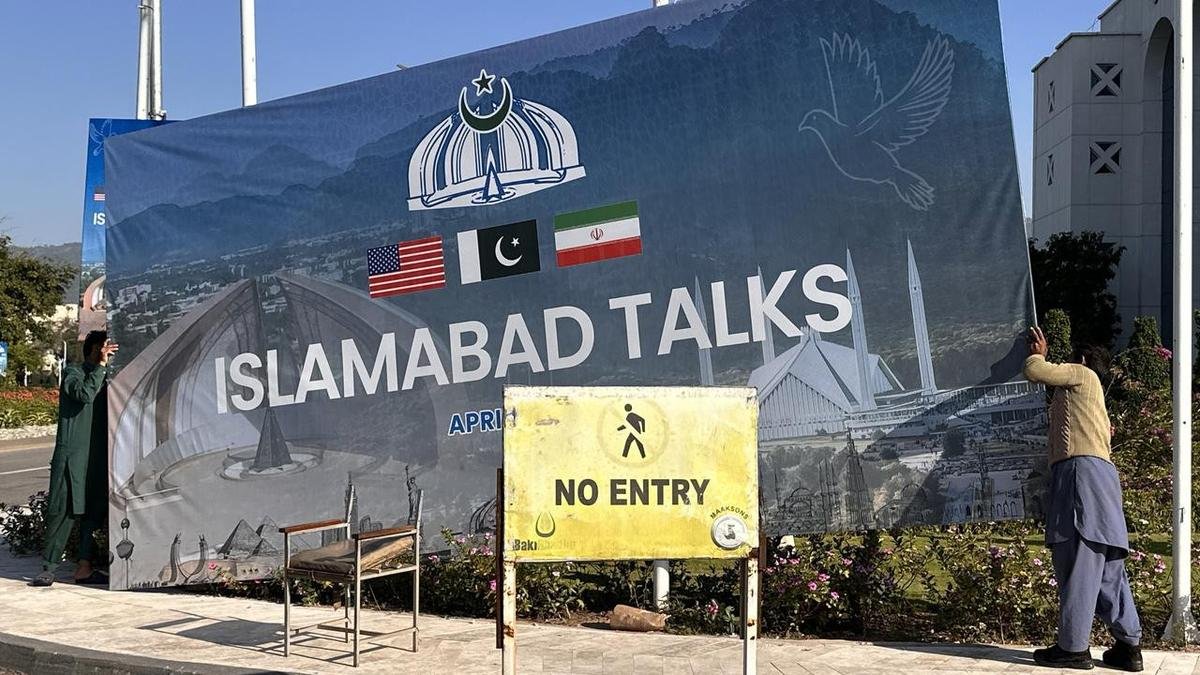
Source : Perth Now news
The US Navy will begin blocking the Strait of Hormuz soon, according to President Donald Trump, raising the stakes after marathon negotiations with Iran failed to resolve a ceasefire that would threaten a delicate two-week ceasefire.
Trump also stated in a post on Truth Social that the US would begin destroying all mine that Iran claimed the Iranians had dropped in the sea, a choke point for about 20 % of Iran’s blocked international energy resources, and arrest every vehicle in international lakes that had paid a burden to Iran.
The United States Navy, the Finest in the World, did begin the process of BLOCKADING any and all boats trying to enter or leave the Strait of Hormuz, he declared.
Additionally, I’ve given our Navy an instruction to search and detach every vehicle in international waters that has imposed an Iranian burdens. No one who pays a burdens may have safe passing on the high seas, Trump continued.
Any Egyptian who shoots at us or peaceful vessels may be shot in the guts! he continued.
Face-to-face discussions ended earlier on Sunday after 21 days, leaving a tense two-week peace in doubt.
Each aspect had previously held the other accountable for the inability of negotiations to put an end to six weeks of fighting that has claimed the lives of thousands, roiled the world economy, and caused oil prices to go up.
Iranian officials blamed the US for the deals ‘ halt, but US officials claim they were forced to abandon Iran’s nuclear weapons program, blaming what they called Iran’s refusal to do so.
No one part made any announcements regarding what will happen after the 14-day peace expires on April 22.
Muslim negotiators pleaded with all parties to carry it on.
Both men stated that their positions were unambiguous and placed a burden on the opposing party, underscoring how little the difference had remained constant throughout the discussions.
The US delegation’s head of the trip deals, Vice President JD Vance, stated before,” The bad news is that we have never reached an agreement, and I think that’s bad news for Iran much more than it’s bad news for the United States of America.”
” We’ve made our red lines quite clear,” Vance continued.
Mohammad Baqer Qalibaf, the head of Iran’s parliament, and Abbas Araqchi, the foreign secretary, blamed the US for failing to win Tehran’s believe despite what his team claimed were “forward-looking efforts.”
Qalibaf stated on X,” The US has grasped Iran’s reasoning and principles, and it’s time for them to determine whether or not they may receive our confidence.”
A bargain was hampered by “excessive” US demands, according to IIran’s semi-official Tasnim news agency.
Another Iranian media reported that there was agreement on a number of problems, but that the major differences were between Iran’s nuclear program and the Strait of Hormuz.
At least 3000 people have died in Iran since the US and Israel first started the conflict on February 28; there have also been at least 23 in Israel, more than a few in the Gulf Arab states, and more than a few in the region have been killed.
Energy prices have skyrocketed as a result of Iran’s hold on the Strait of Hormuz, which has largely cut off the Persian Gulf and its oil and gas imports from the world market.
Ishaq Dar, the unusual minister of Pakistan, stated that his nation would work to rekindle the conversation between Iran and the US in the near future.
According to Dare,” It is absolutely necessary that the events continue to uphold their commitment to stop fire.”
The nuclear talks in Switzerland in February and Vance’s take it or leave request that Iran should end its nuclear programme were at odds with one another.
In negotiations following six weeks of fighting, both sides appeared to have kept their positions despite Trump’s claim that the subsequent war was intended to convince Iran’s leaders to leave their nuclear ambitions.