
SOURCE :- THE AGE NEWS
What in the World, a free weekly newsletter from our foreign correspondents, is sent every Thursday. Below is an excerpt.
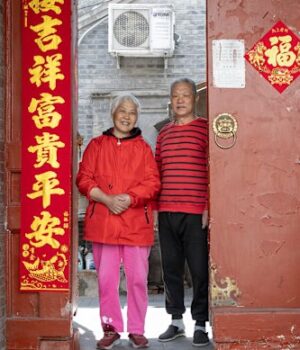
Beijing: Behind a red wooden door in one of Beijing’s old hutong neighbourhoods, Ma Peizeng and his wife, Wu Xiuhua, have built a humble life within the cramped confines of their 23-square metre home.
Such doors, often affixed with brass lion-head knockers, are a distinctive feature of Beijing’s ancient hutong alleyways – grand gateways to the otherwise very modest, single-storey homes of the families who share the courtyard residences behind them.
“We never thought about moving to another place. As long as it doesn’t get demolished, we would stay here. It’s down to earth,” says Ma, 73, as he stops to chat on his doorstep, before welcoming us inside his home.
The couple have lived in Dafangjia Hutong in east Beijing’s Dongcheng district for 40 years. Though retired now, they once made ends meet by working in a pharmaceutical warehouse.
In this cosy space, less than two metres wide in some parts, they raised their now-adult daughter and then her child, their 14-year-old grandson, who lived with them until he grew too big for the loft room they had built for him.
These days it’s just the two of them and their dog Kafei Dou, or Coffee Bean.
Their neighbourhood is one of the more low-key hutong districts dotted inside Beijing’s second ring road, the innermost highway that encircles the city’s ancient heart and its famous landmarks of Tiananmen Square and the Forbidden City.
Today the hutongs – the name given to the network of laneways that link the courtyard residences – are a tourist drawcard, where visitors come to glimpse the soul of old Beijing, preserved among the sprawling high-rises that have risen around them.
On a visit to Ma’s neighbourhood on a Monday morning, local retirees are chatting and playing mah-jong on a footpath in the shadow of the nearby luxury Galaxy Soho shopping complex. Others are chopping and preparing vegetables for the day’s meals.
Some of the hutong districts trace their origins to the 13th-century Yuan dynasty and were once home to imperial China’s aristocratic and political elite, as well as artists and scholars. But by the mid-20th century many of the courtyards had been subdivided, and the dwellings were heaving with multiple families packed into small, unsanitary living quarters.
As Beijing modernised, the government embarked on a bulldozing spree, demolishing 80 per cent of the hutongs to make way for roads and amenities, forcibly relocating many families into high-rise complexes on the city’s fringes.
Showing us inside his home, Ma explains that seven families used to live in the small dwellings that flank the courtyard area but three had moved to apartments in search of better living conditions.
There are rumours, he says, that their courtyard was once the grand home of a Kuomintang military official from the Chinese nationalist forces who fled to Taiwan when the communists declared victory in the civil war in 1949.
Much like the hutongs themselves, old Beijingers such as Ma provide a window into China’s history, having experienced the Mao Zedong era and the country’s transformation in the decades after.
“I didn’t have much good luck all through my life,” he says. “I grew up during the great famine and experienced the ‘Up to the Mountains and Down to the Countryside’ [movement],” he says, referring to Mao’s policy that forced millions of urban youth to poor rural villages to be re-educated in harsh conditions.
But he offers the statement without a trace of bitterness or resentment. In fact, Ma and Wu are effusively warm and friendly.
They repeatedly offer to make food or tea as we chat in their compact living room, surrounded by bottles of cooking oil, bags of rice and other food supplies tucked into corners or squeezed onto shelves alongside medicines – everything tightly packed to maximise space.
When it comes to their grandson, they are effervescent. They show off photos of him displayed on a small piano, a family investment they have miraculously squeezed into this small space so he can take lessons.
Over the years they have saved enough to buy a small apartment on the outskirts of Beijing, but they choose to remain in the hutongs so they can pick up their grandson from the nearby public school, one of the best in the area. This is the ritual investment at the core of the Chinese family structure, one that throws every resource possible at the next generation’s future.
“We have almost completed our mission,” Wu says.
Their home, like many in the hutongs, still does not have plumbed sewerage. Instead, they use the public bathrooms that are scattered throughout the area. They also keep a portable toilet inside their home, which they empty into the shared bathroom facilities each day, saving them a dash into the cold streets at night.
They don’t own the home – it remains the property of the Chinese government – but the rent is extraordinarily cheap: just 440 yuan (about $90) a year.
It’s a challenging life, and a stark juxtaposition with the waves of gentrification that have transformed some of the more famous hutong districts.
Over the past decade or more, boutique coffee shops, bars, fancy restaurants, art galleries and vintage clothing stores have sprung up among the ageing homes as part of efforts by local authorities to preserve the remaining alleyways. Expats have moved into renovated courtyards, seeking a more “authentic” experience than high-rise living.
Walking through the hutongs is a glorious way to spend an afternoon in Beijing. Still, it’s jarring to drink a $10 coffee on a refurbished hutong terrace, overlooking homes that don’t yet have flushing toilets.
This life is enough for ordinary people, Wu tells me.
“Contentment is happiness,” she adds, thrusting a bag of organic tomatoes into my hands, insisting I leave with something.
Get a note directly from our foreign correspondents on what’s making headlines around the world. Sign up for our weekly What in the World newsletter.
 Lisa Visentin is the North Asia correspondent for The Sydney Morning Herald and The Age based in Beijing. She was previously a federal political correspondent based in Canberra.Connect via X or email.