
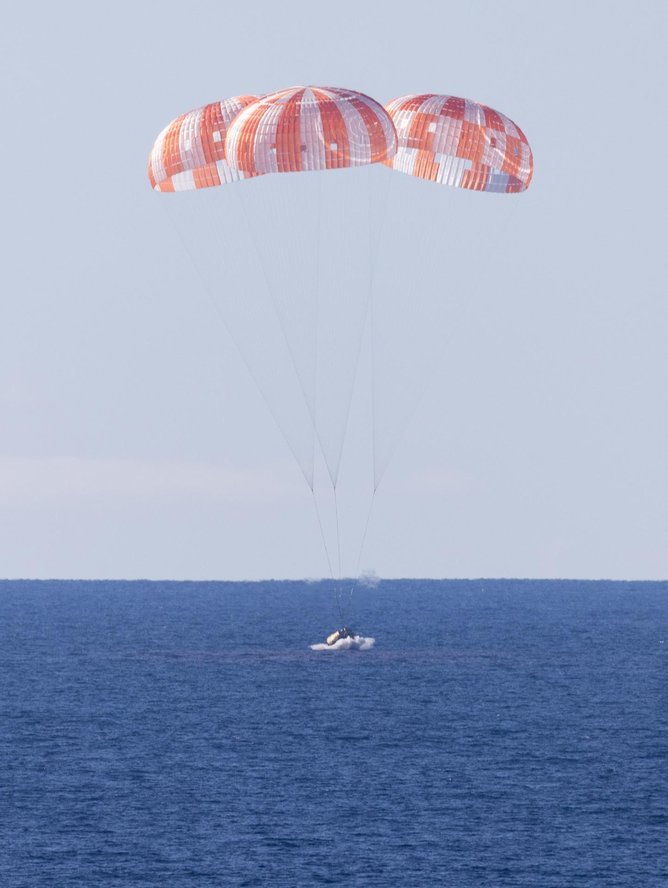
Source : Perth Now news
The Artemis II crew members have been seen by the world for the first time after spending 10 days in space on a history-making mission around the moon.
The four crew members — commander Reid Wiseman, pilot Victor Glover and specialists Jeremy Hensen and Christina Koch — were one by one led out of the Orion capsule about one hour after it splashed down into the Pacific Ocean off the Californian coast.
Commander Wiseman was the last member to be extracted from his ship.
NASA reported all four were “feeling very well”.
As the astronauts exited the ship, they were led onto the “front porch” of the Orion and were put into harnesses so they can be hoisted up into a helicopter.
Rounds of applause could be heard from mission control on the NASA live stream.
All the crew have been transported to the flight deck of the Navy ship USS John P. Murtha where they will undergo a post-mission medical evaluation before being flown back to NASA headquarters in Houston, Texas.
Artemis II has successfully splashed down off the coast of San Diego at 10.07am AEST with the high-risk re-entry into the Earth’s atmosphere going off without a hitch, concluding a mission that took the astronauts deeper into space than anyone had flown before.
Giant orange and white parachutes were deployed to help slow the capsule, which reached speeds of up to 40,000 kilometres per hour.
Artemis II’s crew, consisting of commander Reid Wiseman, pilot Victor Glover and specialists Jeremy Hensen and Christina Koch, are to remain in the vessel for up to two hours before they can be removed by helicopters.
NASA said the four astronauts are “in great condition” following the “perfect bullseye splashdown”.
“They’re all in excellent shape,” NASA said.
NASA’s voice-over explains there needs to be a “thorough systems check” after the vehicle is powered down.
“What we’re concerned about is any other remaining off-gassing that could be happening as the spacecraft continues to cool down,” NASA said.
A stabilisation collar was also placed around Orion, bobbing on the surface of the ocean to make it safe to exit and a “front porch” attached so the crew could stretch their legs.

The journey capped the first voyage by humans to the vicinity of the moon in more than 50 years.
The Orion capsule — which has been blackened from the heat of reentering the atmosphere — will be collected by USS Murtha and studied to help improve future flights.
The quartet blasted off from Cape Canaveral, Florida, on April 1, lofted into an initial Earth orbit by NASA’s giant Space Launch System rocket before sailing on for a rare journey around the far side of the moon.
In so doing, they became the first astronauts to fly in the vicinity of Earth’s only natural satellite since the Apollo program of the 1960s and 70s. Glover, Koch and Hansen also made history as the first Black astronaut, the first woman and first non-US citizen, respectively, to take part in a lunar mission.
At the flight’s peak, the Artemis astronauts reached a point 406,771km from Earth, exceeding the previous record of 399,117km set in 1970 by the crew of Apollo 13.

The voyage, following the uncrewed Artemis I test flight around the moon by the Orion spacecraft in 2022, marked a critical dress rehearsal for a planned attempt later this decade to land astronauts on the lunar surface for the first time since Apollo 17 in late 1972.
The ultimate goal of the Artemis program is to establish a long-term presence on the moon as a stepping stone to eventual human exploration of Mars.