
source : the age
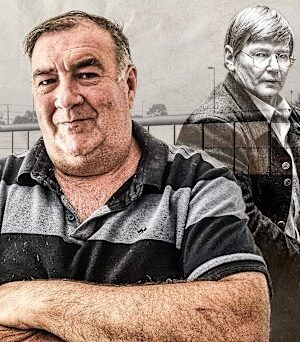
Brian Coghlan is easygoing and laid-back, an asset he was able to use in his workplace. As a prison officer, he quickly learnt that being seen as a good guy around bad people was the key to life behind bars.
For 26 years at Port Phillip Prison he dealt with the worst society had to offer – sex offenders, serial killers and manipulative mass murderers who many knew were destined to die in jail.
When he first walked into the privately owned prison in 1999, he says, the inmates controlled the jail.
“All the managers were from England,” he says. “We didn’t have anything to arm ourselves with, no gas and battens, and things like that. In fact, the whole prison had no guns in it and no towers. The prisoners knew this, and they could have literally taken it with five minutes’ notice. We had tennis courts and swimming pools, and it was like a holiday camp.”
Coghlan says it was only when former Pentridge Prison officers were recruited that discipline was restored.
He spent most of his 26 years (more than most murderers) working inside the protection unit.
“Many of the prisoners there were high profile, most of them had to be kept away from other inmates,” he says. “These are the prisoners who were actually hated by other inmates. We’re talking child molesters, mass murderers, and people who are just pricks inside.”
He decided very early to deal with each inmate based on how they behaved in jail, not what they did to get there. “If you thought about their crimes, it would do your head in, and you would end up jumping the counter [to assault the offender].
“You had to spend each shift dealing with the worst of the worst; they would drive you mad if you kept thinking about what they did.”
He says a good prison officer spends time learning what makes each inmate tick and tries to find some common ground. Do they like football, punting on horses or talking about their families? And you never ask about their crimes.
“People would often say, ‘How can you work with these animals?’ You just deal with them the way they dealt with you.
“Whenever we got new staff into our unit, I would tell them, ‘Give them what they’re entitled to. Don’t play God with them, especially with their visits and mail. Don’t play games. Don’t fall in. Don’t be manipulated. We are the only people in the world that can talk to these blokes with a modicum of respectability.’”
Here are Coghlan’s observations on the worst of the worst. Six, who will never get out, one who has a glimmer of hope, and the case of a surprising redemption.
Peter Norris Dupas
Convicted of stalking and killing three women.
Former lawyer Andrew Fraser, who was doing time for cocaine trafficking, later testified that Dupas confessed to him inside the protection unit to the 1997 murder of Mersina Halvagis, stabbed to death in the Fawkner cemetery.
Dupas was convicted, and the ex-lawyer received a $600,000 reward.
“None of the prisoners who spent a lot of time with Dupas believed that he would have confessed like that,” Coghlan says. “He was their friend, and he’d never confessed to them.
“We just rolled our eyes, and we didn’t believe a word of what Fraser said. There is no doubt Dupas did it, but there is no way he would nod [confess] to it.”
Julian Knight
In 1987 Knight, then 19, fired 200 rounds in Hoddle Street, killing seven people, wounding 19 and shooting the police helicopter. He pleaded guilty and was sentenced to life with a minimum of 27 years. The government later changed laws to ban Knight from being eligible for parole.
“To be fair to Julian, he’s the only prisoner I can think of that’s made it out of serious protection,” Coghlan says. “I must admit, I thought somebody out there [in mainstream] was going to have a crack at him.
“With his legal skills [Knight is a first class jailhouse lawyer], he quickly worked out that to hold the troops off, he would help them on legal issues.
“He’s not a big guy, but was probably the fittest at Port Phillip. They used to do beep tests, and he’d win that every year.”
Ray ‘Mr Stinky’ Edmunds
Serial rapist and double killer Edmunds has served 40 years of a life sentence for the 1966 Shepparton murders of Garry Heywood, 18, and the rape and murder of his girlfriend, Abina Madill, 16.
“He was at Port Philip every day that I was there. He didn’t want to go anywhere else. He manipulated his placement so he wouldn’t be moved.
“He was like having a fifth officer in the unit. He pretty much ran the unit, even when he was in his 80s. He’d just sit by the front door of the unit and guys would come up and get their rations. He was very fair – very fair with everyone. He’s obviously institutionalised. This is his life. He rarely gets visits.”
Greg ‘Bluey’ Brazel
Considered by the Office of Corrections as one of the most dangerous men in the prison system. He was convicted on 78 previous occasions, and is now serving a sentence for two murders.
“He would manipulate other prisoners just by saying the same thing, literally for hour after hour until they smashed up their cell to get away or slashed up [self-harmed],” Coghlan says. “He’d tell them to slash up, hang yourself, do all this sort of stuff. It was just a game to him.”
Les Camilleri and Lindsay Beckett
Camilleri was sentenced to a life sentence with no minimum over the 1997 murder of Bega schoolgirls Lauren Barry and Nichole Collins. He received another sentence of 28 years in 2013 after he pleaded guilty to the 1992 abduction murder of Glenroy schoolgirl Prue Bird.
No one believed his version of the Bird abduction and murder.
Beckett was Camilleri’s criminal partner. It would be Beckett who would eventually break and confess to the Bega murders, leading police to the bodies. Beckett was 23 at the time of the murders. He will be 59 when eligible for parole in 2033.
“I had them both in my unit, Les and Lindsay Beckett – Les was the worst of the worst,” Coghlan says. “When Beckett was going to give evidence against Les, we had to separate them.
“Lindsay actually admitted that he killed those two girls in Bega. But he said Camilleri was there, saying, ‘If you don’t do it, I’m going to kill you too.’
“Les tried to kill Ray Edmunds by poisoning his food. We got wind of it for a while, and we watched it happen. Les was wondering why he wasn’t falling over. Ray was far too smart for that. He got onto it pretty early.”
Coghlan says that when Edmunds uncovered several poisoning attempts from mainstream inmates, prison officers would switch the rations allocating the spoiled food to the kitchen prisoners. They chose not to eat it. “They were horrified,” he says.
Dane Sweetman
A small-time criminal who was recruited into the world of neo-Nazism while serving two years for armed robbery.
He covered himself in swastikas and KKK tattoos.
Sweetman was sentenced to 20 years with a minimum of 15 for the 1990 murder of David Noble, whom he killed with an axe at a party to celebrate Hitler’s birthday.
“I treated him the way I found him,” Coghlan says. “He was always polite and courteous and was no trouble to us. But we did notice a real change in him. Halfway through his sentence, he fell out with the [Nazi] National Guard.
“He renounced them all, and just wanted to get on with his own life, and to his credit, he stuck to it.
“The government spent a fair bit of money on him because he had swastika tattoos removed from his head.
“His cell was full of Messerschmitts and Junkers [German aircraft], and all these planes were hanging from the cell. We turned a blind eye to it because he was no trouble to us.
“It was interesting to watch him rebirth himself. To my knowledge, he’s never been in trouble again, and he was a bit of a success story.”
“Romper Stomper [the movie] was supposed to based around him, and that caused him a fair bit of grief inside.”
Paul Steven Haigh
Longest-serving Victoria prisoner, having served 47 years after being jailed in 1979.
At the age of 21, Haigh killed six people, including a nine-year-old boy. He killed another in jail so he would equal the record held by Julian Knight. He once wanted to go to court dressed as the grim reaper.
“He was crazy and probably still is. He was another one that was never, ever, going to get out. Every five years, the Parole Board would review him. So about a year before he was coming up for parole, he went from his short crew cut, normal cut, to looking like something out of Monty Python’s Life of Brian, with the long, shaggy hair. I said, ‘What are you doing?’ He goes, ‘I want to look as old as possible.’
“He looked like Charles Manson. In his cell he’d have crucifixes hung upside down with blood oozing down the wall.
“He’s one you would just never let out. He is completely bat-shit crazy.”
Start the day with a summary of the day’s most important and interesting stories, analysis and insights. Sign up for our Morning Edition newsletter.