
SOURCE :- THE AGE NEWS
Washington: Donald Trump issued a new warning to Iran that American forces would remain nearby until the country fully complied with a yet-to-be-signed peace agreement, and said the “shooting” would restart if Tehran did not accede.
The US president’s threat came at the end of the first day of a fragile ceasefire between the United States, Israel and Iran that was undermined by a deadly Israeli bombardment of Lebanon – the biggest since the war broke out – and contention over the status of the Strait of Hormuz.
Iran accused the US and Israel of violating the ceasefire, and the White House was forced to clarify that Lebanon was never included in the truce, after Pakistan earlier said it was.
US Vice President JD Vance, who is due to lead the American delegation in peace talks in Pakistan this weekend, said Iran’s belief that Lebanon was included was a “legitimate misunderstanding”.
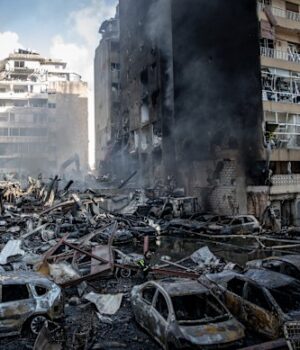
The Israel Defence Forces (IDF) said it hit 100 Hezbollah targets in a 10-minute period during the daylight attack on Wednesday afternoon (Lebanon time). The blitz struck dense commercial and residential areas in central Beirut, and came without warning, the Associated Press reported.
The death toll was not immediately clear, but Lebanon’s civil defence service said at least 254 people had been killed in the highest single-day death toll in the latest Israel-Hezbollah war. Another 1100 people were wounded, it said.
An IDF spokesman said there would be no let-up. “As long as Hezbollah continues to threaten our civilians, we will continue to operate against them,” he said.
Later, though, Israeli Prime Minister Benjamin Netanyahu said he had authorised direct negotiations with Lebanon “as soon as possible”, in response to requests from the Lebanese government.
Talks would focus on disarming Hezbollah and establishing peaceful relations between the neighbouring countries, he said, while welcoming the Lebanese prime minister’s call to demilitarise Beirut.
Netanyahu has also warned that Israel is prepared to resume striking Iran at any moment. “We are ready to return to fighting at any time. Our finger is on the trigger,” he said. “Iran is weaker than ever, and Israel is stronger than it has ever been.”
Lebanon’s exclusion from the truce threatens to derail a possible peace agreement, with Iran’s Foreign Minister Abbas Araghchi saying the world had seen Israel’s “massacre” in Beirut and the ball was in Trump’s court to act.
“The US must choose – ceasefire or continued war via Israel. It cannot have both,” he said.
Pakistani Prime Minister Shehbaz Sharif had initially announced Lebanon was included in the ceasefire, but the US and Israel later said this was not the case.
Vance told reporters he believed Iran thought the ceasefire included Lebanon, “and it just didn’t”. “We never made that promise, we never indicated that was going to be the case,” he said.
The vice president, who was in Hungary campaigning for the country’s prime minister, Viktor Orban, will lead negotiations with Iran in Islamabad alongside US special envoy Steve Witkoff and Trump’s son-in-law, Jared Kushner.
White House press secretary Karoline Leavitt said Trump and Netanyahu might discuss Lebanon’s inclusion in the ceasefire in future, but gave no indication the US was seeking such an outcome imminently.
Trump made no mention of Lebanon or Israel when he posted on social media late on Wednesday night (Washington time) that all US ships, aircraft, military personnel and weaponry would remain near Iran “until such time as the REAL AGREEMENT is fully complied with”.
“If for any reason it is not, which is highly unlikely, then the ‘Shootin’ Starts’, bigger, and better, and stronger than anyone has ever seen before,” Trump wrote.
He reiterated that Iran could not develop nuclear weapons and that the crucial Strait of Hormuz, through which a fifth of the world’s oil usually transits, must be “open and safe”.
Trump’s reference to “the real agreement” came amid significant confusion about what had been agreed between the US, Iran and Pakistani mediators in the hours leading up to the ceasefire announcement.
The president said a 10-point proposal by the Iranians received by mediators was significantly different to an earlier plan disseminated by branches of the Iranian government to media outlets and online.
Leavitt said the regime had since “acknowledged reality” and put forward a much more reasonable and entirely different proposal, though she would not provide details or make the document public.
While briefing reporters at the White House, Leavitt said the US was closely monitoring the Strait of Hormuz, and reports that it was still closed were “false”.
What Iran was saying publicly, including through state-affiliated media outlets, was different from what it was telling the US privately, she said.
“We have seen an uptick in traffic in the strait,” she said. “It’s something we are monitoring minute by minute, hour by hour.”
The Wall Street Journal reported Iran allowed four ships through the strait on Wednesday, “the fewest so far in April”, citing S&P market data, and The New York Times said no oil tankers had yet transited the waterway.
If Iran did keep the strait closed, it would be “completely unacceptable”, Leavitt said. But she added: “This is a fragile truce. Ceasefires are fragile by nature … We understand things take time.”
Iranian parliamentary Speaker Mohammad-Bagher Ghalibaf accused the US and Israel of breaking their deal, including through the Lebanon attacks and by denying Iran’s right to enrich uranium, which he said was the sixth clause of Iran’s framework for a truce.
“The ‘very workable basis for which to negotiate’ has been openly and clearly violated,” Ghalibaf said in a statement written in English and posted online. “In such situation, a bilateral ceasefire or negotiations is unreasonable.”
One of the other outstanding questions is the fate of hundreds of kilograms of highly enriched uranium still in Iran’s possession, which could form the basis of a future nuclear weapons program, and was ostensibly the key reason for the war when it started 39 days ago.
US Defence Secretary Pete Hegseth said the US reserved the right to retrieve the uranium by force if necessary. But he also argued the “new Iranian regime” knew that it could never have a nuclear weapon.
“It’s buried and we’re watching it. We know exactly what they have,” Hegseth said. “They will either give it to us voluntarily … Or if we have to do something else ourselves, like we did with [Operation] Midnight Hammer, or something like that, we reserve that opportunity.”
Meanwhile, Trump suggested the US and Iran would work together to dig up the nuclear “dust”, and that the US would discuss relieving sanctions and tariffs on Iran.
He continued to insist Tehran had gone through “a very productive Regime Change” – a claim rejected by most Iran experts, who say that while US and Israeli strikes killed many of Iran’s former top personnel, the regime’s fundamentals remain intact.
Trump said Iran could begin its reconstruction process. “There will be lots of positive action! Big money will be made,” he wrote on social media.
With AP, Reuters
Get a note directly from our foreign correspondents on what’s making headlines around the world. Sign up for our weekly What in the World newsletter.
CLARIFICATION
An earlier version of this article stated that Israeli Defence Forces (IDF) had claimed it had hit 100 targets in Lebanon in one minute. The one-minute claim was made in an IDF post on X. A separate IDF post on the platform said the attacks were actually conducted in a 10-minute period.
 Michael Koziol is the North America correspondent for The Age and Sydney Morning Herald. He is a former Sydney editor, Sun-Herald deputy editor and a federal political reporter in Canberra.Connect via X or email.