
SOURCE :- THE AGE NEWS
Thank you for joining our continuing live coverage.
Here’s a recap of the latest developments:
- Supreme Leader Mojtaba Khamenei has claimed Iran as the “definitive victors” in the war against the US and Israel in a statement read on Iranian state TV. Khamenei, who hasn’t been seen or heard in public since replacing his father, made the remarks as Donald Trump accused Iran of failing to honour the tentative ceasefire agreement struck with the US. Trump remains “optimistic” about a peace deal, and has urged Israel to scale down its attacks on Lebanon.
- Israeli Prime Minister Benjamin Netanyahu has authorised direct ceasefire negotiations with Lebanon “as soon as possible” in response to repeated requests, focused on disarming Hezbollah and establishing peaceful relations between Israel and Lebanon. However, he confirmed there was “no [present] ceasefire”, and Israel would continue striking Hezbollah with “full force”. Talks are expected to begin next week at the State Department in Washington.
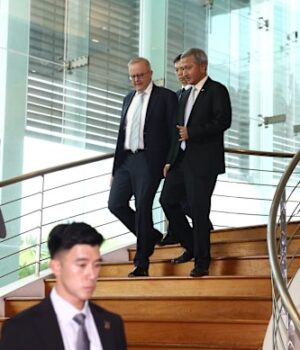
- Prime Minister Anthony Albanese is in Singapore to meet with Prime Minister Lawrence Wong, where he is expected to push for the bolstering of Australia’s fuel supplies. Albanese will tour Singapore’s refining facilities before talks with Wong, in which he hopes to extend fuel stocks to June. Acting Prime Minister Richard Marles has indicated Australia could help reopen the Strait of Hormuz, as it liaises with European partners about a potential contribution.
- Vice President JD Vance will lead the US delegation to peace talks with Iranian officials in Pakistan’s capital Islamabad on Saturday. European leaders have insisted Lebanon be included in the two-week ceasefire deal, after Israel launched record strikes on Hezbollah in Lebanon, killing hundreds.
Delegates and accredited journalists attending the US-Iran negotiations in Islamabad tomorrow will be granted special visas on arrival, as the Pakistan government remains at the forefront of the diplomatic talks.
“All airlines are requested to permit boarding to all such individuals without Visa,” Deputy Prime Minister and Foreign Minister Ishaq Dar said on X. “Immigration authorities in Pakistan will issue them Visa on Arrival.”
Beijing has allowed state refiners to tap commercial oil reserves, Bloomberg News has reported, citing anonymous sources.
Refiners including Sinopec and China National Petroleum would be able to tap commercial inventories held at processing plants or in storage facilities, it reported.
China imports about 11 million barrels of crude oil a day, according to the Centre of Global Energy Policy.
Kuwait accused Iran and its proxies of launching drone attacks targeting it on Thursday despite the two-week ceasefire in the Iran war, as Saudi Arabia said recent attacks had damaged a key pipeline in the kingdom.
A statement from Kuwait’s Foreign Ministry, carried by the state-run KUNA news agency, put new pressure on the ceasefire before planned talks on Saturday between the United States and Iran in Pakistan capital Islamabad.
Kuwait’s Foreign Ministry said the drone attacks targeted some vital Kuwaiti facilities on Thursday night.
Meanwhile, Saudi Arabia’s state-run Saudi Press Agency, quoting an anonymous official, acknowledged a recent attack in the war that damaged its crucial East-West pipeline. That pipeline carries oil out to the Red Sea and avoids the Strait of Hormuz, on which Iran maintains a chokehold despite the pause in the fighting.
AP
Australia’s sharemarket is on track for its best week since 2020, despite slipping today as key oil transit route the Strait of Hormuz remains near a standstill before US-Iran peace talks.
The S&P/ASX200 fell 37.1 points by midday, down 0.41 per cent, to 8936.5.
The local bourse shrugged off a positive session on Wall Street amid uncertainty over upcoming US-Iran ceasefire talks, only a trickle of traffic coming through the strait and Iran raging over Israel’s escalation of attacks on Lebanon.
However, the All Ordinaries is up more than 4 per cent for the week, its best performance since November 2020.
Energy stocks dragged on the bourse, down more than 2 per cent as Brent crude hovered near $US96.30 a barrel, weighing on Woodside and Santos. Ampol and Viva Energy each lost ground, despite Viva winning federal government approval for an LNG import terminal in Geelong, located near a Ramsar wetlands.
AAP
Prime Minister Anthony Albanese is in Singapore to meet his counterpart, Lawrence Wong, and for a tour of Jurong Island, the Asian nation’s fuel hub which produces 1.5 million barrels of crude per day. Albanese will hold a press conference at 3.10pm (AEST).
Photographer Dominic Lorrimer is in Singapore and has been documenting the visit.
South Korea will send a special envoy to Iran as Seoul ramps up efforts to secure safe passage for dozens of its ships stranded in the Strait of Hormuz for weeks, with traffic through the key waterway still severely constrained despite the US-Iran ceasefire.
South Korean Foreign Minister Cho Hyun spoke to his Iranian counterpart, Abbas Araghchi, yesterday by phone and stressed the need for swift resumption of free navigation for all vessels in strait, Cho’s office said. It was their second phone call in three weeks.
“Minister Cho decided to dispatch a special envoy to Iran to discuss the situation in the Middle East and bilateral issues between South Korea and Iran,” the Foreign Ministry said in a statement.
The announcement comes after a 14-day truce took effect this week, which the US said was conditional on Iran unblocking the Strait of Hormuz. But the agreement has yet to translate into a meaningful increase in shipping. Just a handful of vessels were observed making the voyage out of the Persian Gulf this week. Under normal conditions, about 135 vessels traverse the strait every day.
South Korea, which imports almost all of its energy needs, with some 70 per cent via the waterway, currently has 26 ships stranded in the area.
Bloomberg
Japan plans to release 20 days’ worth of oil reserves from May, Prime Minister Sanae Takaichi told a cabinet meeting today, to ensure stable domestic supply while searching for non-Middle East barrels as conflict in the region disrupts global supply.
Japan is dependent on the Middle East for some 95 per cent of its oil. It began releasing reserves on March 16 unilaterally and in coordination with other nations under a plan to make available enough oil to last 50 days. The 20 days’ worth is additional.
As of April 6, Japan had enough oil for 230 days in its reserves, including 143 days’ worth in its public stockpile. By May, Japan should be able to secure more than a half of its oil imports via routes that do not include the Strait of Hormuz, Takaichi said, without naming the sources.
Australian Defence Minister Richard Marles visited Tokyo this week to discuss the global and regional security environment with Japanese counterpart Koizumi Shinjiro.
Speaking on ABC TV this morning, Marles said he was “very confident” about the fuel supplies being received from Japan, which included about 7 per cent of Australia’s diesel needs.
with Reuters
The prime minister has wrapped up his short visit to Jurong Island after meeting with energy chiefs.
He’s now travelling to The Istana, the official residence of Singapore’s Prime Minister Lawrence Wong. The building was home to governors of British descent before Singapore gained independence in the 1960s.
Anthony Albanese is in the small nation today because Australia’s dependency on fuel imports has been exposed by the oil shock, and national stocks are well short of international standards.
Asian importers of Australian LNG are also worried about the Albanese government’s proposals to reserve Australian gas and potentially tax gas firms more heavily. Singapore sources about a third of its gas from Australia.
Wong is in demand among world leaders trying to lock in fuel supply. The pair will hold a press conference this afternoon.
Angus Taylor said it was “absolutely appropriate” for Israel to continue to defend itself as the country’s ongoing strikes on Lebanon threaten a shaky ceasefire in the Middle East.
Asked whether he agreed with Prime Minister Anthony Albanese’s call for the attacks to cease and for Lebanon to be included in the ceasefire, the opposition leader said:
“That is a matter for Israel, and it’s obviously the one that is taking action in Lebanon. So I’m not going to get involved, other than to say that Israel has the right to defend itself against threats that it faces, and it’s absolutely appropriate that it continues to do that.”
Singapore supplies Australia with more than 50 per cent of its petrol and 15 per cent of its diesel from its vast refinery complex located on Jurong Island.
The Middle East supplies more than 50 per cent of the crude oil that Asian refineries import to produce petrol and diesel fuels.
Most of this oil supply has been held up by Iran’s blockade of the Strait of Hormuz and these refineries are running down their storage tanks, which may last for another few weeks or so.
Asian refineries are also scrambling to source new lines of supply from a long list of oil producing nations such as the US, Canada and Brazil.