source : the age
One of the people Ben Roberts-Smith allegedly murdered had a prosthetic leg. Another was a farmer collecting flour for his family. A third was a quivering, teenage boy. Prosecutors will allege the giant soldier shot him point-blank in the head with an Australian Army 9-millimetre pistol.
Each was unarmed, under the control of the Australian troops, and not a threat.
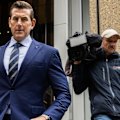
On Tuesday, Roberts-Smith was arrested over killings during his time in Afghanistan. He is expected to be charged on Tuesday with five counts of war crime-murder.
Prosecutors in the criminal process that finally began 17 years – almost to the day – since the first alleged murder, will likely argue that each of them was carried out in cold blood.
If the evidence in an eventual criminal trial follows that in the defamation case Roberts-Smith unsuccessfully launched against this masthead in 2018, the jury will hear not only that Australia’s most decorated living soldier is a serial killer, but that he relished his crimes.
Kill boards, trophy hunting and “blooding” recruits by ordering them to shoot bound prisoners were gruesome features of stories from the giant corporal’s later rotations in Australia’s longest war.
“I shot that c— in the head,” he told one colleague a day or two after killing the teenager, according to evidence accepted in the defamation trial. “It was the most beautiful thing I’ve ever seen.”
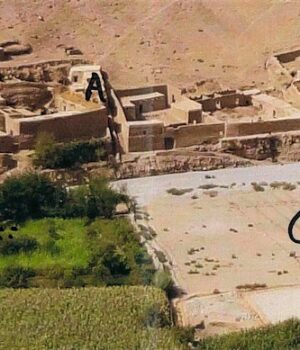
The most high-profile of these killings – and the one first covered in detail in this masthead almost eight years ago – took place in a little village called Darwan.
Darwan and the ‘kick’
The day Roberts-Smith choppered into Darwan with 41 other Australian special forces soldiers was September 11, 2012 – 11 years after the twin towers terrorist attack that prompted the Afghan war.
The troops were on high alert, searching for an Afghan soldier, Hekmatullah, who almost two weeks earlier had killed three of his Australian army mentors.
The Australian raiders did not find Hekmatullah in Darwan. Instead, they were stuck questioning poor farmers.
As they were about to return to base, Roberts-Smith asked some final questions of handcuffed men in a compound at the village’s southern end. One of the men was Ali Jan. He was in Darwan buying flour for his family.
They were no threat. In military parlance, they were “Persons Under Control”, or PUCs.
Under questioning by the Australian soldier, who stands more than two metres tall, Ali Jan made the mistake of smiling, according to one Afghan witness in the defamation case.
Roberts-Smith’s response, according to two Afghan witnesses, was to manhandle the farmer to the edge of a small cliff, or steep slope, still bound. The Australian backed up a few steps. Then, like the Spartan king Leonidas in the violent Hollywood fantasy movie 300, he front-kicked the Afghan man, catapulting him backwards down the slope.
Roberts-Smith, who has a Sparta helmet tattooed on his ribcage and had worn a Crusader cross around his neck, descended the slope with two other soldiers. He ordered them to drag Ali Jan, blood pouring from a mouth full of broken teeth, to a berry tree in a cornfield.
There he ordered one of the soldiers to shoot Ali Jan dead. The other gave direct evidence against Roberts-Smith at the defamation trial.
With the testimony of the three Afghan witnesses it was, Federal Court Justice Anthony Besanko said later, “a strong, consistent and coherent body of evidence”.
Roberts-Smith denied wrongdoing, claiming Ali Jan was a “spotter” who evaded the intensive five-hour operation by hiding in the corn field.
He was only discovered late in the day. The judge found that explanation inherently unbelievable.
According to trial evidence, back at base, a fellow soldier and one of Roberts-Smith’s witnesses, immortalised the incident by drawing a whiteboard picture of a winged-penis kicking a man off a cliff.
It’s worth noting that, in 2018, the incoming Australian Army chief, Angus Campbell, banned Australian soldiers from displaying Spartan paraphernalia, along with other “arrogant … symbols of death”.
Darwan might have been the first accusation of murder against Roberts-Smith that was brought into the public domain by this masthead, but it was not his first alleged murder.
That happened three years earlier, in 2009, on Easter Sunday.
Whiskey 108 killings
The mission was to help regular army troops crossing a river under heavy Taliban insurgent fire during the battle of Kakarak. But the murders Ben Roberts-Smith is alleged to have participated in that day were premeditated.
His SAS patrol had a new recruit in the 2009 rotation, and for weeks before the Kakarak operation, Roberts-Smith and his commander had made it clear the “rookie” needed to kill someone to truly become part of the squadron. They called it a “blooding”.
The assault patrols cleared the compound known as Whiskey 108 and declared it secure. An opportunity for a blooding emerged when a hidden tunnel was discovered in a courtyard. Inside, two Afghan men were found hiding.
One of the men was disabled – he had a knee-high prosthesis. The other was described as an old man. Both were unarmed and had been “PUC’d” – or brought under control. The laws of war dictated they should not be harmed. It did not stop what happened next.
Eyewitness evidence from a soldier at the defamation trial, found by the judge to be truthful, was that Roberts-Smith grabbed the old man by the scruff of his shirt, forced him to his knees inside the cleared compound, pointed at him and ordered the rookie: “Shoot him.”
The rookie followed the order.
Then Roberts-Smith picked up the man with the prosthetic leg, carried him outside the compound and threw him to the ground. Three SAS witnesses say they watched as Roberts-Smith pulled out his Minimi machine gun and shot the man in the back with an extended burst.
Then the alleged cover-up began. In official reporting, Roberts-Smith and his crew described the men as “squirters” – insurgents trying to flee the area – and therefore legal to kill.
In the defamation trial – where for national security reasons many soldiers were given numbers to obscure their identities – the “rookie” was known as Person 4. He declined to give evidence on the basis that his evidence might tend to prove he had committed a crime – specifically, the war crime of murder.
After the men were killed, another soldier souvenired the dead man’s prosthetic leg and took it back to the illegal drinking hole at the Tarin Kowt base, the “Fat Lady’s Arms”, and used it as a novelty beer drinking vessel. They called it “Das Boot”.
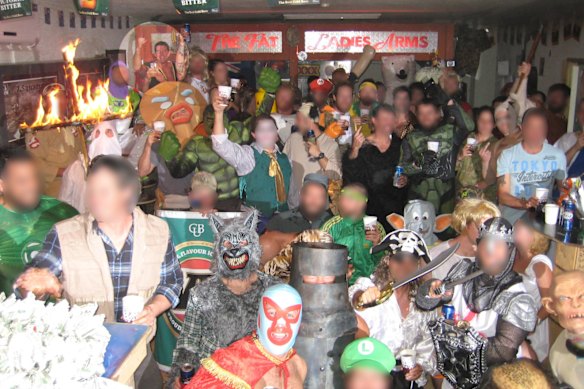
Multiple photographs later turned up, showing the leg being used. Roberts-Smith, who had killed its owner allegedly in cold blood, stood grinning nearby.
In his evidence at the defamation case, he described this as “gallows humour”.
Roberts-Smith is now expected to be charged with two criminal counts relating to Whiskey 108 – the war crime of murder, and aiding, abetting, counselling or procuring a second war crime-murder.
Syahchow
The final two war crime-murder related offences that Roberts-Smith is expected to be charged with happened in the village of Syahchow on October 20, 2012.
One of these killings – another blooding – was also alleged by the newspapers during the defamation case. However, the judge ruled this was not proved – even to the civil standard of the balance of probabilities – because of a lack of evidence.
The reason for that was that, when the rookie in question, Person 66, was asked, he refused to give evidence, saying he did not want to incriminate himself in a murder.
There were no other direct witnesses.
In relation to the blooding incident, Roberts-Smith is expected to be charged with war-crime murder in that he aided, abetted, counselled or procured another person to intentionally cause the death of a person.
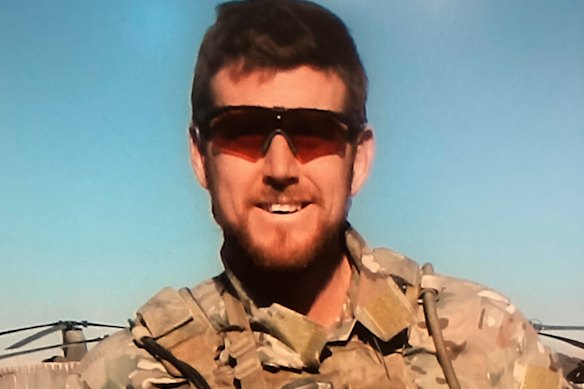
Roberts-Smith is also expected to be charged with the war-crime murder of a second Afghan man in the same incident. Investigators will allege he intentionally caused the death of an Afghan with the help of another person.
According to the evidence originally advanced by the newspapers in the defamation trial, Roberts-Smith invited the rookie into a compound where there were several Afghans. He and Roberts-Smith took two of them into a nearby field, where it was alleged Roberts-Smith ordered the newcomer to shoot one. The rookie did.
Evidence at the trial suggested that, to cover up the murder their actions, they put a rifle magazine, a pistol and a “chest rig” – used to carry weapons and ammunition – on the man’s body before it was photographed. These objects were widely known as “throw-downs” – found by the judge to have been used in other incidents when Roberts-Smith wanted to suggest that unarmed prisoners were actually Taliban insurgents.
Former SAS captain and now federal Liberal MP Andrew Hastie – who was on the Syahchow mission – said he had heard over the radio that shots had been fired. Later, he said, Roberts-Smith had walked past and remarked, “Just a couple more dead c—s.”
At the official debriefing after the mission, Hastie said he heard Roberts-Smith say both men had been killed, “one of the insurgents firing and another reaching for a grenade”.
A couple of days after the mission, Hastie said, Roberts-Smith sat at a table in the mess hall with him – an officer – and made a comment that, “officers shouldn’t be on the ground. You guys should be sitting on a hill away from it all.
“You know, we’ve got to do certain things, so, you know, you shouldn’t be around.”
During the defamation case, the newspapers led two other allegations of Roberts-Smith’s involvement in alleged war-crimes murder – in the villages of Fasil and Chinartu.
The defamation judge found the Chinartu case proved to the civil standard, and the Fasil case unproved for lack of evidence. At this point, the police have not flagged charges over either of the following allegations.
Chinartu and the Person 12 lie
About a month after the 2012 Darwan cliff kick, Roberts-Smith and his patrol were in Chinartu village trying to capture or kill a high-value Taliban target. It was classic SAS soldiering.
Again, as the mission wound up and the patrol was waiting for helicopters home, Roberts-Smith and the partner force, a group of Afghan National Army soldiers, were questioning a detainee. Evidence at the defamation trial was that the man was compliant and no threat.
Meanwhile, another Australian soldier had spotted a suspicious discolouration in the wall of the compound. He kicked it in, finding a cache of weapons hidden inside a cavity, including bags of bullets, binoculars, rifles and rocket-propelled grenade warheads.
That soldier told the court Roberts-Smith reacted immediately. He pointed at the Afghan army commander and told his interpreter: “Tell him to shoot [the man being questioned] or I will.” The Afghan commander spoke to his soldiers. One of them, wearing a balaclava, stepped up and shot the man up to 10 times in the body and head.
In the defamation case, the judge found this murder proven to the civil standard of the balance of probabilities.
Again, an alleged cover-up began immediately. In official reports, the time of the shooting was backdated to suggest the man was killed in action.
And in the trial itself, Roberts-Smith and four witnesses friendly to him also swore the Afghan commander, known as Person 12, could not have been there that day. He was serving a suspension, they said, because he’d shot a dog a few months earlier and a bullet fragment had wounded an Australian patrol commander in the leg.
Unfortunately for Roberts-Smith and his alleged co-conspirators, the Defence Department produced official records proving the Afghan commander had not shot the dog and was not stood down. He was in Chinartu, commanding his soldiers, on the day of the shooting, as the SAS witness had testified.
In the defamation trial, the judge found Roberts-Smith and his friends had concocted what became known as the “Person 12 lie”. They “colluded to put forward a false story,” said Besanko in his judgment, noting the newspapers’ argument that it was “deliberate, material and told out of a consciousness of guilt”.
Fasil
There was another murder killing within weeks, according to allegations aired at the defamation trial, in a village called Fasil. In the lead up to this operation, Roberts-Smith allegedly said to his comrades, in substance: “Hey fellas, we’re on 18, we need two more to get to 20.” He was referring to a kill board his patrol kept at the Tarin Kowt base.
In Fasil, two soldiers intercepted a Toyota HiLux with four Afghans on board. One of them, who was in his late teens, was described by an Australian witness, a medic, as being terrified – “shaking like a leaf”.
On request, the medic handed over the men to Roberts-Smith and another soldier for questioning. About 15 to 20 minutes later, he said he heard over the radio Roberts-Smith reporting “two EKIAs” (enemies killed in action).
A day or two later, the medic said he’d asked Roberts-Smith what had happened to the young, shaking Afghan male.
“I shot that c— in the head … pulled out my nine-mil [9mm pistol], shot the c— in the side of the head,” Roberts-Smith is alleged to have replied. “Blew his brains out. And it was the most beautiful thing I’ve ever seen.”
In the defamation case, Roberts-Smith denied the allegation, saying the two enemies had been killed in action.
The judge accepted the medic’s evidence that he had handed over the boy, and that Roberts-Smith had expressed joy at the killing. But because no eyewitness to the shooting had come forward to give evidence, it could not be proved, even to the civil standard.
The court did hear, though, that there was another person in the compound – a soldier known in the defamation trial as Person 56. If the murder did take place, he would have been an eyewitness.
When he was called to give evidence and asked whether he had participated in the Fasil mission, he objected to answering the question on the grounds that his evidence might tend to prove he had committed the war crime of murder.
Determining that there were reasonable grounds for this objection, Besanko allowed him not to give evidence.
Two new allegations
Two other alleged murders could not be aired in the defamation case because Besanko found in pre-trial arguments that the newspapers simply did not have enough evidence.
The first related to an event towards the start of the 2012 rotation, in July, when another rookie – the same Person 56 from the Fasil incident – was allegedly blooded. The newspapers’ lawyers in the defamation case had very few details of this incident, and Person 56 would not implicate himself.
The second unheard case would form an allegation of Roberts-Smith’s second murder, chronologically, if it were proved. It dates to May 2010, when Roberts-Smith was involved in a compound clearance. Afterwards, another soldier was going room to room taking photographs for the final report.
He photographed a man, a person under control, then moved into another room. When there, he heard gunfire from a suppressed M4 rifle nearby. It was not completely unusual to hear gunfire in such a situation, he said, but normally there would be some sort of communication about it.
Minutes later, the soldier told people, Roberts-Smith had allegedly come into the room and asked him if there were pictures of the room with the PUC on the camera. Then he asked for the camera and took it away.
When he returned the camera, the PUC was allegedly dead and the picture of the room with the live Afghan man in it had been deleted.
Read more on Ben Roberts-Smith’s arrest:
Start the day with a summary of the day’s most important and interesting stories, analysis and insights. Sign up for our Morning Edition newsletter.