
Source : the age
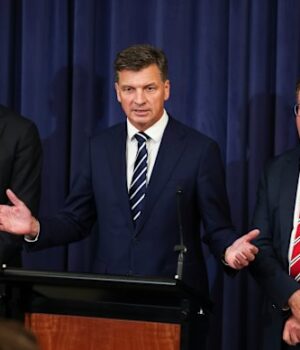
Prime Minister Anthony Albanese has all but ruled out boosting the number of MPs in federal parliament this term after Opposition Leader Angus Taylor launched an assault against the proposal following pressure from the Coalition backbench to launch a Voice to parliament-style campaign.
A month after this masthead revealed Special Minister of State Don Farrell was speaking to the Nationals about adding dozens of new seats in time for the next election, Albanese said he was satisfied with the current size of the parliament, which has not increased in size since 1984.
In doing so, he effectively killed off the work being undertaken by Farrell, who as recently as Monday talked up the idea of expanding the number of MPs in line with population growth.
In question time on Tuesday, the prime minister suggested that adding new electorates might mess with Labor’s commanding majority in the House of Representatives.
“I am satisfied with the current number of seats in the House of Representatives. That’s 150,” Albanese said.
“If I was to say to [Labor campaign director] Paul Erickson, ‘We got 94 seats, but how about we throw it all up in the air and see how it lands’, I think Paul Erickson would have a pretty clear response.”
Albanese left the door open to making changes after the election, and also did not rule out adding senators in the NT and ACT.
His shutting down of major change came hours after the Coalition decided to attack the proposal, demanding Albanese rule it out.
At a party room meeting last week, Taylor and his MPs discussed the potential political benefit in running a public campaign similar to the 2023 Voice to parliament referendum, which former leader Peter Dutton portrayed as an elitist idea that would entrench power in Canberra.
On Tuesday, Taylor said the opposition had commissioned Parliamentary Budget Office modelling showing the change would cost $620 million.
The Coalition had initially thought Farrell was considering boosting the number of MPs after the next election, but it emerged in recent months that Farrell was pushing to pass laws as early as this year.
“Australians are in a cost-of-living crisis. They’re in a fuel crisis. We have an economy that is not working for hardworking Australians. And the priority of this government, clearly, is to increase the size of the parliament,” Taylor said.
“We don’t need more politicians. We need a government focused on the Australian people.”
Several Liberal MPs are privately in favour of raising the number of MPs, which has not changed since the 1980s despite the growth of Australia’s population, because it would allow the Liberal Party to regenerate with fresh blood.
But, as one shadow minister who spoke on the condition of anonymity said, “we are so desperate for a fight that we had to oppose this for political reasons”.
The Institute of Public Affairs, an influential right-wing think tank, is one of many civil society groups advocating for an expansion of parliament.
In a submission to a parliamentary inquiry, the IPA said a failure to send more MPs to Canberra would have “significant consequences for the health of our democracy”.
“With Australia’s population now exceeding 27 million, electorates are becoming excessively populous and geographically large,” it said in its submission. “[MPs] are increasingly distant from the communities they represent.”
“It also weakens the effectiveness of parliament itself, as a relatively small number of
representatives is expected to scrutinise an ever-growing executive government”.
Bob Hawke was the last prime minister to expand parliament, doing so in 1984.
Farrell’s spokeswoman said the Coalition was getting ahead of itself, as Labor waited for a parliamentary inquiry to make a judgment on the merits of adding more MPs.
“This is clearly not about the policy or issues; it’s about the internal audition for attention in the Coalition,” the spokeswoman said.
The Coalition’s opposition to the move makes it harder for Labor to pass any legislation through the Senate. Albanese and Farrell might still get a deal done with the Greens, which are open to the change, but the prospect of a scare campaign might dull Albanese’s enthusiasm.
Farrell is exploring options, this masthead reported last month, but is narrowing his sights on increasing from 12 to 14 the number of senators for each state, an overall increase in the size of the Senate by 12. The House of Representatives would add 24 seats, as the Constitution requires that the House have roughly twice as many MPs as the Senate.
Cut through the noise of federal politics with news, views and expert analysis. Subscribers can sign up to our weekly Inside Politics newsletter.
 Paul Sakkal is Chief Political Correspondent. He previously covered Victorian politics and won a Walkley award and the 2025 Press Gallery Journalist of the Year. Contact him securely on Signal @paulsakkal.14.Connect via X or email.