
SOURCE :- THE AGE NEWS
Rome: A gang of thieves took less than three minutes to steal paintings by Cézanne, Renoir and Matisse worth an estimated €10 million ($17 million) from a gallery in Italy.
Police say the gang forced their way into the Magnani-Rocca Foundation private collection near Parma and made off with the three artworks.
They used crowbars to prise open metal bars that protected a back entrance to the gallery housed in an elegant palazzo.
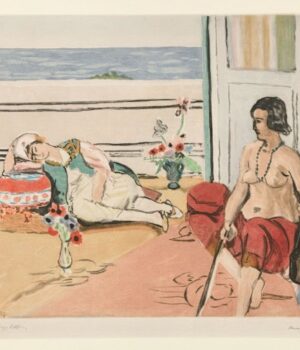
The three stolen paintings are Paul Cézanne’s Tasse et Plat de Cerises (Cup and Plate of Cherries), Pierre-Auguste Renoir’s Les Poissons (The Fish) and Henri Matisse’s Odalisque sur la Terrasse (Concubine on the Terrace).
Established in 1977, the Magnani Rocca-Foundation hosts the collection of Luigi Magnani, an art historian, and includes works by Titian, Rubens, Van Dyck, Goya and Monet.
The theft was reminiscent of the high-profile heist of jewels and other items worth €88m from the Louvre in Paris in October.
The thieves in Italy appeared to know exactly what they were looking for and may have made surveillance visits before the raid.
They went to a room that is dedicated to French artists and grabbed the paintings.
The gang tripped the museum’s alarms, and private security guards and police were quickly on the scene. But by the time they arrived, the thieves had escaped, fleeing through the property’s gardens.
In their hurry, they left behind a fourth painting. That artwork has not been identified.
“The criminals struck in less than three minutes, not in an impromptu manner but in a well-organised way,” the museum said.
The heist took place on the night of March 22, but was only disclosed on Monday (Italian time).
“I think what has happened here is that criminals have learnt that with … speed – the raid took less than three minutes – you can do almost anything,” Christopher Marinello, a London-based expert in the recovery of stolen art, told the London Telegraph.
“The alarms went off but three minutes is very fast – by the time the security officers got to the location, it was too late. We are now looking at a smash-and-grab world.”
Museums and galleries around the world need to rethink their security protocols, said Marinello, the founder of Art Recovery International, who has recovered stolen art worth more than $US600 million ($876 million) from around the world.
“Days or weeks beforehand, the gang was probably scoping out this museum. So the museum probably has CCTV footage of them,” he said.
Although the heist appears to have been well-organised, he doubted whether the paintings were stolen to order by a shadowy private collector.
“In all my time investigating art thefts, I have never come across a theft to order,” Marinello said.
“That is more a creation of Hollywood. These guys are thugs who are just looking to steal big name artists. They will then try to move the paintings to Belgium or Eastern Europe and find buyers in Russia or the Middle East, where there is less due diligence.
“But the press is now all over this theft, which makes the artworks radioactive.”
If the gang manages to sell the paintings, it would receive a fraction of their true value – as little as 5 to 10 per cent. Reputable dealers and collectors would not touch the stolen works, he said.
The robbers may instead try to ransom the paintings, demanding money to return them unharmed to the collection in Italy.
Or they could trade them through the criminal underworld for drugs or guns.
There is a third option. The stolen works could be used as bargaining chips by criminals who find themselves arrested and facing jail time for other offences.
“The paintings could be used as a get-out-of-jail for free card. A criminal can say to the police, ‘I know where they are and I will tell you if you give me a lesser sentence.’ That has been an established practice for decades,” Marinello said.
The Telegraph, London
Get a note directly from our foreign correspondents on what’s making headlines around the world. Sign up for our weekly What in the World newsletter.