
Source : ABC NEWS
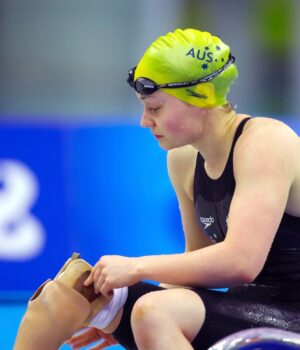
Over 20 years ago, Hannah MacDougall had a stellar swimming career, claiming bronze in the 4x100m relay at the 2004 Paralympics before going on to captain the swim team in Beijing.
Despite this success, burnout from inappropriate training regimes led to an early retirement.
“Sport isn’t all roses. There’s some hard stuff that comes with being A, female or B, having an impairment,” MacDougall told ABC Sport.
“So, you can have what’s known as the double whammy based on discrimination.”

Macdougall (right) claimed bronze in the 100 metre medley relay at the 2004 Games, alongside Brooke Stockham, Kate Bailey, and Chantel Wolfenden. (Supplied: Hannah Macdougall)
MacDougall’s experience isn’t unique. More than half of respondents to the ABC Elite Athletes in Australian Women’s Sport survey experienced discrimination because of their impairment.
Now a Para triathlete, Macdougall feels things have improved over the past few years, but there is still a way to go.
A single leg amputee, she has been diagnosed with osteopenia and osteoarthritis, which have shaped the way the now 38-year-old can and can’t do things in sport.
“Getting into triathlon and wanting to rebuild that bone density has been an epic journey in terms of leg fit, getting it right and having to start hormone replacement therapy,” she said.
Just as day-to-day life isn’t always accessible to the needs of disabled girls and women, so sport isn’t structured to cater to many of their complex needs.
“If we look at elite sport broadly, we have a very masculine power, ego-driven sport system based on getting medals,” MacDougall said.
“But you have females perhaps clashing against their natural physiology; you’re almost like a round peg trying to get into a square.”
Hannah Macdougall felt her disability wasn’t considered in her training regime. (Supplied: Hannah Macdougall)
With only 19 per cent of disabled Australian women regularly participating in sport, and an even smaller percentage choosing to pursue elite sport, the survey revealed that one of the biggest barriers faced by disabled women in elite sport is the intersection between impairment and health.
Impact of disability and chronic illness
MacDougall’s burnout from swimming came from a lack of support staff and National Sporting Organisations (NSOs) understanding the energy expenditure of athletes with a physical disability.
Using a prosthetic leg for mobility, Macdougall expends more energy to do normal everyday tasks, like walking and using stairs, compared to non-disabled people.
“You’re training as an elite athlete in a male environment and there’s all of these other energy requirements to consider,” MacDougall said.
“We just didn’t have the science behind training female athletes, and then also you add into that a context of being an amputee … it’s a bit of a ripple and a spiral that’s gone on.”
But that “double whammy” for MacDougall and others is not only the impact of impairment on energy and strength, but also the impact of ongoing women’s health issues, including chronic illnesses and menstruation.
Paralympian Hannah Macdougall wants to see change in Para sport for disabled women. (ABC News: Jane Cowan)
Though disability and chronic illness can often be looked at as separate issues, people with lived experience of both can often experience similar barriers and forms of discrimination.
Several respondents, who compete in mainstream sport, revealed they live with chronic illnesses like postural orthostatic tachycardia syndrome (POTS) and endometriosis.
First-time Olympic ski mountaineer Lara Hamilton has spent the last few years navigating a diagnosis of ankylosing spondylitis, a form of arthritis, alongside her sporting commitments.
Hamilton told ABC Sport how living with her condition meant navigating pain and stiffness during training and competition.
“[With] my condition, my joints and bones in my pelvis, and spine particularly, attack themselves,” she said.
“When I stress them, instead of adapting or healing, like when you do micro damage when you train or you have an accident, they just attack, attack, attack.”
Lara Hamilton made her Olympic debut in ski mountaineering at the Milano Cortina Games. (Getty: Christian Petersen)
Like MacDougall, sport hasn’t been “all roses” for Hamilton; there have been moments where she has thought she might retire.
“It’s not because I want to, it’s because I get so down about it and I just can’t keep fighting this condition,” she said.
Managing her condition includes taking medication, as well as trying to live a low-stress lifestyle, which can be incredibly difficult when you are competing at the top of your sport.
“I think it’s resilience and perseverance and glimmers of hope; you have a couple days, a streak, where I’m not in the hold of pain,” Hamilton said.
Call for more autonomy
Pain from disability and chronic illnesses can be a constant companion for many athletes in both para and non-disabled sport, with some survey respondents wanting more autonomy over choosing medical practitioners for their support team.
Eight-time Paralympian Danni Di Toro knows her disability and its impact on her body better than anyone.
Danni Di Toro competed in wheelchair tennis at the 2000 Sydney Olympics, but she now competes in wheelchair table tennis. (ABC News: Brendan Esposito)
She recognises how generalised views of disability can be a disservice to the unique experiences of disabled girls and women in sport.
‘We’re still kind of superimposing an able-bodied model onto a disabled sporting environment and I think that becomes really problematic,” the 51-year-old said.
Di Toro has fought for more control over who she has in her support team, including chiropractors, osteopaths and acupuncturists; specialists who often sit outside the high-performance model.
“We’re still looking in this medical view of someone with a disability rather than this holistic view and asking them what’s working for them,” she said.
Some respondents spoke candidly about the negative experiences they had with support for their conditions from coaches and support staff, with poor communication between NSOs and athletes’ external medical teams reflected in the survey.
“I cannot see the doctor at our sport institute because he is extremely sexist and does not believe in concussion — his medical beliefs are extremely outdated — so I have to try and find my own medical team and fund this all myself,” one respondent said.
“It is very hard finding the right doctors and specialists who understand elite sport and women’s health and can be extremely costly.”
Paralympian Danni Di Toro wants to see elite athletes have more control over their choice of medical support. (Getty: Kelly Defina)
Di Toro said no single model of disability is necessarily going to work for the wide variety of impairments represented in para sport.
“When we do disability really well, we’re taking the person in front of us and having a conversation with them about what they need and putting a plan together to enable them to kind of really thrive in this environment,” she said.
‘Tip of the iceberg’
Little research has been undertaken into the impact menstruation has on disabled women’s and girls’ participation in sport, let alone the impact on elite Para athletes.
One respondent said periods were never spoken about by high-performance staff.
“They’re all male so seem to avoid the topic entirely, which is missing a huge opportunity to support female athletes and maximise our performance,” they said.
One respondent with POCS, who was often left bedridden when she had her period, was told to train anyway, because it might happen during competition. She said no reasonable adjustments were offered.
Hannah Macdougall competed at the Athens 2004 Paralympics as a swimmer, and is now an elite Para triathlete. (Supplied)
MacDougall didn’t start getting her period until her mid-teens.
She also used the pill during her swimming career and felt pressure to lose weight by a male coach, all of which has impacted her long-term health.
Even now, she still experiences an irregular menstrual cycle.
Despite the difficulties she and others have faced, MacDougall believes there has been a positive shift in the way sports approach female health and training.
“But we are the tip of the iceberg,” she said.
“I wish I had’ve known [when swimming] what I know now about fuelling my body as a female athlete and treating it with more respect.”